

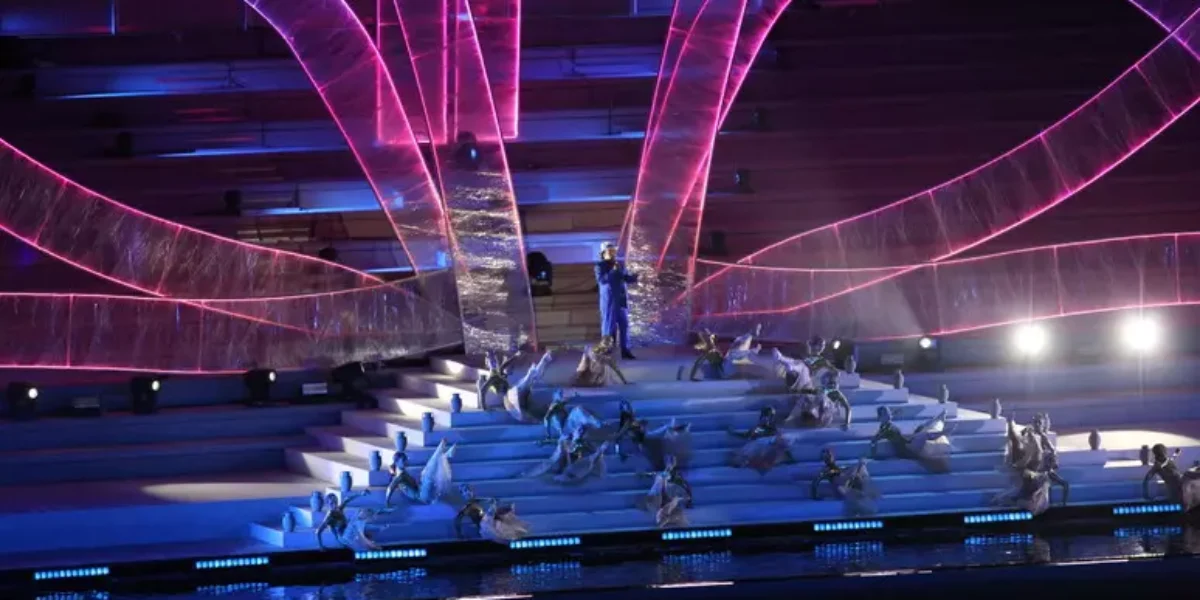
The athlete from Taranto rises again and runs towards the future dancing on a map of the Mare Nostrum: in the choreography that opens the XX edition of the Mediterranean Games there is the metaphor of a city that aims to re-embrace its future, according to the hope expressed on the eve by President Mattarella tonight in the stands (for him an ovation upon arrival at the Iacovone stadium) to declare “the Games officially open”.
A chance – not necessarily the last, certainly the tastiest in a long time – to give a different future to the city of steel and chimneys in the aftermath of Prime Minister Meloni’s announcement (for her some signs of disapproval from the north curve of the stadium) of a double table for September on Taranto, one on the former Ilva, the other on the development of the city.
In front of the Heads of State (of Algeria, Kosovo, North Macedonia and Lebanon) and of Government (those of Serbia and Algeria), Taranto redoes its make-up in an explosion of lights and colours, Mediterranean sounds and Apulian pride. In the stands the most important institutional positions: with President Mattarella, Prime Minister Meloni, the presidents of the Chamber and Senate Fontana and La Russa, four ministers (Abodi, Foti, Schillaci and Mazzi). Sports festival but also international crossroads of diplomatic relations.
Before the evening appointment, in the afternoon a welcome ceremony at the Aragonese Castle: with Mattarella and Meloni doing the honors of the foreign Heads of State and Government who arrived in Taranto. The renovated stadium dedicated to Erasmo Iacovone, an unforgettable contemporary icon, acts as the stage. Iacovone itself is one of the flagship facilities refurbished thanks to the resources arrived for the Games, around 300 million, as part of a race against time to refurbish 41 facilities.
“At the beginning – commissioner Massimo Ferrarese revealed today – I awarded the design tenders without financial coverage. If I had waited for the funds and the decrees, we would have lost another four or five months and we would not have built the systems”. The two-hour show curated by director Angelo Bonello for Francesco Paolo Conticello’s G2 Eventi is staged on the pitch. Taranto is seen through the eyes of a boy who looks to the past to draw useful lessons for the future in a continuous temporal coming and going. There are two blocks: in the middle the parade of athletes with the Italian delegation of 497 athletes led by flag bearers Irma Testa and Filippo Tortu.
The whole stadium, including president Mattarella, stands up to applaud the Azzurri. Seventy performers involved, for a theatrical show, with a common thread that goes from Ancient Greece to today: in the middle the story of Taranto told by Mietta (for her a song inspired by the rhythms of the taranta), Al Bano (who proposed a new version of ‘Nel Sole’) and Serena Brancale (medley of songs), all artists from this land. The Mameli anthem was entrusted to the interpretation of Simone Grande, 13 years old, winner of The Voice Kids, accompanied by the Magna Grecia orchestra.
Closing with the athlete from Taranto played by the dancer Christian Pace: a legendary athlete who won the Games in Ancient Greece who embodies the values of sport, a metaphor for a city, Taranto, which wants to draw strength from its past to re-embrace its future. Tomorrow the first medals with podium expectations for the Italians involved in cycling (the men’s and women’s time trial) and fencing. The Azzurri hosts – present with 497 athletes – aim to set the record for medals. But sporting competition takes a back seat to the real game at stake: giving Taranto the possibility of a different future. Also thanks to the Mediterranean Games.
‘Taranto ready to write history’
“It’s an important day, we always hoped it would arrive.” Massimo Ferrarese, president of the organizing committee and extraordinary commissioner of Taranto 2026, cannot hold back his emotion at the joint international press conference with Mehrez Boussayene, acting president of Cijm, the International Committee of the Mediterranean Games, in view of the opening ceremony of the XX Mediterranean Games this evening at the Iacovone stadium in Taranto.
“We had 30 months to organize the Games and redevelop 41 facilities in Puglia. They are all ready and some have already started hosting athletes and competitions”, underlined Ferrarese, defining the appointment as “the largest event ever held in the history of Southern Italy”. Over 3,800 athletes are expected, 26 participating countries, 33 sports scheduled and 1,853 medals up for grabs. “We have carried out important works without leaving the allocation. Out of 275 million we have saved around 23, offsetting the increase in costs by 18 million and carrying out further interventions”.
The hope is that the facilities “are well maintained” and can continue to host large events in the coming decades. Thanks to the Government “who kept their promises”, to the institutions, to the management of the organizing committee, to Sport and Health, to the volunteers and to all the sponsors of the event.
Mehrez Boussayene – Davide Tizzano’s successor at the helm of the Cijm – spoke of “an extraordinary collective effort” and “an absolute record of participation”, also underlining the novelty of the floating Olympic village set up on the ships moored at the Taranto naval base. “Taranto has been transformed by these Games and this legacy will remain long after the competition has concluded.”