

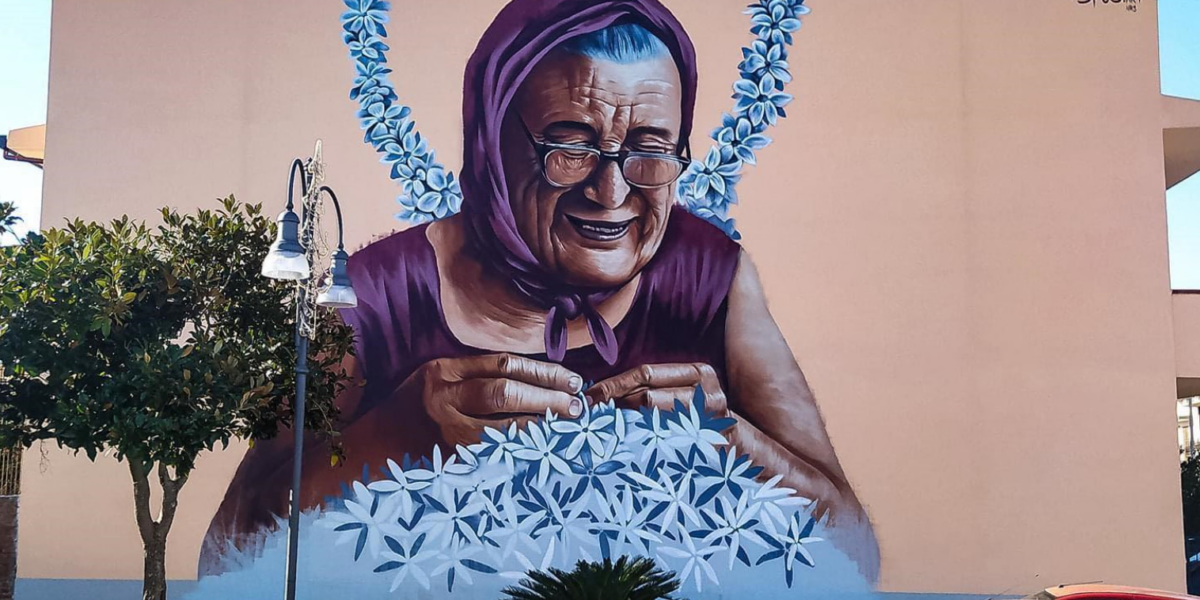
In bookstores from today a story that was waiting to be written, «The long summer of jasmine» (North) by Licia Tumminello, from Palermo and Crema by adoption, graduated in law and already a banker, who has always had a passion for writing.
A story made of people, of fatigue and subordination, and of rebellion, which is inspired by the first women’s strike in Sicily, which took place in August 1946 in Milazzo by the jasmine workers, who collected at night the jasmine from baronial lands then destined for the distilleries beyond the Alps. A story that smells of the intense fragrance of jasmine but smells of effort, and which the author encountered by chance, in times of pandemic, on YouTube, with vintage films and photos from Rai Teche, and from which the story “Gelsomina” was born. And that from the story, “which could say very little about the trouble that led the jasmine workers to go on strike” says Tumminello, became a novel thanks also to documentary research at the Ryolo museum in Milazzo.
At the center of it all, twenty-three-year-old Grazia, inspired by the real Grazia Saporita, “the Bersagliera”, who set the strike in motion. But Grazia is also the name of the only jasmine worker with whom Tumminello spoke and who worked in the 1960s, when working conditions had already improved. To fuel the narrative tension, Tumminello builds relationships between female and male characters in post-war Milazzo, with its plain, the Acqueviole district, the ‘Ngonia beach, the cemetery, places reconstructed through period photos and thanks to toponymy. Among the founding themes of the novel, the tireless toil of women within the family, the lack of education and economic independence, the exploitation of minors, the denied health and economic rights, the abuses of the capolarato, motherhood as a “duty” together with marriage, and the dreams of women including, at the time, that of becoming a teacher and owning a sewing machine.
A story that seems to be waiting to be written.
«A story of redemption and female solidarity that was even waiting to be known before being written because it concerns the strike of the jasmine workers who rebelled against the truly inhuman conditions in which they were forced to work and which, as a Sicilian, I didn’t know. Perhaps, despite being so important, it wasn’t even known in the places where it took place because in addition to being a women’s story it was also a story of the South, while instead a similar situation like that of the rice weeders is known by everyone, and has also been consecrated by cinema.”
At the center there is the female protagonist, Grazia, and a male supporting character, Francesco.
«I built the whole story around Grazia as I wanted her to be, one of the many girls as they were in the 30s and 40s, a daughter of the patriarchy, because that was the social and cultural context. At the age of 11, Grazia goes to work among the jasmine fields with her aunt Assunta (who in the novel represents the rebel), because she has to do so out of necessity, after her first years at school, even if she is good and has the dream of becoming a teacher. The lack of education makes her insecure, takes away her ability to speak, even when after several years she meets her schoolmate, Francesco, who has become a doctor. And so in the confrontation and lack of dialogue (she is already married), the inadequacy emerges again. With Francesco, a fictional character to whom I gave the surname La Rosa in homage to the trade unionist Tindaro La Rosa, who with his wife Eliana Giorli supported the struggle of the jasmine farmers, I wanted the main male character to wreak havoc in the midst of an immobile and resigned world of poverty and the subjugation of the population after twenty years of dictatorship. Obviously I had to make him study and gain experience outside the country, where, when he returns, he brings progress, modernity and awareness to the community. Thanks to the closeness of Francesco Grazia, she shakes off the immobile daily life in which she has to “stay in her place”, as everyone tells her, even if men decide to stay in her place, she acquires awareness, grows and makes her companions grow until she convinces them to go on strike.”
Speaking of lack of words, if Grazia doesn’t say them, she entrusts them to a diary highlighted in italics in the novel.
«While little Vita, Grazia’s granddaughter, also a jasmine worker, is unable to speak due to a trauma during the war, Grazia is afraid that she lacks the right word. Here, then, is the diary to which she entrusts her unexpressed thoughts, as those of many women must have been, and which I wanted to come out. On the other hand, with the third person I make other characters speak according to various points of view, to build a varied narrative world beyond that of the jasmine workers, who at the beginning are like an indistinct lump without a voice and without a face”.
Returning to the male characters, there is chauvinism, patriarchy, but also a certain sensitivity on the part of some.
«I wanted to put a certain sensitivity into fictional but realistic characters: Michele, Grazia’s husband, a little rough and jealous, who however supports Grazia when she is fired and pushes her to improve, to attend the sewing course. To Baron Liborio Puglisi, owner of the lands where the jasmine workers work, I gave an enlightened impression, of someone who, without forgetting profits, is convinced that it is better for him to improve the working and economic conditions of the jasmine workers. And then there is Don Gioacchino Torre, who manages the baron’s lands, a realistic and certainly negative character to whom I also tried to give his own “humanity””.
Speaking of narrative choices, how did you construct the novel with its dialectal stylistic features?
«If you think about the social fabric and the cultural background of the characters in the story, obviously they spoke in dialect. But I tried to use as little dialect as possible, except for those rare words and expressions, including songs and idioms, in the dialect I knew and consulted in dictionaries. But I maintained a Sicilian cadence in the sentence, a construction of the sentence much more similar to Sicilian than Italian, introjected into the concreteness of the whole story.”