

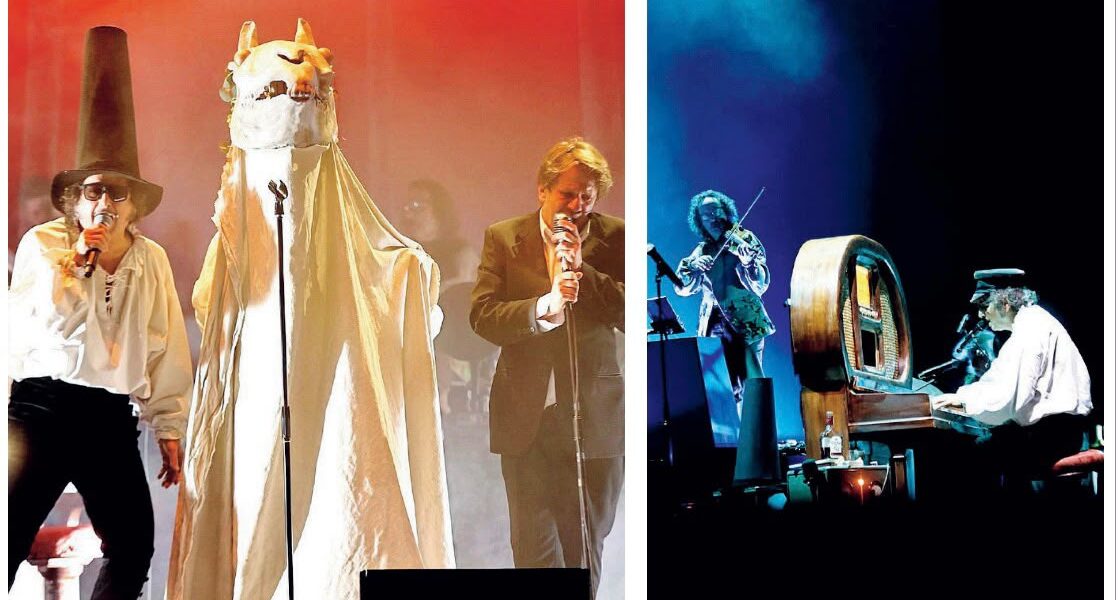
Laying power bare, stripping it of its respectable aura and praising the “irregular” men who have made their art the only form of resistance. From the poet Dylan Thomas to the radio DJ Renato Striglia; from the singer-songwriter Vincenzo Costantino known as “Cinaski” to the musician Daniel Melingo, they are all part of the same “epic of failure”: «And death will not have dominion», the ballad opera with Vinicio Capossela and Pierpaolo Capovilla (with Naples, this was the only date in the South). A praise to irregularity even before it begins.
When the audience of the XXIII edition of the Autumn Festival took their seats at the Politeama Theater in Catanzaro they were greeted by indefinite sounds: electronic noises, animal sounds, bellowing. Then, the lights off. On the scene a man lying, Capovilla, in a tub surrounded by bottles of alcohol and objects of all kinds. Next to him Vinicio Capossela, on the radio-piano. The story is the life of Renato Striglia, the radio DJ and friend of Capossela who passed away in 2020, intertwined with his unfinished project dedicated to the radio play «Under Wood Milk», i.e. «Under the milk forest» by Dylan Thomas.
The dialogue between the two immediately explains the objective of the show: «To bring a message to a world that despises humanity». One unreleased song after another, fifteen in total, which make up the album «Milk Wood Bar», out on January 22nd on BMG Rights. Interspersed with them are stories about Striglia’s life entrusted to the voices of Ornella Vanoni, Patty Pravo, Nada, Luciana Littizzetto, together with bizarre characters – the beautiful losers – who animate the Welsh village of Llareggub, overlooking the sea. There is Captain Gatto, who tries to tame Striglia’s loneliness; then Lily, obsessed with her image and appearance; Rita Testa Grossa, who seeks lightness in a long-awaited kiss; finally, Time, what passes, what runs.
«Only lovers jam the hands. Lovers and death”, says Captain Capovilla-Striglia who in the meantime becomes the new Noah leading his creatures on the Ark. They are all imperfect characters, strange in their naturalness, linked by an innocent desire to live, love, hope. Furthermore, everyone wants the same thing: for life in the forest to be simple and peaceful. Ultimately, “nothing that isn’t already.” In an era in which judgment seems to dictate the rules of relationships, in Llareggub the characters seek a different coexistence: a heterogeneous, plural community, where diversity is praised. Where irregularity is continually absolved.
But it is with the arrival of the Chimney Sweep that the innocence of this fairy-tale world changes inexorably. The Cleaning Order arrives which becomes «Order and Police!» and the beauty of diversity becomes meekness and mutiny. It sweeps away the innocence, the dream, the wonder. «Let’s be police! Let’s evict the people! Let’s create a desert and call it Peace!» is the cry of Capovilla-Striglia who, standing up, recalls that natural feeling of resistance, rebellion and revolt, even if life in the woods is over for him. The boat, in fact, becomes the coffin in which Capovilla lies down awaiting death. Capossela performs «Ai cancelli dell’Eden», the most poignant song on the album inspired by a poem by Thomas about the death of a child under the bombs. “You will be dead, but not therefore meek” is what he had said to his friend at the beginning of the work. So the curtain falls. Death, however, is not the end. With «Milk Wood Bar» Capossela is alone on stage. Among the notes emerges the idea of an afterlife where everyone meets to celebrate memory through poetry. This is how he remembers “Cinaski” and his Argentine friend Melingo. His greeting to the audience is Thomas’ line from the poem “Should lanterns shine”: “The ball I threw playing in the park / It hasn’t hit the ground yet.” Thus he throws a ball into the air which remains suspended. So this is the end of a story that needed to be told, a message that needed to be told. A story over which death has no dominion.