

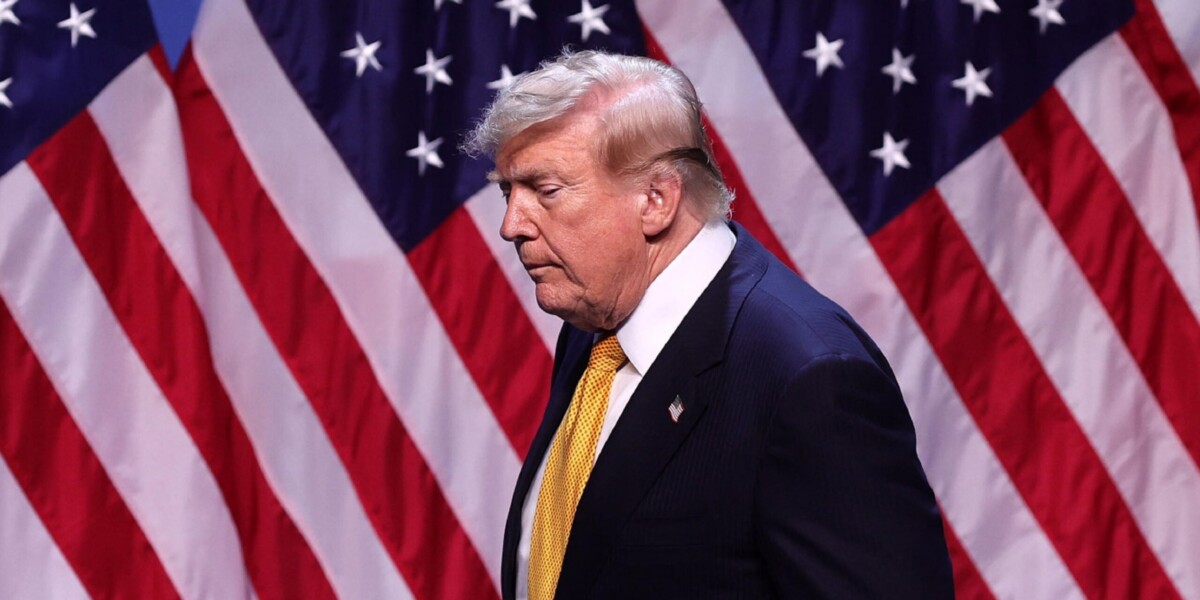
“I announce that any country that allows its financial institutions, corporations, airports or government agencies to provide any kind of lifeline to Iran will itself face tremendous economic consequences,” Trump said. The US president did not provide details on the types of sanctions to which the countries involved would be subjected. He also did not specifically name any country in his statement on social media. His comments come nearly a week after Treasury Secretary Scott Bessent said the United States would impose unprecedented economic isolation on the country. “It will be a combination of economic isolation the likes of which the world has never seen,” Bessent told conservative television network Newsmax last Thursday. Iran has taken a defiant stance after months of resisting US military operations, which failed to decisively end the war.
After the Israeli-US attacks against Iran on February 28, Tehran responded with bombings against neighboring countries allied with Washington and blocked the Strait of Hormuz, a strategic route for the transport of hydrocarbons. The United States has in turn imposed a blockade on Iranian ports. Despite a recent decrease in hostilities, tensions in the region remain high.
The United Arab Emirates accused Iran on Tuesday of launching two ballistic missiles, which fell into the sea and were aimed at maritime traffic. Iran has denied launching missiles into the Gulf and “categorically” rejected the accusations. Immediately afterwards, the Emirati diplomacy announced the suspension, until further notice, of “commercial exchanges” and “financial transactions” with Iran. Tehran had already threatened on Wednesday morning the Gulf countries that provide any type of support to the US army. “Any assistance or facilitation provided to the aggressor US army is equivalent to participation in American military operations,” declared General Ali Abdollahi, head of the Armed Forces, in a statement released by the Mehr agency. The two countries, separated by the Strait of Hormuz, share deep cultural and historical ties.
In fact, until the beginning of the conflict, the United Arab Emirates was an important commercial partner of Iran, subject to US sanctions. Trump said Tuesday that “there is no dialogue and no talks are underway, or even planned, with the Islamic Republic of Iran.” According to a US source contacted by AFP, these exchanges have been suspended and Trump has asked his aides not to resume dialogue until Tehran moves closer to the US position. The Iranian authorities have so far given very few signals in this direction. Iran’s top negotiator, Mohammad Bagher Ghalibaf, said the Strait would not be reopened until Washington fulfilled its commitments under the memorandum of understanding signed in June. The text, which provided for a 60-day truce with a view to a lasting agreement, fell apart with the resumption of hostilities in July. Ghalibaf reiterated on Wednesday, during a visit to Iraq, the importance of strengthening the regional “new order” and denounced foreign interference.
Meanwhile, Iran and Oman, whose coasts overlook the Strait of Hormuz, have been discussing the future management of this strategic passage for several weeks. Iran, which attacks ships that attempt to cross the Strait without seeking authorization, wants to impose shipping fees for services provided to transiting vessels, a measure that is strongly opposed by the United States and some countries in the region.