

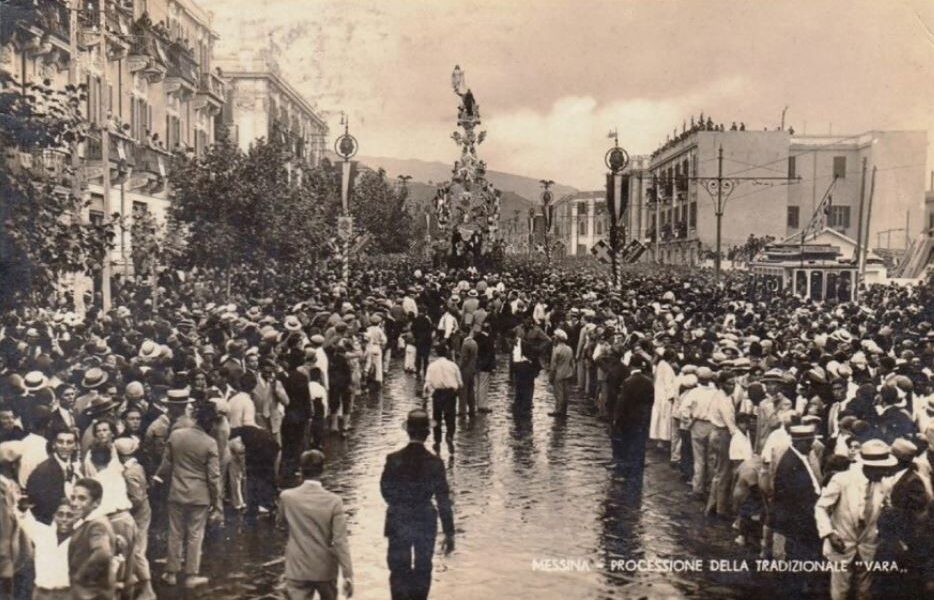
«…The whole city, as if by magic, was decorated with lights and large triumphal arches, and in one of them at the entrance to Via Garibaldi, it was written: “Long live Messina Risorta!”». (The Ferragosto in Messina. Gaetano La Corte, 1926).
In 1926 the reconstruction of Messina after the earthquake had not yet been completed, also due to the economic resources stolen in support of the Italian-Turkish War (1911-1912) and the First World War (1915-18); yet, the resumption of the August holidays, strongly desired by the population, were considered the true rebirth of the city.
For the people of Messina, the Vara has never been just a votive apparatus, nor just a scenic representation of the Assumption of Mary, nor a “spectacular” procession. Vara has always been Messina, which wraps itself around its identity. As Giuseppe Pitrè said, who observed it in 1894 from the top of one of the balconies of the Palazzata, «the Vara must be seen while it is in motion. Stop, it only gives you a pale idea of itself.” For almost five hundred years, the popular will to keep it alive has been stronger than wars and natural disasters (not least Covid). And the people, the “true” ones, fought against everything and everyone, every time the public administrator on duty attempted, with cynical decision, to interrupt the ritual or to transform the centuries-old methods of dragging. This happened in 1969, when the lava pavement of Via Garibaldi was asphalted, on which the steel skates slid; according to municipal technicians, the skates would have ruined the new road surface.
The “brilliant” idea was therefore to mount the Vara on a wheeled trolley, specially designed by the Rodriguez company and Pirelli, and then tow it with a truck! It was the revolt. Overwhelmed by the protest sit-ins and the disappointment of having been deprived of what the people of Messina held dear, the Administration decided to divert the route onto Via Vittorio Emanuele, still equipped with lava paving, and arrive at Via Primo Settembre, which was asphalted. But the shooters, shouting Viva Maria, did not stop and asked the tankers to water the bituminous road surface. And the Vara slipped on the wet asphalt under the applause of the crowd and the technicians who, with amazement, noted what had happened.
Then the tram arrived and the then Committee, supported by a popular petition, fueled the proposal for a variant to the project which involved the installation of the tracks on Via Garibaldi. But once again the people’s will to keep the tradition alive prevailed; and so the tram was moved to Via Vittorio Emanuele. The resignation of those who, in the face of wars, earthquakes and health emergencies, tried to “throw in the towel” with phrases such as “The Vara is over now!”, has always been compensated, over the centuries, by a great desire for recovery among the people of Messina.
One hundred years later, we collect what History gives us: a people without its identity symbols loses its roots; because Messina, without its Vara, would feel stripped of its past, of its devotion to Mary, of its desire for redemption. In one day, as if by magic, all divisions and problems are put aside; on that day, there are no longer “bad guys and bad guys”, but a united city, in which everyone is and feels like a shooter, even those outside the ropes. All shooters, by faith or by sense of belonging, around a symbol of our identity: the Vara