

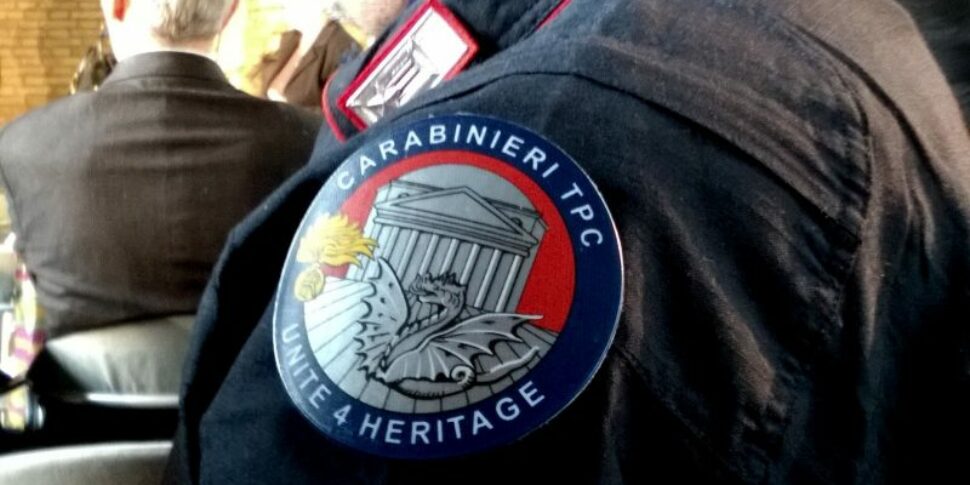
The Carabinieri for the Protection of Cultural Heritage this morning delivered to the director of the Archaeological Parks of Crotone and Sibari 46 archaeological finds recovered in Italy and France during the activities carried out in the investigation called «Achei», with the coordination of the Public Prosecutor’s Office of Crotone. The event took place in Cosenza in the Sala Leone of Palazzo Arnone, in the presence of the Prefect of the city, the Prosecutors of the Republic of Cosenza and Crotone, the provincial Carabinieri commander of Cosenza, as well as the civil, military and religious authorities of the province and city.
The extraordinary archaeological finds returned, of important historical-cultural and economic value – it was highlighted – were traced in the context of a complex investigation activity carried out by the Carabinieri of the TPC Unit of Cosenza which ascertained the existence of a vast trafficking on a national and international scale – with ramifications in Great Britain, France, Germany and Serbia – of archaeological finds clandestinely excavated on Italian territory. Among the goods delivered there are also artefacts seized in France and repatriated on 16 October following the order of the French judicial authority which ordered their delivery to the Italian state.
The investigations, carried out between 2017 and 2018, made it possible to reconstruct the systematic looting carried out by teams of “grave robbers” who, with a detailed division of skills and roles, guaranteed a continuous flow of precious archaeological goods to the clandestine market, sold in articulated and complex receiving channels in Italy and abroad.
The operation concluded with the issuing of an order for the application of precautionary measures by the investigating judge of Crotone, at the request of the local prosecutor who coordinated the investigations, against 23 people held responsible, in various capacities, for being part of a criminal association aimed at committing the crimes of damage to the archaeological heritage of the State, illicit possession of cultural property belonging to the State, receiving stolen goods and illicit export, as well as the execution of 80 search decrees against as many subjects, investigated in a state of freedom.
The return of recovered cultural assets to the state heritage – it was underlined – is the result of complex actions, carried out in close synergy with the central and peripheral bodies of the MiC, with the commitment and professionalism of women and men, military and civilians specialized in the specific sector, which have made it possible to save important artistic testimonies that belong to the community and which tell the story and evolution of our civilisation.