

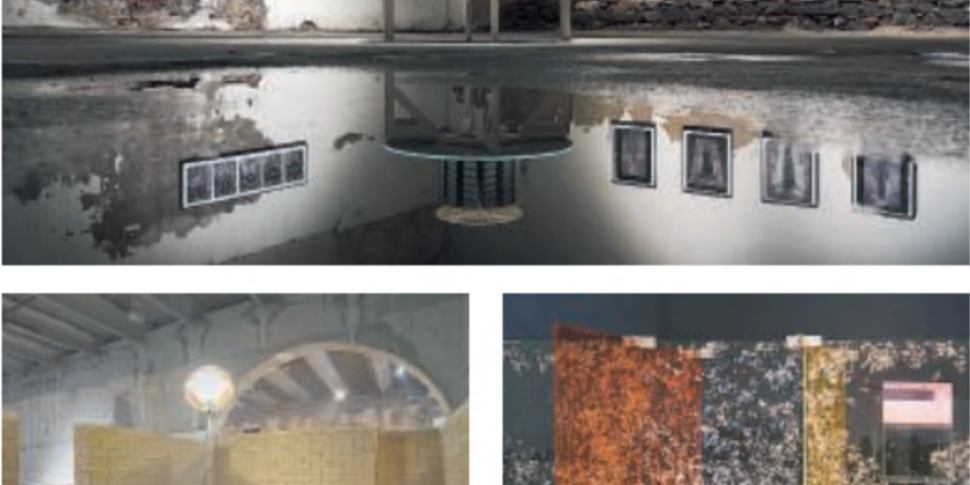
«Making things» is the significant title of the exhibition by Alfredo Pirri (Cosenza, 1957), which “fills” the post-industrial spaces of the Brodbeck Foundation, the former liquorice factory in the San Cristoforo district of Catania, open until 30 September. The entire exhibition itinerary, in addition to the culture of thinking and creating, allows you to experience first-hand a space of existential experimentation in which you become protagonist participants. Focusing on the development of the relationship between art and architecture (and, I would add, also with the very idea of human existence), watercolors, installations and other works contain everyday life and monumental intent. Pirri presents, among other things, the reactivation of «Cure», conceived for the 1988 Biennale, and the unpublished «The archive», a representation of the need to conserve and preserve culture. Highlighted are the creations that the artist has long dedicated to Antonio Gramsci. With the title «Companions and Angels», next to the model of the space-work of the same name, a series of watercolors, on the bottom of which is printed the reproduction of a cover of the notebooks written by Gramsci during his detention in the Turi prison. We talked about it with the artist.
Gianluca Collica, one of the curators (the other is Cesare Biasini Selvaggi), talks about the narrative capacity of his works. Do you recognize yourself in this concept?
«Yes, because today the term narration can be used to call different things, therefore not only story, but also, for example, representation. I think that today many terms need to be given new meaning: the term narration can be accompanied by that of evocation, one can narrate by evoking or hinting at shreds of narrativity arranged in columns among themselves like pearls on a necklace. The purpose? Achieving a narrativity that no longer has the characteristics of the subject telling something immediately comprehensible, but rather a mechanism that evokes different co-existing realities”.
What is your creative path to make works that were originally conceived for other places become “site specific”, such as, for example, “Cure”?
«When we say “site specific”, we often refer to works that are born within a space and end there. This is a gesture that has never interested me. I am interested, however, in being able to combine the works within certain spatial contexts, specific ones, and making sure that they live a new life. “Cure” has been reworked and reformulated on the spatial dynamics of the Brodbeck Foundation, and therefore takes on a different meaning. I would add that the work, once made of wood, is now made of tuff, because in Catania it had to take on a different weight and gravity. So if anything I would talk about repositioning the works, redeveloping them in different spaces, recontextualising them; and they are always an original act, while maintaining a strong identity spirit: the original ideas from which they arose.”
Consequently, what is its relationship with space (and spaces)? And with the materials?
«The one that starts from their knowledge and also from the affection that they inspire in me. The Brodbeck Foundation is a place I have known and frequented since the beginning. My relationship with space comes first and foremost from knowledge and from the bond I manage to establish with it. Furthermore, I am convinced of a sort of objectivity of the work in relation to space: often a work can only be placed in a certain way. It is as if the space were a sort of magnet towards the work, attracting it to itself and placing it naturally within the exhibition. So my job is to search for the magnetic aspect and the exhibition is a sort of mega magnet, which first highlights a magnetic force, rather than the individual works. The same goes for the materials: they follow the logic inherent to the work and seek to highlight their sensitive aspect, sensitive I would almost say, so that the magnetism can express itself.”
Your relationship with Gramsci is constant: what was the spark that triggered your “passion” for the intellectual?
«I come from a generation that made the relationship with politics a foundational fact and therefore Gramsci represented one of the most important points of reference. A dissident par excellence, someone who spent his life for his ideas, original and necessary even today. Some sparks have sprung from this predisposition. One, for example, is the request made to me by the Albanian government and the Puglia Region to dedicate a work, a sort of monument, to his figure. When I discovered the Albanian origin of Gramsci’s family, it was a strong moment for me. His family comes from a town near Tirana called Gramsh, and Antonio’s original relatives fled from there, persecuted, to land first in Calabria and then in Sardinia. This has led to great interest in his figure, starting from some definitions by scholars, as a “luminous thinker”. Not enlightened in the Enlightenment sense of the term, but luminous, in that it is capable of expressing ideas that represent a beacon for us. And from there I thought about the relationship between what I do as an artist and his figure; the need arose to create watercolors that start from the question of light, and also a social sculpture initially intended for the city of Turi and which today is permanently exhibited in Bari”.
At the beginning of your career you participated in Florence in the theatrical adventure of the Krypton group of another important Calabrian, Giancarlo Cauteruccio, who recently passed away. How important was it?
«Very much, it was my first great professional experience. As ex-offsite students we have contributed to waking up a city like Florence. We were born as dissidents and we remain so. Every time we do a work we think about how it can contribute to renewing the surrounding landscape. We are permanent dissidents.”

Find out more in the digital edition
To read everything, buy the newspaper
or download the digital version.