

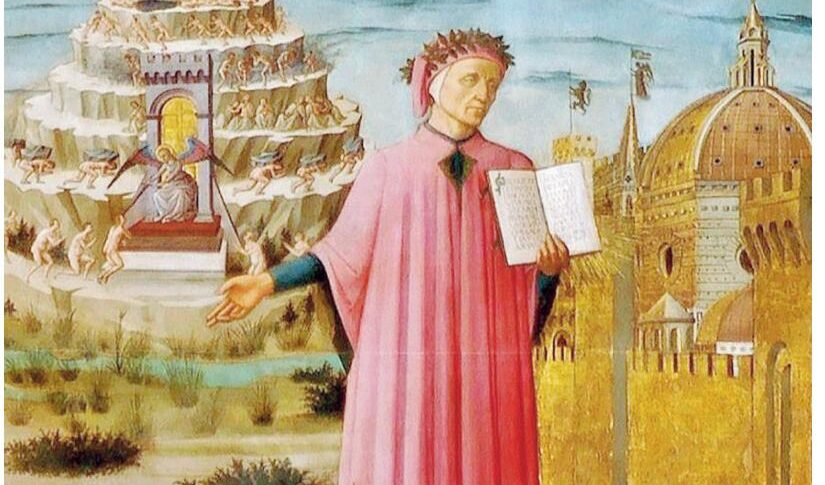
Dante’s great beauty told and unfolded in the beautiful volume “Face to face with the comedy” (Laterza) of the linguist Giuseppe Patota. Moving in the plural atlas of the Dante universe is demanding: understanding the divine comedy – warns Patota – is difficult both for the contents of the encyclopedic poem and for the language in which Dante wrote it, “a language that has become our mainly thanks to him , with all the expressive possibilities that seem to go beyond the human, from the lowest register to the highest one, from the sordid to the sublime one ».
That’s why, in the endless bibliography that has been questioning Dante for centuries and his poem, gift and heritage for humanity, his great beauty must be even more told. And then it was necessary “this non -trivializing work of dissemination” with which Patata, an ordinary of Italian linguistics at the University of Siena, corresponding partner of the Academy of Lincei, academic of the Crusca and Arcadia, co -director with Valeria Della Valle del del Dictionary of the Italian Treccani, as well as the author of numerous scientific studies and popular writings, has tried “to do what a professor must always do: to make easy and accessible things difficult and not very accessible ».
«One day – continues the linguist – I started thinking about the comedy and I told me so: in 1300 a thirty -five -year -old man finds herself in a frighteningly dark forest, from where she embarked on a surprising journey that takes him on here and beyond the world. First sink into the bowels of the earth, where evil reigns, then reaches a mountain on top of which there is a lost paradise, finally it is launched in space, from where it realizes that the earth, its small planet, is a fragment insignificant of an immense space-time universe. He reaches the moon on a date between March 30 and April 13, 1300, 671 years before Neil Armstrong, he makes contact with the other planets and constellations. At the end of this superhuman adventure he sees God. Start by making angels and demons, characters of history and myth, real and fantastic animals, stories and real characters who from Ciaco to Filippo Argenti, from Francesca da Rimini to Ugolino della Gherardesca would do in some archive document of the medieval news if Dante had not spoken to us; He speaks with competence of theology, philosophy, logic, moral, politics, law, literature and ancient history, astronomy, science of numbers and measures, music, optics, medicine, art of war and navigation. He tells this experience in a verses diary and named him comedy ».
Now, “Reading or hearing this diary in verses is a unique experience, but difficult for the doctrinal, scientific and technical contents that conveys and the stories he tells”, therefore the linguist has “put himself in the head to transform this work Beautiful and complicated in a text that could be understood and appreciated by those who do not know him, by those who know him little and by those who have known him but do not remember him “and wrote 114 stories in which he presents the more verses Significant, curious or surprising of the one hundred songs whose work is made up and explains the word for word: «I do not take nothing for granted – he says – I connect the facts with the doors and in the end I propose their reading, without changing a comma. In this way, I sing after singing, I try to accompany those who read on the same journey that Dante made. In each story I always present the same sign: “You are here” ».
So Patota (and who reads with him) crosses that incandescent matter following Dante to travel the topography of evil “blood on blood”, travel in an open, bright and inclusive purgatory even if painful, fly, the first human, between the moon and the skies in Mystery of the Divine: “Reality irraccontable but approached by the poet to something known through similarities, and screenplays that deserve a thousand Oscar prizes”. Punctually accounting, as a linguist, of precious phonetic, grammatical, semantic, etymological explanations on that invention of the language that thanks to Dante has become ours, reflecting on the discovery of meanings and words starting from Dante’s terms to reach the words of which the Poet did not have.
“Trust Dante,” repeats Patota several times. And among the many Chiosa of the linguist here is someone: it is not true, as the verses of the poem clarify, that the “but” at the beginning of sentence cannot be used and, again, it is not true that the present is not corrected Of the future in phrases of the type “I go on vacation in a month”. “Dante’s word,” said Luca Serianni, and then trust Dante!