

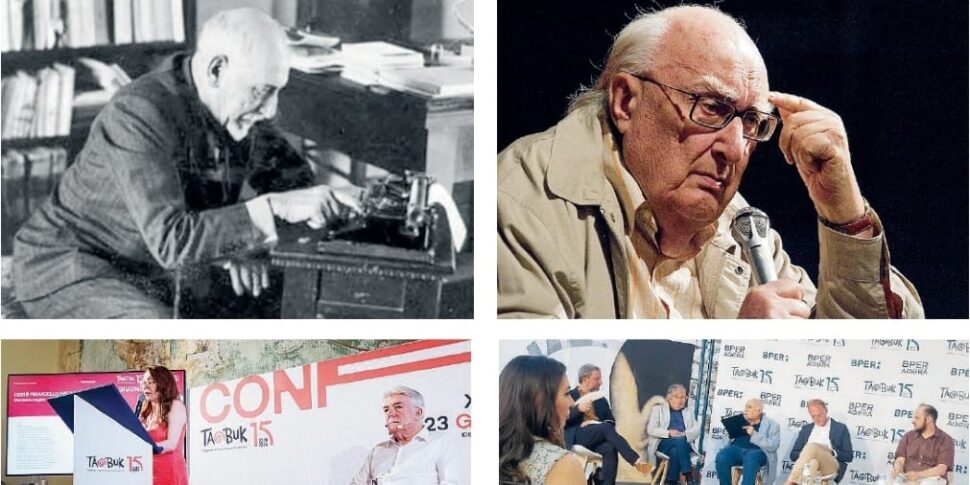
They staged the complex laboratory of life, the mystery and the crazy rope of our private, civil, public dimension, two agrigentini, two phenomena of Italian literature. Phenomena in the etymological sense of the term, of what manifests itself as an exceptional fact. AND They are the noble children of a Sicily-Mondo, both Agrigentini, Luigi Pirandello, Nobel of literature, and Andrea Camilleri (born in Porto Empedocle) of which the one hundred years have been celebrated this year since birth. And it is no coincidence that they were both Celebrated on the same day, the last of the fifteenth, prestigious edition of Taobukthe international festival created and directed by Antonella Ferrara which closes with record numbers.
Because there is a first and after Pirandello, there is a before and after Camilleri. Pirandello, with his gigantic presence, was the protagonist of the meeting “So it is Pirandello (if you like)”, a lectio magistralis of Matteo Collura, writer, journalist and essayist, also Agrigento, friend of Sciascia, and author, among other essays on Pirandello, of “The game of the parties” published by Longanesi in 2010 and “now returned to the film. Scene Michele Placido, and illuminates aspects of Pirandello’s life so far unknown or underestimated. A grandson of Pirandello, Andrea, son of Stefano, the eldest son of the playwright, said a few years ago that his grandfather had to be freed from the “moralistic protection” in which for long years he had been held by family, friends and by the same criticism ». This intended to collide with his book and yesterday’s conversation. “And I was able to write it as I wrote it – he continues – because I had first -handing information, having met some of his grandchildren. Stefano Pirandello’s son, in fact; Lieta’s daughter, and my dear friend Maria Luisa Aguirre D’Amico; Pierluigi, Fausto’s son, the painter. In addition, I was able to read the hundreds of letters that Pirandello sent to Marta Abba, a mine of information, to which the biographers before me could not draw. From the documents and from what was revealed to me by those who knew him alive (the grandchildren, in fact), clearly show that Pirandello was a convinced fascist. And I can add that, if he had lived a few more years, it is not excluded that, like many other Italians, he would become an anti -fascist. I wanted to tell how much the life of Pirandello, his family drama entered his works, “the six characters looking for author”, is the most eloquent mirror and as it seems to have found in unhappiness the most powerful impulse to create his masterpieces “.
Anniversaries are precious appointments with the greats of literature, with the masters. And the teacher of which the centenary is celebrated throughout Italy, is Andrea Camilleri, with the happiness of telling that he maintained throughout his life. Professor Salvatore Silvano Nigro, the literary critic who from Camilleri has always been one of the main scholars, a born storyteller. And with Nigro in Taobuk, Felice Laudadio (president of the National Committee for the celebrations of the centenary of Andrea Camilleri), the publisher Antonio Sellerio and the actor Fausto Russo Alesi, together to talk about the literary and civil lesson of the great writer in the meeting “Cento years of Andrea Camilleri: the century, the craft, the story”.
A century that Camilleri crossed with his experience, his passions, his daily work, and then with the epiphany of his stories with the invention of Vigàta and the Commissioner Montalbano and a speaking language translated into many countries: his “great theater” in which humanity is represented, entered the homes of readers and viewers without borders of any kind. But there is a book by Camilleri that must absolutely read and interrogate: his epistolary, “I will write to you again. Letters to the 1949-1960 family” (Sellerio) edited by the daughters and who Nigro with a fascinating story has outlined: it is a young Camilleri who writes to his parents of what he would have been and that he himself did not know but that we know. An epistolary in which you can read the path that would have led him to the “Vigatese”, and much more on a whole intimate and family world.