

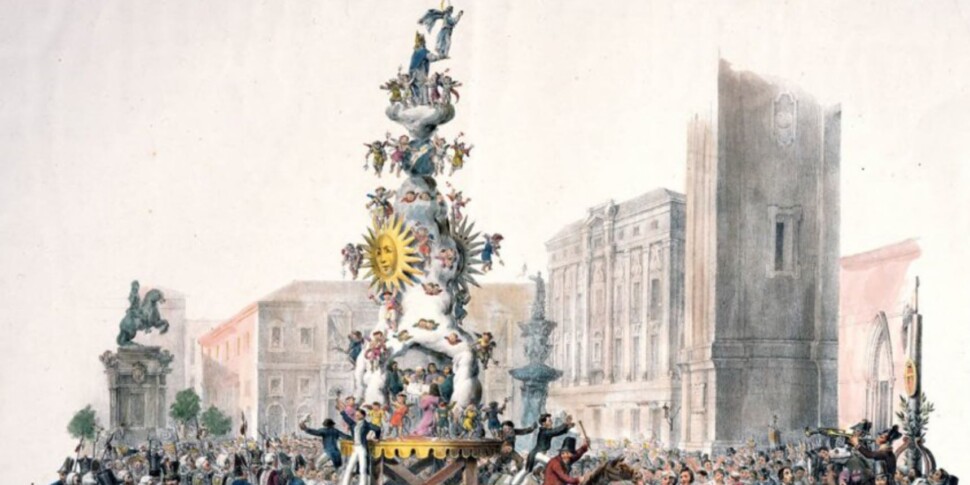
“Do not persist in wanting to analyze it; happy with the whole. The coffin must be seen while it is on the move; firm, it does not give you more than a pale idea of itself. When walking, the interior devices are set in motion, and the wheels turn in different senses without you can follow the details. While at the bottom, in the platform, a chorus of angels travels the great disc, without moving, without moving. Maria, dead … “. This is the description that, at the beginning of the twentieth century, the greatest scholar of Sicilian popular traditions Giuseppe Pitrè, wrote of the Vara di Messina, among the most present holidays in his works, for the peculiarity and charm. This is the transposition intended for the popular devotion of a city linked to the Marian cult of hiring, the recurring iconographic dormitio theme from the first Byzantine realizations, and represented by the pyramid chariot, with the soul of the Madonna rising towards the sky. The festival has origins that date back to the 16th century, as part of the celebrations at the arrival of Charles V in Messina, on October 21, 1535, back from the victories of Tunis and the Goletta, episodes of the Ottoman-Asburg wars. In honor of the emperor the Senate Messina gave proper “fulfillment at the Vara car”.
The procession of Vara, on the afternoon of August 15, attraction of faithful and tourists who attend the show, between sacred and profane, with the “shot” through the long tires of the entire structure, in the last two decades, thanks to the attention of the civic administrations, the sensitivity of historical-scientific commissions and of committees of lovers and experts of the event, has regained historical and solemn characteristics of the first testimony of the first testimony of 1562 Francesco Maurolico. After the unification of Italy, in fact the Vara procession was suspended by the Sabaudo government and resumed only in 1886 to suffer a new interruption, after the 1908 earthquake, until 1926: brackets these that have determined over time, the loss of many symbols and values that, thanks to this choral commitment to reconstruction of memory, are recovering in favor of new suggestions for those who assist “this kind of mobile theater”, nineteenth -century chronicler described the Messina Vara. The peculiarity of the Vara is precisely that of having been designed as a “machina” of simultaneous movements aimed at recreating the overall image of a cosmological and ontological event at the same time-as underlined in 1991, Sergio Todesco precisely in the volume theater mobile festivals of half-aging in Messina which constituted a historical-documentary support of the exhibition “Come: the festive machines of half-aged between history and Anthropology “, curated by Todesco himself on behalf of the Municipality of Messina in August 1990, with the contributions of the disappeared Giovanni Molonia and Franz Riccobono, competent collectors and lovers of the Messina History.
Themes and insights also taken up in 1997 with another publication of the Municipality of Messina, Vara through the centuries, in which among the other contributions of Andrea Bombaci, Nino Principato, Luciano Tringali and Francesco Forami, a prayer to the Virgin BM assumed in front of the vara of the Archbishop Msgr. Giovanni Marra, as soon as he was hinted at the Messina headquarters. The prelate who participated for the first time in the historic procession, interpreting the needs and expectations of the city in the invocation “as in the past centuries”, attracted the entrustment to the Madonna, “confiding in the hope of rebirth of the people of Messina in Concordia, justice and solidarity”.
A structure, the Vara, rather complex from an iconological and iconographic point of view, so much so that Pitrè in its descriptions, recommends: «Well, if you have been posted on these figures – the only preserved by real characters on the whole chariot -, you will lose the effect of the rotary movement of the sun on the right and the moon on the left, the one forward, the other behind, with their puttini, and the triumphal car will be unnoticed. Pillars, and is represented by a sky of the most beautiful color you can imagine. And if you look at the sun and the moon, you will get the sight of the world, and the clouds that surround it, and the angels etc. ».
A series of representations and decorations, in the various levels with the classic Mantuan that surrounds the perimeter of the Vara, to the axes – commonly called “stancon” – on which the Ceri rest (memory of “twelve huge candles of sixteen inch in diameter and six feet in height”, as the French traveler Jean Houel wrote in 1778), and the seats where twelve children sat Serafini in wood, to the astronomical and celestial representations.
With an anthropological perspective, Vara is properly theater, that is, a ritual space within which characters act. The fixity, the immobility of the medieval mysteries in which the figures are almost crystallized in their roles, marries – as Todesco highlights – here with the baroque need of false movement. «We move, but only to return to the starting point; The path has already been established in advance … the religious and political elites manage the Vara, but the real recipients, the real users of the machine are the subordinated classes. The Catholic-Egemone reading of the Baroque of the Vara (triumph of the Virgin and hierarchical structuring of the universe, Magna etc.) is opposed to the different popular perspective, which puts in place a work of emotional fruition of a magical-religious type with intent and compensatory effects, of consoling use of holidays “.
The Vara is an axis of the mobile world, that is, it allows the faithful who follow it to be always at the center of their universe. Through the ritual paths of the “machine”, in fact, a re -appropriation of spaces is always made which, becoming deputies of the festive event, are proposed as pregnant spaces, with meaning, and not empty and naturalistically inert.
The symbolic elements of the Vara di Messina create a visual and narrative experience that is deeply linked to the literary tradition, as in particular to the “golden legend” text of the thirteenth century of Jacopo da Varazze, which inspired the representation of Mary’s assumption. The triumphal chariot reproduces its scene, and literature, both ancient and modern, contributes to keeping tradition alive, with mentions and descriptions that celebrate its history and meaning. Just refer to the works of Placido Sampi born in Messina on August 17, 1590, to those of the historic Messina Giuseppe Buonfiglio (1547) and Caio Domenico Gallo (1697).
The Vara therefore through these memories and with its scenic complexity, still continues to come to life through the traditional procession and above all from the set of practices, beliefs and religious manifestations that develop and spread, often outside the official canons but which does not remain more tied to one period of the year, the famous Messinese Mezzagosto.
The permanent exhibition of Vara and the Giants was set up at PalaCultura in 2021, inserted in the project of the identity policies of the municipal administration. Many finds of great interest including the beautiful painting by Michele Panebianco of 1842 already in the collections of the German console in Messina in 1871, Felix Bamberg, and purchased by the Civic Administration in 2017. An image that manages to grasp the reality of the event Vara with its historicity and the ability to cross the threshold of the contingent and the fleeting to immerse yourself in the mystery of the “beyond”.