

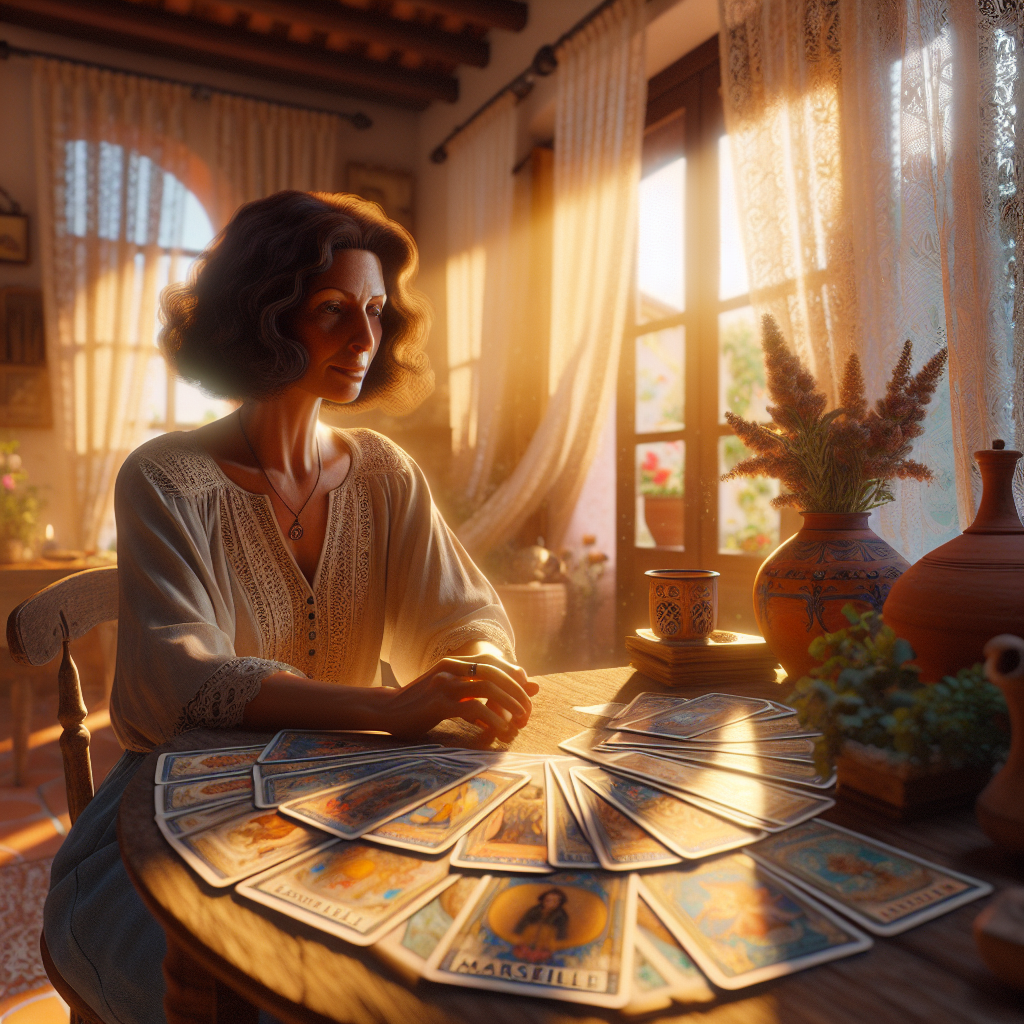
Discover how the Marseille Tarot reveals Mediterranean family values, spirituality, and social codes. Learn to read tarot through Latin cultural wisdom for deeper personal development and authentic connections to ancestral traditions.
Introduction – The Tarot as a Cultural Mirror
The Marseille Tarot is far more than a simple divination tool – it’s a fascinating window into the soul of Latin European cultures. When we examine its rich symbolism and archetypal figures, we discover centuries of Mediterranean wisdom, family values, and spiritual traditions that continue to resonate with modern women today.
Whether you’re a complete beginner to tarot or someone seeking deeper meaning in your readings, understanding the cultural roots of the Marseille Tarot can transform your relationship with these ancient cards. This deck, born from the crossroads of Italian Renaissance art, French craftsmanship, and broader Mediterranean influences, carries within its imagery the very essence of how Latin cultures view family, spirituality, honor, and the art of living well.
As mothers and women navigating today’s complex world, we often find ourselves searching for guidance that honors both tradition and personal growth. The Marseille Tarot offers exactly this – a bridge between ancestral wisdom and contemporary self-discovery. Its cards don’t just predict the future; they reveal timeless patterns of human experience that have shaped Latin societies for generations.
What You’ll Discover in This Cultural Journey
- How family values are encoded in the Major Arcana
- The Mediterranean approach to spirituality and wisdom
- Social codes that still influence Latin cultures today
- Practical ways to apply these insights to your personal development
Let’s embark on this enlightening exploration together, uncovering how the Marseille Tarot can deepen both your divination practice and your understanding of the rich cultural tapestry that created it.
The Historical Roots: A Mediterranean Heritage
The Marseille Tarot’s journey begins in 15th-century Italy, where Renaissance artists first gave visual form to the archetypal energies that would captivate seekers for centuries. This deck carries the DNA of three major Latin cultures – Italian creativity, French refinement, and Spanish mysticism – creating a unique synthesis of Mediterranean wisdom.
The original tarot cards emerged in the Italian courts during a time of unprecedented artistic and intellectual flowering. Noble families commissioned these elaborate card sets not merely for entertainment, but as tools for contemplating life’s deeper mysteries. The imagery reflected the values, beliefs, and social structures of Renaissance Italy – a society where family honor, spiritual devotion, and artistic beauty were paramount.
As these cards traveled northward into France, they underwent a remarkable transformation. French cardmakers, particularly those in Marseille, refined the designs while preserving their essential symbolic power. The port city of Marseille, with its bustling trade connections across the Mediterranean, became the perfect melting pot for these cultural influences to merge and evolve.
The Cultural Migration Path
- Italy (1400s): Birth of tarot in Renaissance courts, emphasis on nobility and divine order
- France (1600s-1700s): Standardization in Marseille, focus on craftsmanship and accessibility
- Spain: Mystical interpretations influenced by Moorish and Jewish traditions
- Mediterranean synthesis: Blending of Catholic symbolism with ancient wisdom traditions
This rich historical tapestry explains why the Marseille Tarot resonates so deeply with anyone who shares Latin heritage or values. It speaks a cultural language that transcends time, connecting us to ancestral ways of understanding family, faith, and fate.
Family Values in the Major Arcana
The Major Arcana of the Marseille Tarot reads like a portrait of the ideal Latin family structure, where maternal wisdom, paternal guidance, and intergenerational bonds form the foundation of society. These archetypal figures don’t just represent abstract concepts – they embody the very roles and relationships that Latin cultures have cherished for centuries.
As mothers, we can immediately recognize ourselves in the nurturing presence of The Empress, who represents the creative, life-giving force that sustains families. Her abundant imagery – flowing robes, fertile landscapes, protective gestures – mirrors the Mediterranean ideal of motherhood as both powerful and tender. Similarly, The High Priestess embodies the wise woman, the keeper of family secrets and traditions, often represented by grandmothers or spiritual matriarchs in Latin households.
The masculine archetypes are equally telling. The Emperor doesn’t rule through tyranny but through protective authority – the father figure who provides stability and security. The Pope represents spiritual guidance within the family unit, reflecting the deep Catholic influence in Latin cultures where faith and family are inseparably intertwined.
Key Family Archetypes in Latin Culture
- The Empress: The nurturing mother, creator of abundance and emotional security
- The High Priestess: The wise matriarch, keeper of intuition and family traditions
- The Emperor: The protective patriarch, provider of structure and stability
- The Pope: The spiritual guide, representing moral authority and religious devotion
- The Lovers: The importance of choice in relationships and family formation
The Tower card reveals another crucial Latin value: when crisis strikes the family home, it’s not just a personal tragedy but a community concern, reflecting the collective nature of Mediterranean societies where extended family networks provide both support and accountability.
Mediterranean Spirituality Revealed
The spiritual landscape of the Marseille Tarot reflects the unique blend of Catholic mysticism, ancient wisdom, and folk traditions that characterizes Latin European religiosity. Unlike the austere spirituality of northern European cultures, Mediterranean faith is embodied, emotional, and deeply integrated into daily family life.
The Pope card perfectly encapsulates this approach to spirituality. Rather than representing distant theological concepts, he embodies the accessible spiritual guide – much like the beloved parish priests who have shepherded Latin communities for generations. His gesture of blessing suggests a spirituality that flows from divine source through human intermediaries, reflecting the Catholic emphasis on saints, Mary, and the communion of believers that permeates Latin culture.
The Hermit reveals another facet of Mediterranean spirituality: the reverence for elder wisdom. In Latin families, grandparents aren’t just respected – they’re considered living repositories of both practical and spiritual knowledge. This card honors the contemplative tradition that values experience over book learning, embodying the Mediterranean belief that true wisdom comes through lived experience and reflection.
Spiritual Elements in Latin Tarot Tradition
- The Pope: Accessible spiritual guidance, parish-centered faith community
- The Hermit: Elder wisdom, contemplative tradition, respect for experience
- Judgement: Resurrection and renewal, core Christian themes of redemption
- The Star: Hope and divine protection, reflecting devotion to Mary and saints
- The World: Sacred completion, the integration of earthly and divine realms
The Judgement card speaks to the deeply ingrained Catholic concept of resurrection and second chances – a spirituality that emphasizes forgiveness, renewal, and the possibility of transformation, values that resonate strongly in cultures where family reconciliation and community healing are paramount.
Social Codes and Relational Patterns
The Marseille Tarot encodes the intricate social dynamics that govern Latin European relationships, where honor, respect, and community standing form the invisible threads that bind society together. These cards reveal a worldview where individual actions are always considered within the context of family reputation and community harmony.
Justice stands as perhaps the most culturally significant card in this regard. In Latin societies, justice isn’t merely about legal proceedings – it represents the maintenance of social equilibrium, family honor, and personal integrity. The figure holds scales not just to weigh evidence, but to balance the complex web of relationships, obligations, and respect that defines Mediterranean social life. For mothers in these cultures, teaching children about “what’s right” extends far beyond simple rule-following to encompass dignity, respect for elders, and protection of family reputation.
Strength offers another crucial insight into Latin social codes. The woman gently controlling the lion doesn’t represent domination through force, but mastery through patience and inner power. This reflects the Mediterranean ideal of controlled passion – the ability to feel deeply while maintaining social grace, a quality particularly valued in women who are expected to be both emotionally expressive and socially astute.
Core Social Values in the Tarot
- Justice: Honor, reputation, and social equilibrium within the community
- Strength: Inner mastery over raw emotion, controlled passion and dignity
- The Chariot: Directed ambition that serves family and community goals
- Wheel of Fortune: Acceptance of fate while maintaining personal dignity
- The Hanged Man: Sacrifice for the greater good, family-centered decision making
The Chariot embodies the Latin approach to success – ambition must be channeled not for purely personal gain, but in service of family advancement and community contribution, reflecting societies where individual achievement is meaningless without collective benefit.
The Mediterranean Art of Living
The Marseille Tarot captures the essence of Mediterranean joie de vivre – that distinctive Latin approach to life that celebrates beauty, balance, and the profound joy found in simple pleasures. These cards reveal a philosophy where happiness isn’t pursued as a distant goal, but cultivated as a daily practice through harmony, moderation, and appreciation of life’s abundant gifts.
The Sun card radiates the pure optimism that characterizes Latin cultures. Unlike northern European traditions that often view happiness with suspicion, Mediterranean societies embrace joy as a natural state. The dancing child in the card reflects the Latin belief that celebration, laughter, and warmth are not frivolous luxuries but essential nutrients for the soul. For mothers, this card reminds us that creating moments of pure joy for our families isn’t indulgent – it’s fundamental to healthy living.
Temperance embodies perhaps the most sophisticated aspect of Mediterranean wisdom: the art of balance. This isn’t the rigid moderation of ascetic traditions, but the graceful blending of life’s pleasures and responsibilities. The angel’s gentle pouring between vessels represents how Latin cultures masterfully integrate work and leisure, passion and restraint, individual desires and family obligations.
Elements of Mediterranean Life Philosophy
- The Sun: Celebration of life, natural optimism, and communal joy
- Temperance: Graceful balance, integration of opposites, measured living
- The Star: Hope and beauty in everyday moments, aesthetic appreciation
- The World: Completion through harmony, fulfillment in community and family
- The Fool: Openness to life’s adventures while maintaining cultural roots
The Star speaks to the Latin appreciation for beauty as a spiritual necessity. In Mediterranean cultures, surrounding oneself with beauty – through art, food, music, or nature – isn’t vanity but a form of prayer, a recognition that aesthetic pleasure nourishes the soul and strengthens family bonds.
Practical Applications for Your Personal Development
Understanding the Latin cultural codes within the Marseille Tarot transforms your readings from simple fortune-telling into profound opportunities for personal growth and cultural connection. By incorporating these Mediterranean values into your tarot practice, you can develop a richer, more nuanced approach to self-discovery that honors both individual growth and family harmony.
When you draw The Empress in a reading, don’t just think “fertility” or “creativity” – consider how Latin mothers balance nurturing with strength, how they create abundance through resourcefulness, and how they maintain family unity through emotional intelligence. Ask yourself: “How can I embody the Mediterranean mother’s ability to be both tender and powerful?” This cultural lens deepens your understanding and provides concrete guidance for your daily life as a mother and woman.
Similarly, when Justice appears, explore it through the Latin concept of honor and social harmony. Rather than focusing solely on legal matters or fairness, consider how your decisions affect your family’s reputation, your community standing, and the example you’re setting for your children. This approach connects your personal choices to the broader web of relationships that define Mediterranean social life.
Cultural Questions for Deeper Readings
- Family-centered questions: “How does this decision serve my family’s wellbeing?”
- Honor-based inquiries: “What would my ancestors counsel in this situation?”
- Community-focused reflection: “How can I balance personal needs with social harmony?”
- Spiritual integration: “Where do I find the sacred in my daily life?”
- Joy-cultivation practices: “How can I bring more Mediterranean warmth into this situation?”
Daily Meditation Exercises with Latin Arcana
- Morning with The Sun: Begin each day by finding three reasons for joy and gratitude
- Evening with Temperance: Reflect on how you balanced competing demands with grace
- Weekly with The Empress: Consider how you nurtured growth in yourself and others
If you’re inspired to begin your own journey with these culturally rich cards, discover the finest Marseille Tarot decks available to ensure you’re working with authentic representations of this Mediterranean wisdom tradition.
Conclusion – A Bridge Between Past and Present
The Marseille Tarot serves as a living testament to the enduring wisdom of Latin European cultures, offering modern women a pathway to reconnect with ancestral values while navigating contemporary challenges. Through its rich symbolism, we discover that the Mediterranean approach to family, spirituality, and community remains remarkably relevant for mothers seeking balance and meaning in today’s complex world.
To deepen your understanding of these cultural patterns, try exploring them through a comprehensive 78-card Marseille Tarot spread that reveals the full spectrum of Mediterranean wisdom embedded in both Major and Minor Arcana.

As we’ve explored throughout this cultural journey, the cards reveal timeless patterns of human experience that transcend historical boundaries. The nurturing strength of The Empress, the balanced wisdom of Temperance, the protective authority of The Emperor – these archetypes continue to resonate because they represent fundamental truths about how Latin cultures have successfully maintained strong families and vibrant communities across centuries of change.
For modern mothers, these insights offer more than historical curiosity – they provide practical guidance for creating homes filled with warmth, raising children with strong values, and maintaining personal authenticity while honoring family traditions. The Mediterranean emphasis on joy, beauty, and celebration reminds us that happiness isn’t selfish but essential, while the focus on honor and community connection helps us raise children who understand their place in the larger human story.
Key Takeaways for Modern Women
- Family as foundation: Personal growth flourishes within strong family bonds
- Balanced spirituality: Faith integrated into daily life rather than compartmentalized
- Joyful living: Celebration and beauty as spiritual practices, not luxuries
- Community wisdom: Individual decisions considered within social context
- Generational connection: Honoring ancestral wisdom while embracing personal evolution
Your Next Steps in Cultural Tarot Exploration
Consider keeping a special journal dedicated to exploring these cultural dimensions in your readings. Notice which Latin values resonate most strongly with your own family experiences, and experiment with incorporating Mediterranean approaches to celebration, spirituality, and community connection into your daily life.