

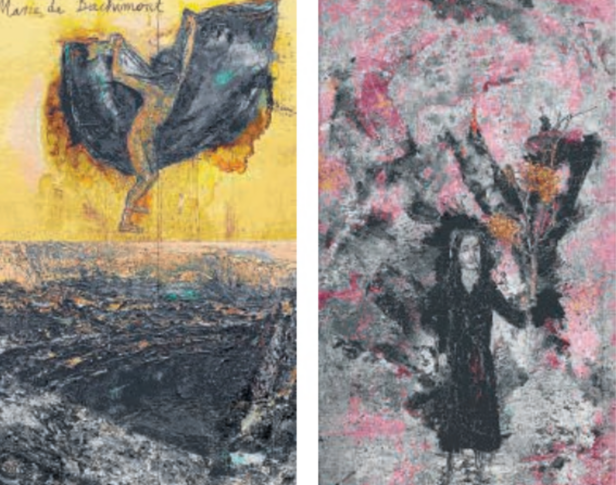
In contemporary painting Anselm Kiefer (81 years old) is the German who explains: «Artists are like shamans, who sit on a tree while they meditate, remaining suspended between heaven and earth». This atmosphere of suspension is immediately felt upon entering the Hall of Caryatids of the Royal Palace in Milan, where the exhibition “The Alchemists” is on display until 27 September. Forty-two large canvases (eight of which are in the adjacent Sala del Lucernario) tell the story of the women, sometimes persecuted, sometimes neglected or erased, who over the centuries worked on the transformation of matter, in search of the mythical philosopher’s stone capable of turning any metal into gold, or, more simply, were pioneers of what would one day become chemistry, and aimed to transform various elements into medicines (in the wake of Paracelsus) or into products that were the forerunners of modern cosmetics.
Having chosen women, rather than the more famous male alchemists, for this exhibition promoted by the Municipality-Cultura, produced by Palazzo Reale and Marsilio Arte and curated by Gabriella Belli, makes Kiefer’s works more powerful for the multiplicity of meanings that the feminine – with the concepts of fertility and motherhood – adds to transformation and rebirth. Those figures that emerge with difficulty from a painting that mixes many components, which at the same time are expelled and retained, awkward in movements shrunken (by time and perplexity), determined and undecided in coming back into the world, alien to a protagonism other than that of research, are metaphorical interpreters of a society which, although it no longer cancels women, still keeps them on a level of disparity disguised as equality.
Gabriele Guercio writes well in the beautiful catalog published by Marsilio Arte: «The portraits of the alchemists (…), breaking down and recomposing themselves, represent a journey through time, but each painting occupies its own space and preserves a unicum of an effigy even if it is reluctant to calm down». Here, this sentence brings us straight to the point: when we leave the exhibition, the idea remains somewhere within us that, returning another day, we will find those portraits different, as if there were an irrepressibly ongoing alchemy (Kiefer’s and ours, drawn as we are into the web of transformation) which is impossible to escape. A concept expressed well by Natacha Fabbri, again in the catalogue: «The installation fragments and multiplies the women of these paintings in a kaleidoscope of images that are recomposed in ever-changing ways, which generate wonder through the play of reflection created by the mirrors of the Hall of Caryatids».
I believe that this is precisely the expressive and philosophical (or philosophical?) virtue of the exhibition, accentuated by the co-presence of the Caryatids, the statues on the walls which were never restored, if not in part, after the fire caused by the bombing in 1943, also a symbol of a transformation, this time negative, that of war, an obvious but never learned lesson. If it was precisely the characteristics of the room that convinced Picasso in 1953 to exceptionally exhibit his “Guernica” there for a few days, it can be assumed that Kiefer, so profoundly different in style from the Spanish artist and absolutely similar in the tension of continuous research, experienced the invitation from Palazzo Reale as a challenge of form and content, above all of transformation (here is the word “magic”), with his predecessor. Let’s take into account, because it is fundamental to “enter” the world of the German painter (also influenced by the Jewish Kabbalah and oriental cultures), that these Alchemists fully represent the fundamental concept of his way of operating. Kiefer transforms more than paints because he doesn’t limit himself to painting itself, but also uses lead, gold, ash, sand, straw, dried flowers and petals (and more). All elements subjected to manipulation (sometimes risky because they could destroy the painting during the work) with acids and electrolysis, an electrochemical phenomenon used in industry. On this occasion, lead takes on greater significance because it is alchemy’s favorite material for obtaining gold, an operation that was never successful, except for a sort of patina that made the material apparently similar to the most noble metal. Wim Wenders’ film “Anselm”, presented at the 2023 Cannes Film Festival, focuses on these aspects.
Profound meanings investigated and confirmed by the psychoanalyst Massimo Recalcati who, in the book “The holy seed. The poetics of Amselm Kiefer”, published by Marsilio Arte on the occasion of the exhibition, goes in search of the creative mystery “which allows the wound of trauma to be transformed into poetry, the ruins into a new beginning”.
Considered (even today) heroines or witches, angels or demons, proto-scientists or charlatans, the alchemists make their way through the material consistency of the canvases and are famous and unknown names and perhaps only legendary. There is Caterina Sforza (1463 – 1509, a true homage to Milan), who left a manuscript with recipes, cosmetics and alchemical formulas. Or the other Italian Isabella Cortese, who lived in the Renaissance, or the famous Christina of Sweden (died in Rome in 1655) or Margaret Cavendish, the seventeenth-century Englishwoman who worked between philosophy, poetry and science, or Anne Marie Ziegler, the first court alchemist in Germany and then condemned to the stake in 1575.
But they are all important, extraordinary stories of 38 extraordinary women for 42 extraordinary paintings.

Find out more in the digital edition
To read everything, buy the newspaper
or download the digital version.