

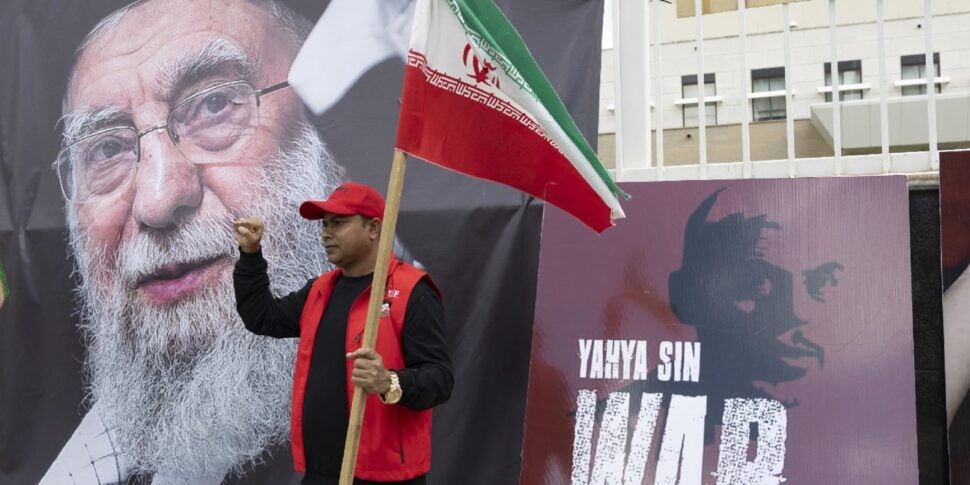
The warning sirens, the explosions, the trails of the missiles and the noise of the drones continue to mark the time of a war, the one launched by Israel and the United States against Iran, which enters its second week without any hope of a truce.
Because if on the one hand Iranian President Masoud Pezeshkian has shocked world leaders by offering “apologies to neighboring countries that have been attacked” and signaling his commitment not to target them unless there are raids against the Islamic Republic, on the other hand he has ensured that Tehran “will never surrender to the USA and Israel”, making it clear that American bases in the region remain “a legitimate target”.
Zero-sum words that do not change the reality on the ground: the raids on the Gulf continued throughout the day, also causing one death in Dubai. Attacks praised by the harshest wing of the Iranian establishment which in the meantime is accelerating the election of the new Supreme Leader.
“We have the confident hope that, with God’s help, this can happen in the next 24 hours”, announced Saturday afternoon Ayatollah Hossein Mozaffari, member of that Council of 88 Experts called to choose Ali Khamenei’s heir amid pressure from the fundamentalist clergy, the Pasdaran and the more moderate wing of the establishment.
At first glance, the apology offered by Pezeshkian seemed to signal a change in tactics, in the face of the diplomatic pressure Tehran is under to change course due to the risk of uniting the entire Arab world against Iran.
Some military analysts interpreted the president’s recorded televised address as an attempt to de-escalate as the Islamic Republic runs out of ammunition and is drawn into a longer and more far-reaching military conflict than expected.
As the hours passed, the significance of the president’s declarations was, however, dampened first by the head of the Iranian judiciary – and exponent of the hard line of the interim triumvirate council – Gholamhossein Mohseni Ejei, according to whom there is “evidence” that some countries in the region have made themselves “available to the enemy” and consequently, “heavy attacks against these targets will continue”. Subsequently, even the powerful speaker of the Iranian parliament Mohammad Bagher Ghalibaf made it clear that the States hosting American bases in the region “will not enjoy peace.”
Positions that clearly show the short circuit underway within the Iranian leadership in the game for the future of the war and of the Islamic Republic itself. Faced with this picture, no one was surprised that Iranian attacks continued throughout the region.
The Emirates have intercepted dozens of missiles and drones: in Dubai, a person of Asian origin died after his car was hit by debris from an intercepted missile, while in the morning the emirate’s airport had suspended operations for a few hours. In Bahrain, an Iranian attack caused a fire in the capital Manama, damaging a house and other buildings, while the Pasdaran claimed to have struck the US base of Juffeir “in retaliation for the attack by American terrorists on the Qeshm desalination plant”.
Explosions were heard in Doha, and Saudi Arabia said a missile aimed at one of its air bases fell in an uninhabited area. And regarding the tensions on Hormuz, although the spokesman for the Iranian armed forces Abolfazl Shekarchi assured that the strait “will not be closed”, Tehran “cannot guarantee their safety” and the ships of “the United States and Israel will be targeted by the Iranian armed forces”, fueling the crisis in the essential passage for global commercial and energy traffic. Things were no better on the front with Israel, where the Islamic Republic launched a series of attacks that set off alarms in Tel Aviv and central Israel throughout the night, while the IDF announced that it had destroyed 16 planes in raids on Mehrabad airport between attacks on Tehran and Isfahan. And regarding the military clash in Lebanon, a blitz by Israeli forces to recover the remains of a pilot in the village of Nabi Sheet, in the east, caused at least 41 deaths, according to the Beirut government.