

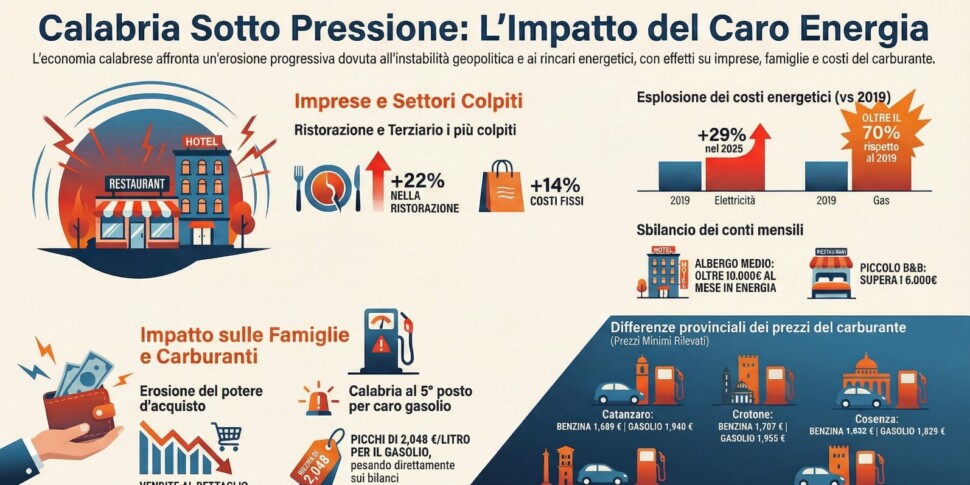
Calabria with bated breath. The war in the Middle East has made projections on the effects of increases in energy prices even more uncertain. The crisis is a sting stuck in the accounts of companies and in the daily actions of families. The resulting scenario does not have the features of an emergency, but the more insidious ones of slow but progressive erosion. Over the last year, according to Confcommercio Calabria, the fixed costs of trade, tourism and service businesses have grown on average by 14%, with peaks reaching 22% in the most energy-intensive sectors, such as catering.
The energy node
The main issue remains that of energy, of course. Fluctuations in international markets translate into further ballast of additional costs for businesses. In 2025 the electricity bill for the tertiary sector is on average 29% higher than in 2019, while gas records an increase of more than 70%. Numbers that are no longer cyclical, but become structural and inevitably redefine the geography of costs. «International tensions and geopolitical instability are also producing direct effects on the economy of our region», observes Klaus Algieri, regional leader of Confcommercio. «In Calabria these impacts are even more evident due to the critical infrastructural and logistical issues that continue to penalize the production system».
The weight of logistics
Logistics, in fact, is the other open front. The transport of goods records an average increase of 11% on regional price lists: a figure which ends up modulating the final price, impacting the competitiveness of companies. The expensive energy is also reflected in the concrete size of the activities: over 10 thousand euros per month for a medium-sized hotel, around 6,800 for a large sales point, more than 6 thousand for a small accommodation facility. These are not light figures but thresholds beyond which it becomes difficult to plan, invest, even maintain the ordinary.
Consumption decreasing
Meanwhile, demand is slowing down. Inflationary pressure compresses purchasing power and translates into a real contraction in consumption: retail trade is at -2.1% on an annual basis. It is a setback that does not manifest itself with sudden falls, but with a progressive rarefaction of purchases, with more cautious choices, with a shrinking daily life. «Many companies are trying to absorb a significant part of the increases by compressing their margins so as not to completely pass on the price increases to consumers – continues President Algieri – but in some cases the reduction in margins reaches up to 30%, a situation that cannot be sustained for much longer».
Requests to the government
And it is along this dangerous margin that the request for structural interventions lies. «For this reason – concludes leader Algieri – we ask for structural interventions and no longer temporary measures. It is necessary to reduce the tax burden in a stable way and intervene on the cost of energy, starting from the charges that weigh on companies’ bills, to guarantee more sustainable conditions for the tertiary economic system”.
Effects on families and fuels
But the crisis does not remain confined to the company perimeters. It slips into habits, is reflected in household budgets, measured at fuel stations. And it is in petrol stations that we experience hours marked by the act of pain of families who pay the price increases at the pump twice: with a full tank and on the table. The National Consumers Union, re-elaborating the Mimit data, records an increase in diesel fuel fills of 70 cents in 24 hours, with a peak of 2.048 euros per liter which places Calabria in fifth place in Italy. Petrol follows with an increase of 20 cents in one day, and reaches 1,764 euros per self.
The price map
And while the signs of out of fuel (especially petrol) appear in some service stations (these are the effects of the traffic blockade in the Strait of Hormuz), from the price map you can obtain an atlas of possible convenience. On the A2, in Tarsia Ovest, there is the cheapest fuel: diesel costs 2,107 and petrol costs 1,767. On the ordinary Cosentino network, diesel drops to 1.829 at Gasoline International dei Laghi di Sibari, while the cheapest petrol is found at Eni in Via Nazionale in Corigliano Rossano at the same price. In the Catanzaro area, the minimum for diesel is in Simeri Crichi (1,940), while petrol stands at 1,689 at the GT fuels of Sersale. In the Crotone area, the Eni stations of Crotone, Cirò Marina and Isola Capo Rizzuto show 1,955 for diesel and 1,707 for petrol. In the Vibonese area, Dasà offers diesel at 1.959, while in Ricadi, at Conad, petrol drops to 1.669. Finally, in Reggino, the Panoramic Stop confirms the lowest prices: 1,659 for petrol and 1,669 for diesel.