

He painted luxury and elegance, but also – or rather, above all – the restlessness and uncertainty of a time full of wars, conspiracies and economic collapses. Faces that exude a sense of power and at the same time also seem to tell of experiences that are not only those that appear in the opulence of the portraits. Or they also tell of a pride of soul even before the gestures and poses in front of the painter, sometimes even a sense of family perhaps authentic, probably desired, certainly necessary in front of their contemporaries and posterity who would have admired them. The great value of Anton Van Dyck’s paintings (Antwerp, 1599 – London, 1641) is that his characters “speak” and tell their story even beyond their elegant appearance.
A pupil of Rubens and, ideally, of Titian, the Flemish artist portrays what, with a somewhat abused concept today, can be called the psychology of people, he captures something that goes beyond the rich (period) fashionable clothes and relaunches it to this day. In short, through the looks and gestures that often send us the movement that is not there in the only apparent fixity of painting, he gives us a glimpse of the soul.
In a certain sense he could be considered the heir of Antonello da Messina, the first to paint characters who seem to point those who look at them straight in the eyes.
If the great Sicilian (in the fifteenth century among the very first to have contact with Flemish painting) only painted half-length portraits, in the seventeenth century Van Dyck indulged his clientele’s desire for greatness with full-figure portraits (which were paid more) and used with unique wisdom all the technical improvements that painting had undergone in almost two centuries of time difference.
The exhibition «Van Dyck the European. The journey of a genius from Antwerp to Genoa and London”, set up in the Palazzo Ducale (Doge’s Apartment and Chapel) in Genoa and which brings together 60 works (many in large format) by the painter (these numbers are now obsolete at this level) until next July 19th, presents itself as an exceptional event. Curated by Anna Orlando and Katlijne Van der Stighelen and produced by the Palazzo Ducale Foundation for Culture and the Municipality of Genoa, with the support of the Liguria Region, the exhibition retraces the entire span of a prestigious career, very rich in works despite the limited scope of a short existence: the artist died at just 42 years old.
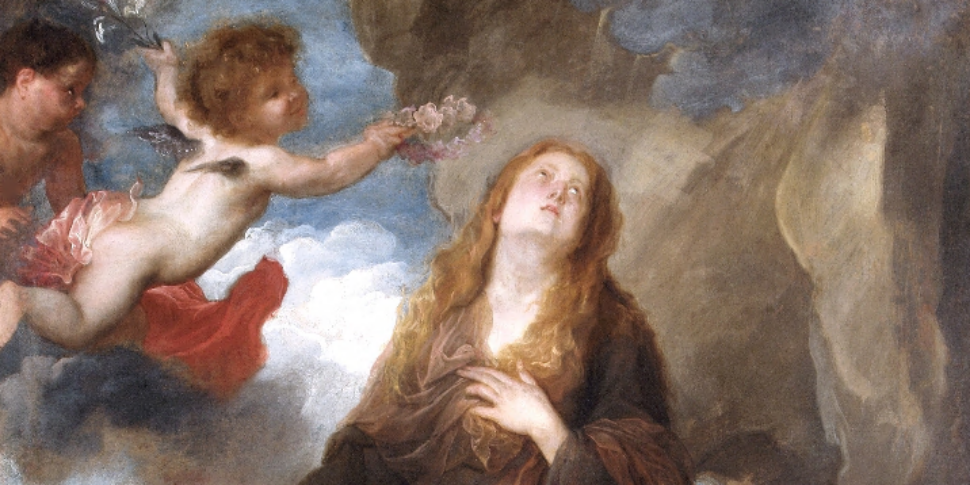
The title “European painter” refers to the artist’s continuous travels, even though he focuses mainly on the triad of Antwerp, Genoa and London. In reality, Anna Orlando in the very interesting catalog published by Allemandi proposes a new chronology of Van Dyck’s various trips to Italy, where Sicily finds ample space with the long stay in Palermo, where he had been called by the viceroy Carlo Emanuele of Savoy, dating from May 1624 to August 1625, which proved to be longer than expected due to a plague epidemic which blocked any possibility of leaving again. In that period, the relics of Santa Rosalia were found on Mount Pellegrino, whose “official” image became the one painted by Van Dyck in various versions. In Sicily, moreover, the artist, while not giving up portraits (including one of his compatriot Hector Vanachtoven, a merchant resident in Messina, which was lost) immersed himself in what Orlando defines as a “forge of the sacred” to express “pathos, emotion, feelings and anxieties”.
Of the five known versions of the patron saint of Palermo, «Santa Rosalia intercedes for the plague victims», painted in Sicily and preserved in London, is exhibited in Genoa. In the overall design of an exhibition out of the ordinary, the work fits into a particular focus on Van Dyck’s religious works, such as «Mystical Marriage of Saint Catherine», «San Sebastian» and an unpublished «Ecce Homo», coming from a private European collection.
The greatest expectation, however, remains for the portraits which do not appear to the visitor in chronological succession, but rather collected by theme (the homeland, the family, etc.), so that, room by room, one can compare the differences in style, the adherence to the geographical location, the ability to capture family attitudes, even with children as protagonists. From the first self-portrait painted at just 15 years old to very famous works such as «Portrait of Charles V on horseback», «Portrait of Alexander, Vincenzo and Francesco Maria Giustiniani Longo» (children, in fact), «Samson and Dalila», «Portrait of Charles I and Queen Henrietta Maria» the succession is whirlwind and bewitching. The curiosity remains as to how, once a painter’s workshop was a complete success, it was capable of producing – so it was calculated – 400 portraits in seven years, with an average of one painting per week. The “assembly line” is revealed in the catalog by Karen Hearn and refers to the London period. The client’s posing lasted an hour, then a servant cleaned the brushes and prepared a new palette while Van Dyck (“come on another one!”) welcomed the next client. The real study of the figure and clothing was given to the assistants who enlarged it and transferred it to canvas. Then he “went over the brush with a light and quick touch over what they had done.” That light and quick touch – brilliant – passed from one masterpiece to another. After all, the seventh of twelve children, motherless at twelve, with his merchant father in financial bankruptcy, Van Dyck was forced to learn the value of money early.