

We who live on the Strait – or who were born there and never stop returning – know it as we know things with the body, before with the mind or words. We know it even if we have never said it to ourselves, perhaps we wouldn’t even be able to find the words to say it: the Strait is an uninterrupted lesson in gaze, dialogue, responsibility. Of music and conscience, as the poet (Pablo Neruda, another irreducible southerner of the world) said of his sea.
We who live on the banks, and participate every day in their changing colour, shape and distance, in the uninterrupted succession of epiphanies and enchantments – so much so that some of us no longer even see them, and here blindness is the worst betrayal -, we who continually cross them, caught in an eternal return that is never departure, know instinctively that we are border people, threshold people. And the confusion that overcomes us when faced with the open sea also tells us this (or, vice versa, the sense of contentment and shelter that places with double banks and closed mirrors evoke in us, be they even rivers or mountain lakes).
This intimate and collective secret, this physical and sentimental knowledge, has been told to us in many ways by narrators and poets who have lived on the Strait or been enchanted by it. But now there is a precious little volume that collects the threads – another Strictese theme: the weavings – of all this ancient and ever new feeling: the latest book by Father Antonio Spadaro, Jesuit, theologian, journalist, philosopher. Strictly. Who signs «Sicily is a feeling. Journey on the edge of the Strait” (Italian Touring Club); a philosophical manual, a treatise on wonders, an (un)reasoned map of mirages. A journey that does not claim to explain the place, its genius and its genes, but only, with the passionate sweetness of a refined yet clear speech, to indicate its nature as a device of prodigy and thought.
A place of doubles, the Strait immediately gives us a “symbolic grammar” organized by pairs, starting from what we eat on its banks (and orality is the first form of knowledge and assumption of meaning): the pignolata (“philosophy of the fragment, of shared time, of the absence of hierarchy”) and the focaccia (“the broken bread of the Strait”); the black and white (“Narrow in the form of a dessert”, in its capacity as a summary of opposites) and the “python” (“food that asks for a relationship”, folded but not closed). «Eating them is already thinking», incorporating their lesson into a «gesture of daily philosophy». Because the landscape in which we live is not an inert set, it is what we literally incorporate, what we feed on, with which we nourish the deep layer of thought, we build identity (whatever it is, but certainly not the fortress closed to the world with barbed wire that so much politics today claims to tell us about).
Identity, like knowledge, is first and foremost relationships and bonds: to exist is to co-exist. Like the banks, like the sight of the other-than-us but-like-us who lives on the other side, under our eyes, and we under his. And here are other pairs of opposites that Father Spadaro aligns, describing that uninterrupted “pedagogy of limits” which is tension towards the other and dialectics. As between the fluidity of the sand and the stability of the rock, Torre Faro and Scilla. And isn’t that what philosophical thought does, the perpetual coming and going between immersion in the sensitive and critical detachment, between transience and permanence? With your feet in the sand, or lost in the tangled waters of Ganzirri, your gaze at the fortress of Scilla, this is what anyone from Strict knows, even if they know nothing about philosophy. His body, including his soul, knows the consistency of doubles, their dense and continuously renewed dialogue, at every dawn and sunset.
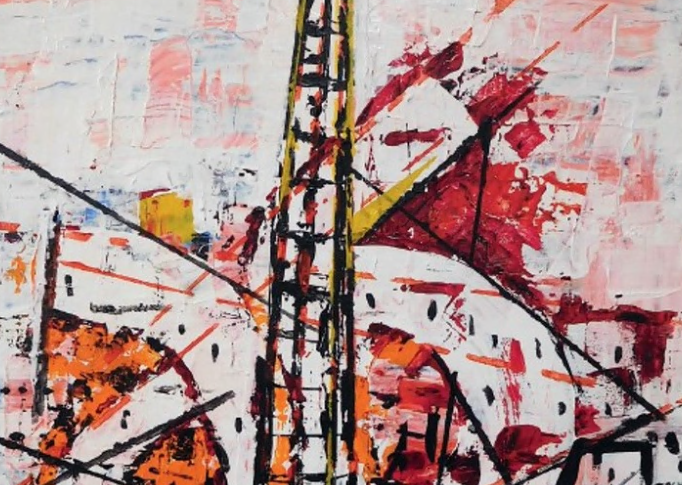
And the whole philosophy of the border is summarized here. A border that is – another tasty dialectical pair – “edge” and also “tear” (that fracture that still vibrates in the name of “Rhegion”), an infinitely dynamic threshold that requires us to “consciously inhabit this dialectic”. What an ethical lesson from Maestro Stretto! A lesson that is immediately visually given to us by its two silent sentinels, the pylons – the epicenter of the book in Nino Sechi’s painting – which «are there like wounds and frontiers, like technical utopias and poetic traces». In the technological, and economic, realm of the useful, their wonderful practical uselessness (but their pure narrative quality) introduces a further layer of meaning: «involuntary» works of art teach us «that the link between the shores is a question of responsibility. That it’s not about passing through, but about being present.”
Here it is, the ethical point, the 38th moral parallel. The key concept for Father Spadaro: the Strictese logic of “reciprocity without complementarity”. Let’s not match, but let’s kiss. Let’s observe our differences to recognize ourselves. Let’s not eliminate distances to assimilate, but let’s ask each other questions, listening to each other’s otherness. Here is the Strait as a “place of desire”. Kaleidoscope of fragments of a love discourse (and perhaps he could tell it, these days, to his colleague from Hormuz…).
And there is much more: the manifestation of the Strait, its phenomenology of appearance which is different depending on whether you come down from the Continent by train (the appearance of the sea as for Xenophon’s soldiers: «Thálatta! Thálatta!») or you move from Catania. And the winds – in a powerful and poetic chapter (the wind, after all, is «anemos») – which are its aerial syntax and generate that other surprising effect (or presence): the voice of the Strait. The changing system of currents, lights, stars, darkness. Its double phenomena: the Fata Morgana who doubles and the Lupa who cancels. As many harmonies of conflicts, disharmonies of agreements that make it an always transformative, densely generative threshold. School «of instability, contradiction, plurality. An apprenticeship to uncertainty.”
A reference cannot be missed to another phenomenon of the complex meteoropsychology of Strict: the black shadow of the Bridge that is not there. A shadow that is projected, dense, and worries many of us, those who are not enchanted by the positivist fairy tale of the great thaumaturgical work, and instead, as Father Spadaro underlines, have their eyes wide open on the devastation taking place in fragile and unguarded territories (thus managed by the same ones who now would like to heal, make everyone forget, with the help of the Bridge).
As many times, even in other precious writings, the author said, in the debate on the Bridge too often “culture is missing”: no sense of the symbolic and cultural significance of the space of the Strait, and the reduction of the Bridge theme to a problem of calculations and money. «But the Strait is not a void to be filled», says Father Spadaro, pointing instead to the overabundance of symbols and meanings that swim and are reflected and turn on its waters and within us. A debate should start from here, from what we are, from the relationships we want.
Finally, there is a “musical” appendix which concerns the sounds of the Strait, which are not its system of sounds and silences (we all recognize the long roar of the ships, the frenetic splashing of the carnations, the buzz of the night which exchanges proportions and distances), but fifteen songs, from Bach to Rosa Balistreri, from U2 to Colapesce-Dimartino, well annotated by Father Spadaro (also a fine connoisseur of music). There is a QRcode to listen to them: they are just as many metaphysical crossings from shore to shore and can be a listening track for a place that remains, fortunately for us, (and for now without concrete monsters) inconsumable.