

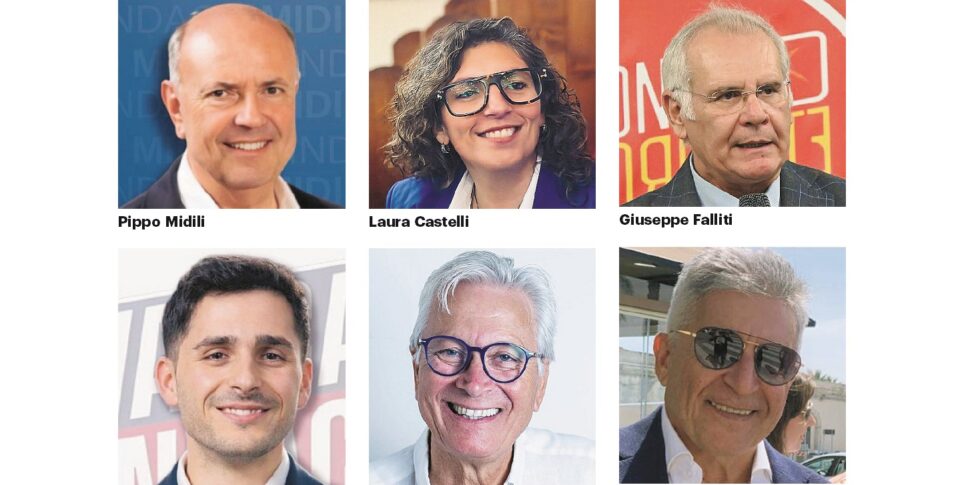
No surprises. The official presentation of the candidatures confirmed the previous rumors both regarding the number of aspiring mayors and the support lists.
There will be six candidates for the most important seat in Palazzo dell’Aquila: Giuseppe Midili, Laura Castelli, Lorenzo Italiano, Michele Vacca, Giuseppe Falliti and Carmelo Torre. Overall, however, 17 lists were presented.
Of these, seven (Fratelli d’Italia, Forza Italia and the “civics”, Cambiamente, Fare Milazzo, Prima Milazzo, Città Futura and Milazzo 2026), support the outgoing mayor Giuseppe Midili, four (Castelli mayor of Milazzo, De Luca mayor of Sicily, An extra march for Milazzo and The turning point for Milazzo) support the candidacy of Laura Castelli, three (Lorenzo Italiano mayor, Insieme per Milazzo and Milazzo al Centro) those of Lorenzo Italiano, while one list each supports Vacca (Progressives), Failed (Countercurrent) and Torre (Carta Canta). The electoral body has approximately 27,500 eligible voters. According to current legislation, to be elected in the first round it will be necessary to reach at least 40 percent of the valid votes.
From the analysis of the lists, a strong presence of outgoing administrators emerges: 19 city councilors out of 24 have decided to run again. Only Pippo Doddo, Antonio Foti, Santina Sgrò, Maria Sottile and Alessia Pellegrino remain out. Alongside the experienced administrators, there is also a significant participation of young candidates, as well as a significant female presence in all the lists, also in view of the new provisions which provide for a composition of the boards with 50 percent women.
The ritual of handing over the lists and nominations took place without any particular tension, except for the usual fibrillation linked to verifying the documentation. No controversy, however, on the signature front, unlike what happened in Messina with the South Calls North case, a sign of an overall more relaxed climate in the city, at least in this initial phase.
Now the word passes to the electoral campaign, which in the coming weeks will come to life with programmes, public meetings and direct discussion with the voters, called to choose the administrative future of the city.