

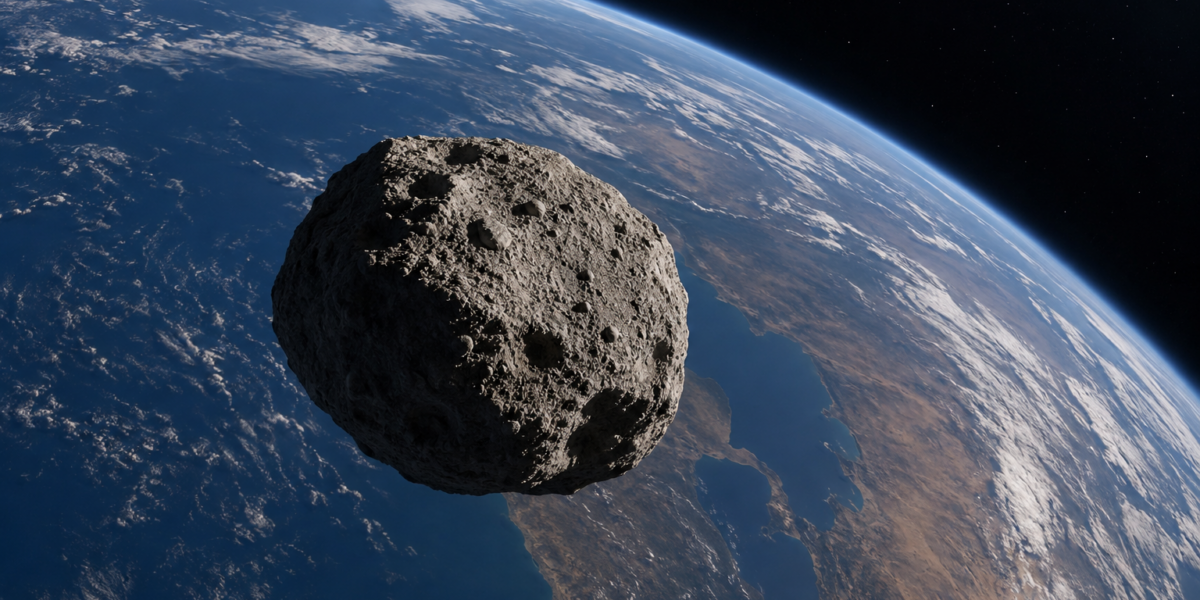
Two asteroids of a size comparable to that of the Chelyabinsk Meteor meteorite will pass close to the Earth today, in a phenomenon defined as “rather rare” by the Laboratory of Solar Astronomy of the Russian Academy of Sciences. In a message published on Telegram, the research center spoke ironically of two “Chelyabinsk Meteors”, referring to the asteroids 2026 JH2 and 2026 KB, discovered only a few days ago, on 10 and 13 May respectively.
According to scientists, both measure about 20 meters in diameter and are therefore almost twins of the celestial body that exploded over the Russian region of Chelyabinsk on February 15, 2013, causing thousands of injuries and widespread damage. That meteorite is considered the largest object to hit Earth in the 21st century.
The passage of the two asteroids: 2026 KB and 2026 JH2
The slightly smaller asteroid 2026 KB will reach its minimum distance from our planet today at 5.15 pm, passing at around 230 thousand kilometres. The second, 2026 JH2, a little larger, will pass even closer at 11 pm, at a distance of about 91 thousand kilometers. According to the Russian laboratory, this is the closest flyby observed this year for an object of this size.
No risk for the Earth: «Except for divine intervention»
However, experts have ruled out any risk to the Earth. “Both bodies do not represent any danger,” the laboratory assured, underlining that, a few hours after their passage, no natural force – “except divine intervention” – could modify their trajectory and direct them towards the planet.
How to observe 2026 JH2 from Earth
Thanks to its shorter distance, 2026 JH2 could be observed from Earth with semi-professional instruments, such as telescopes with at least 12 times magnification, although the celestial body’s high speed will make it difficult to follow it. “We bid farewell to these rocks today and eagerly await our next visitors,” the Russian researchers jokingly concluded.