

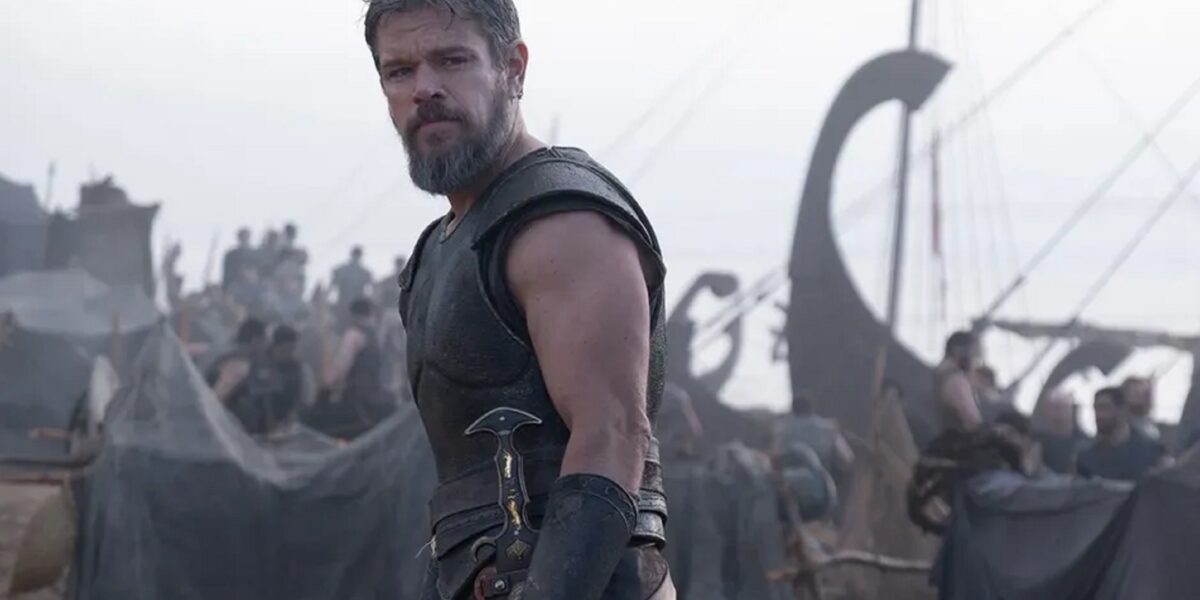
Director Christopher Nolan’s Odyssey arrives at the cinema and inspires this summer’s holidays: ancient Troia, Favignana, Lipari, the Peloponnese, Corfu, Scotland and Iceland, even Circeo and Ostia are among the locations chosen by Nolan for his blockbuster on the places told by Homer. Between myth and reality we travel in the footsteps of Ulysses and in the numerous places used by the crew to make the film, starting from Turkey and ending in the studios of Universal City, California, where the last scenes of the film were completed.
The departure from Troy and the settings in Morocco
The legendary journey that Ulysses, played by Matt Damon, undertakes to return to Ithaca after the end of the war, starts from Troy, today in western Anatolia: the Turkish city retains the same charm as a border land between Europe and Asia and offers a dive into history and nature between the archaeological sites of Hisarlik and the surreal landscape of Pamukkale, famous for its white terraces shaped over the centuries by the thermal waters. In fiction, the director chose Morocco for the first scenes of the film: the fortified village of Aït Ben Haddou reproduces Troy during the last moments of the war. Its ancient ksar, a complex of mud brick buildings surrounded by defensive walls, a World Heritage Site, was chosen to represent the city besieged and burned by the Greeks before the start of Ulysses’ journey. Also in Morocco, the crew also filmed scenes in Marrakech, Tahannaout and Essaouira, before going near Dakhla, on the coast of Western Sahara, where there is an expanse of light sand that represents Ogygia, the island where the nymph Calypso holds Ulysses for seven years before he can resume his journey to Ithaca.
The Sicilian stages and the Egadi islands
From Morocco we move to Sicily, where Homer places some of the most compelling episodes of the Odyssey: the clash with Polyphemus, evoked by the majestic stacks of the Cyclopes of Acitrezza; the dangerous passage between Scylla and Charybdis, among the impetuous currents of today’s Strait of Messina filmed in the Aeolian archipelago, where Aeolus entrusts Ulysses with the winds necessary to return home. Here the island of Lipari was chosen as the setting for one of the most famous episodes of the poem, that is, Ulysses’ meeting with the sirens, one of the trials that the protagonist must face together with his companions after the fight with Polyphemus and the clash with the sorceress Circe. The film was shot behind the port of Pignataro, on board vintage sailing ships. Also in the Sicilian archipelago, scenes were filmed on the island of Vulcano, between the rocks of Pietra Lunga and Pietra Menalda, between Pietra del Bagno and the islet of Basiluzzo, north-east of Panarea. Other scenes were made in the Egadi archipelago, in particular on the island of Favignana, chosen for its uncontaminated and wild landscapes: Cala Rotonda was used as a sea access point to Ithaca; the islet of Preveto was the ideal place to recreate a mythological village; the castle of Santa Caterina offered a panoramic point of the island with a view of the entire archipelago and the coast of Trapani. Here where all the scenes of Ithaca are filmed, where Penelope waits for Ulysses.
The trip to central Italy and Greece
The shooting of the film also involved the Lazio coast, the port of Ostia and Circeo, where the meeting with Circe marks one of the longest pauses in Ulysses’ journey and where the beauty of the sea inspires stories and legends. Most of the scenes were obviously filmed in Greece, in the southern peninsula of the Peloponnese, in particular in the region of Messenia where Nestor’s cave is set, a natural cavity near the beach of Voidokilia, the place where the king of Pylos kept his herds. Other locations: Almyrolaka beach in Crete, the medieval castle of Methoni in Kalamata and Acrocorinth, the imposing acropolis of the ancient city of Corinth. Scheria, homeland of the Phaeacians governed by King Alcinous, is present-day Corfu, the place where Ulysses is welcomed before the last leg of the journey. Even today the island embodies the spirit of Mediterranean hospitality, among villages overlooking the sea, quiet bays and slow rhythms. Another stop for Ulysses along his wanderings is present-day Thrace, where the hero fights against the Ciconi population; today it is one of the least explored areas of Greece, where you can discover the most authentic country between the Evros Delta National Park and Kavala, the Greek ‘blue city’, overlooking the Aegean, among alleys, climbs and Ottoman references. Finally there is Ithaca, the island symbol of the return, to visit with its picturesque port of Vathy, the hidden bays such as Gidaki beach, and the small villages perched on the hills that offer splendid views of the Ionian Sea. According to some scholars, the real Ithaca is actually the Paliki peninsula, the lesser-known corner on the island of Kefalonia among vineyards, fields, beaches, cliffs and limestone rocks.
Nordic scenarios: Scotland and Iceland
To shoot the film, director Nolan also chose non-Mediterranean locations such as Culbin Forest, a wooded area located on the coast of the Moray Firth, a fjord in the north-eastern part of Scotland, where some scenes of the battle between Ulysses’ fleet and the Laestrygonians, the people of anthropophagous giants in the service of King Antiphates, were filmed. Other Scottish locations included the coastal town of Burghead, the ruins of Findlater Castle and the harbor at Buckie, where Odysseus’s vessel, the 35 meter long Viking ship Draken Harald Hårfagre, was moored. Finally, some surprising landscapes belong to Iceland, a land to which the English director is very attached, having set two of his other films there, ‘Interstellar’ and ‘Batman Begins’. The filming took place near the port of Landeyjahöfn, in the southern part of the island.