

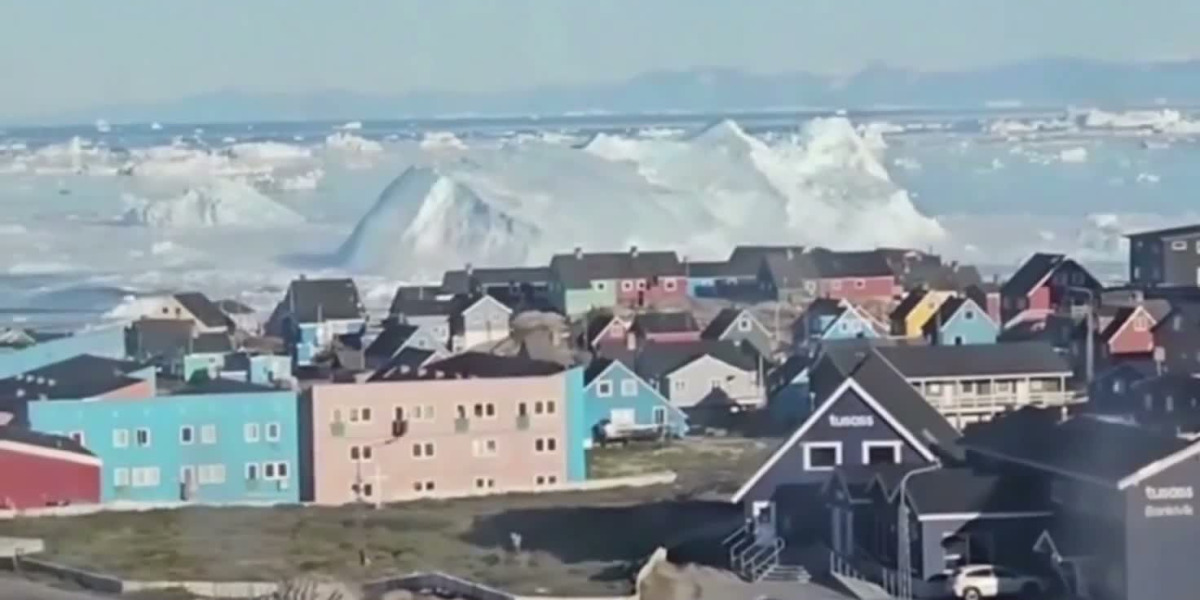
A large iceberg capsized in the waters off Ilulissat, on the west coast of Greenland, raising a series of waves that rapidly spread across the surrounding sea. The phenomenon dates back to Saturday 25 July and did not cause injuries or damage to boats or coastal structures.
The sequence captured on video
The images, taken by some present and relaunched on social networks within a few hours, show the entire sequence. The block of ice initially appears almost immobile, then begins to slowly tilt until it completely loses balance. During the rotation, the portion previously submerged emerges from the water, while the movement of the mass raises splashes and waves of notable intensity.
Why an iceberg capsizes
Tipping is a natural and recurring phenomenon in this area. About 90 percent of the volume of an iceberg is below the surface: the submerged part melts more rapidly than the part exposed to the air and the progressive shift of the center of gravity can lead the block to lose its buoyancy and tip over. It is an event that can occur without easily recognizable signals and which, in addition to sudden waves, involves the risk of ice fragments detaching: for this reason, approaching an unstable iceberg with boats is considered dangerous.
Ilulissat and the Ice Fjord
Ilulissat is located north of the Arctic Circle, overlooking Disko Bay, and its name in Greenlandic literally means “iceberg”. A short distance from the town is the Ilulissat Icefjord, included in the UNESCO World Heritage list since 2004. Ice masses from the Sermeq Kujalleq glacier, also known as Jakobshavn, pass through the fjord, one of the most active and most studied glacial systems in the northern hemisphere.