

Add the Gazzetta del Sud as a source
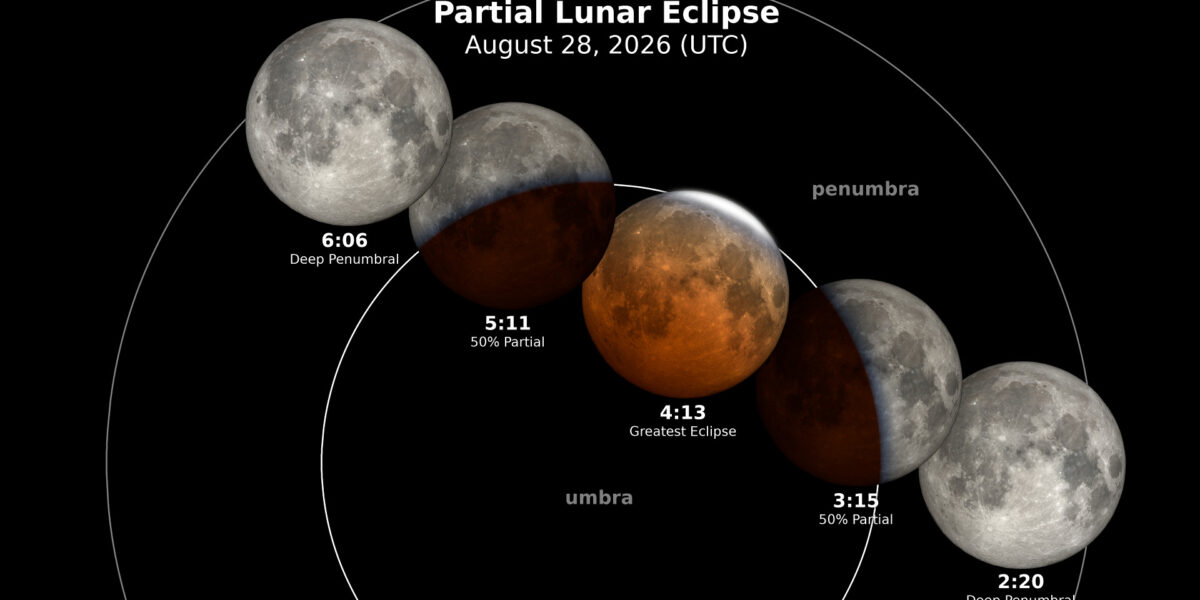
After the total solar eclipse, the August sky also gives us the red Moon, with a partial eclipse visible from Italy at dawn on August 28th. The start of the eclipse is expected around 4.40 am and the maximum will be reached around 6.10 am when up to over 90% of the lunar disk will be immersed in the shadow of the Earth which will give the Moon a characteristic brick red color.
The partial lunar eclipse of August 28th
After the extraordinary spectacle of the solar eclipse of August 12 – said Alessandra Masi, one of the most famous Italian astrophotographers – the “eclipse season” of this exceptional August 2026 is not over yet”. Closing the circle will be a second unmissable event: the partial lunar eclipse on August 28th.
The two eclipses in fact belong to the same eclipse season: “in these windows, which occur when the Sun is close to the nodes of the lunar orbit, two eclipses separated by about two weeks can occur”, added Masi.
Why the Moon turns red
Unlike the one on August 12th, this new eclipse is lunar, meaning the Moon (and not the Sun) will be covered. There is also another important difference: «during a total lunar eclipse, our satellite never disappears completely into the darkness, but takes on a color that can vary from golden copper to the darkest brick red. This fascinating phenomenon, popularly known as the “Blood Moon”, is the result of precise physical laws linked to light and the Earth’s atmosphere.”
The show will be better in the South
A show that this time will especially reward those in the South of Italy because seen from the north, as in Milan, the Moon will set before the eclipse reaches its maximum, while those in the South will be able to enjoy the eclipse until almost the final phases.
«At that time the Moon will be very low on the western horizon – continued Masi – offering in some locations the possibility of photographing it together with mountains, buildings or other elements of the landscape».
But when the Moon, still partially eclipsed, is close to sunset, the sky will already be clear. “This condition – concluded the astrophotographer – could on the one hand make photographic shooting more difficult, due to the lower contrast between the Moon and the sky, but on the other hand it could give very particular and evocative images”.