

Add the Gazzetta del Sud as a source
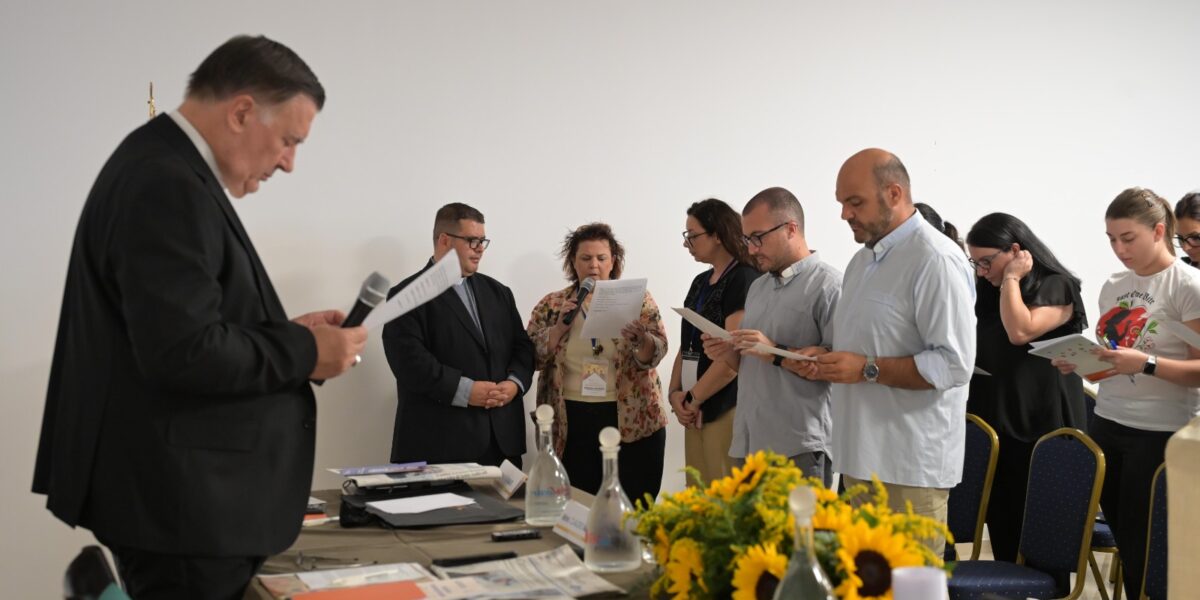
Over three hundred delegates from across the Archdiocese of Catanzaro-Squillace are gathered today, 12 September, at the Mirabeau Park Hotel in Gasperina for the diocesan assembly convened by Archbishop Mons. Claudio Maniago, which accelerates the path of renewal of catechesis and Christian initiation.
A significant participation, an expression of the different ecclesial realities of the territory, for a day that marks an important step in the pastoral path of the diocese. After the listening phase and the discussion experienced in the forane, we now enter the time of discernment: it is not simply a matter of updating programs and subsidies, but of questioning ourselves on the very way of accompanying the new generations to the faith.
The style of the journey is indicated by the evangelical icon of the disciples of Emmaus, placed by Maniago in the background of the Assembly: walking alongside, listening to the questions, rereading life in the light of the Word, recognizing Christ in the breaking of the bread and returning to the community. An image that becomes a pastoral method for a Church called to meet people in the concreteness of their lives.
In fact, the issue goes far beyond the preparation of children and young people for their First Communion or Confirmation. The question posed to the Assembly is more radical: how do we become Christians today, in a society in which the transmission of faith can no longer be taken for granted?
The report by Don Francesco Vanotti, priest of the diocese of Como, director of the Office for Catechesis and member of the team of the National School for trainers in evangelization and catechesis, focused on this scenario. Vanotti indicated some passages that outline a true conversion of catechesis: “from the sacraments to the Christian life”, “from the presupposed transmission to the first announcement”, “from the class to the community”, “from the lesson to the experience”.
The prospect is to no longer concentrate the entire journey on the celebration of the sacrament alone, but to accompany children, young people and families towards a Christian experience capable of involving life. In a profoundly changed cultural context, the announcement must also reach people for whom faith does not necessarily represent an acquired fact.
Within this change, the rethinking of the figure of the catechist also emerges forcefully. Not just the person who transmits content or leads a weekly meeting, but an adult in the faith capable of listening, creating relationships, accompanying and progressively introducing them to the life of the Christian community. The catechist thus increasingly takes on the face of witness and companion. A transformation that also requires renewed training and the ability to read people’s questions, building paths in which faith can be encountered and experienced.
Consequently, the languages also change: knowledge of the contents is accompanied by the Word of God, the liturgy, prayer, brotherhood, charity, service, silence and testimony. The transition “from the classroom to the community” indicates precisely the overcoming of an almost scholastic conception of catechism: children and young people cannot just meet their catechist for an hour a week, but must be able to enter into a relationship with a living community and with adults capable of concretely bearing witness to what they announce.
For this reason, the conversion of catechesis does not only concern catechists. It is the entire Christian community that is questioned about its ability to welcome, accompany and generate faith.
During the morning Don Ivan Rauti recalled the meaning of the synodal path, while Don Ferdinando Fodaro placed the emphasis on the Christian community as a generative place. Vanotti’s report therefore offered the coordinates for the discussion in the synodal tables, called to collect experiences, questions and proposals.
The Gasperina Assembly therefore does not deliver an already defined model, but opens a diocesan construction site. The direction given by Archbishop Maniago is clear: to make the renewal of Christian initiation a pastoral priority, moving from the question of “how to do catechism” to the much more demanding question of how a Christian community can generate faith today.