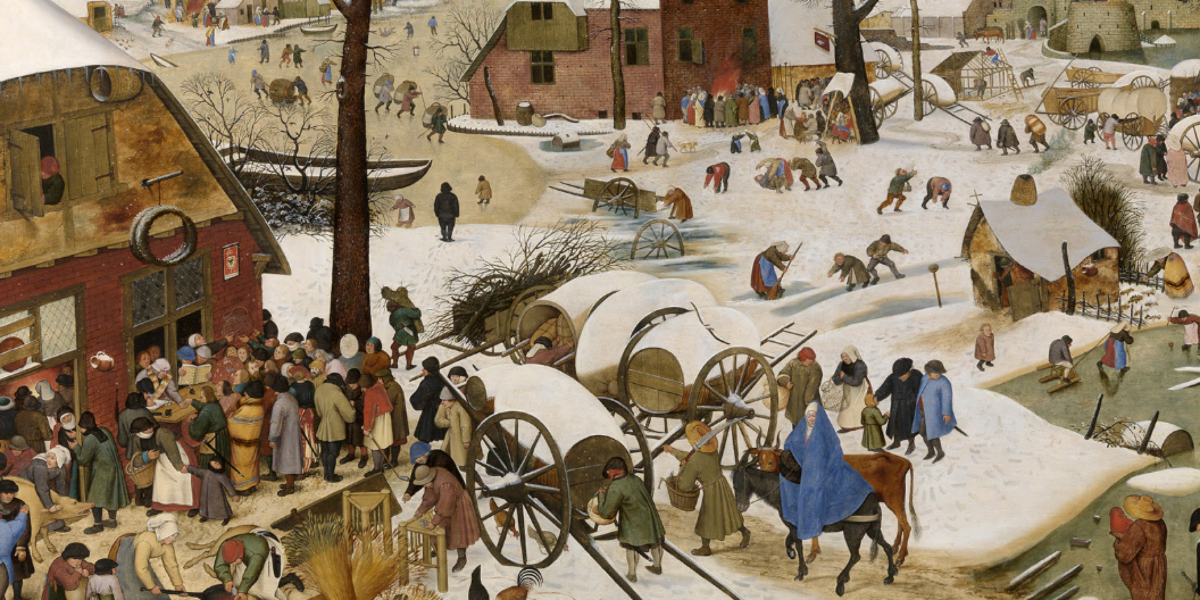
There are many ways of looking at a great exhibition, such as «The Brueghels. The origins of pictorial genres in Europe”, ongoing in the Royal Palace of Milan, until January 31st, promoted by the Municipality of Milan – Culture and produced by Palazzo Reale and 24 Ore Cultura. I would like to do so by underlining two aspects: that of the “brand” of a family-business and the other of a “minor” work on display, which instead – in my opinion – contains a good part of the meaning of this exhibition. The “brand” (since it is international painting, the foreign word is acceptable instead of our “brand”) is much evoked by Bernard Aikema, who created the exhibition (an ideal continuation of those on Dürer and Bosch), and by Carlotta Striolo who curated it. Rightly so, because the evolution of style in Flemish painting brought about by the founder Peter Brueghel the Elder (circa 1525/1530 – 1569, the only one who had removed the h from his surname thinking of improving his desired internationality) marks a fundamental turning point in subject matter, and was the starting point for an artistic-commercial operation carried out by his son Peter Brueghel the Younger (1564 – 1638).
Less gifted than his father, whom he had only just met because he died prematurely, he had the ability to “export” his change of style over time, amplifying and multiplying his work: as Aikema lists in the interesting catalogue, they are “scenes of peasants, episodes of everyday life, vast landscapes”, in addition to the fantastic visions which in part make them a natural sequel to those of Hieronymus Bosch. The renewal of society with the expansion of the bourgeoisie, in fact, had brought to artists a new type of clientele who did not have to adorn palaces and princely palaces with painting but simpler homes of people linked to a popular way of life, even in rural areas.
Portraits disappear and landscapes are discovered instead, while paintings become smaller in scale: the protagonists are often a small mass in antithesis to the sometimes individual titanism of so much painting of that time. A choice certainly based on economics, but also a figurative way of saying that another Renaissance was possible. A fundamental change of pace, which would influence all painting to come and which found an illustrious representative in the other son of Peter the Elder, that is, Jan Brueghel the Elder (1568 – 1625), born a few months before his father’s death. The exhibition dedicates a detailed and meritorious work of re-evaluation to him, with the consequence that the “brand” broadens its horizons and looks towards modernity, while maintaining the innovative characteristics of its father.
Before delving into the exhibition path that concerns Jan, I would like to return to the other aspect indicated at the beginning, namely the “minor” work. It is «Cattle market on the riverbank» by Roelant Savery, another Flemish. A herd of cows moving in the dim light confronts a bright central area, dominated by a ruined tower and populated by men and animals, while on the right a patch of blue opens up. Without being a masterpiece, the painting expresses a strong visual suggestion and makes us understand the quality of an exhibition, which is strong even in minor paintings. An important note because, it must be said, the “great absentee” of the exhibition is Pieter Bruegel the Elder, in the sense that none of his original paintings are present, few of them and now considered unportable.
We see a high-quality (and therefore long considered original) copy of “The Wedding Dance” by him, crowded with dancing peasants and with an extraordinary sense of rhythmic movement. For the rest, in the exhibition, in addition to an original drawing, there are a series of reproductions of his works. Among these there is a “View of the Strait of Messina”, taken from one of the drawings made during the founder’s trip to Italy. However, the seriality of Pieter Brueghel the Younger accounts for his father’s stylistic choices, starting from the idea of placing the protagonists of religious scenes in a corner (for example, the adoration of the Magi) or the collection of “Proverbs” and is the logical premise to the original progress of his brother Jan Brueghel the Elder, the substantial protagonist of the exhibition.
Here we can refer to Savery, who was his follower, because the previous «Landscape with the young Tobit» presents the same chromatic choices and, in its compositional completeness, was certainly an example. Jan, who spent a long time in Italy, was among the favorite painters of the Milanese cardinal Federico Borromeo who admired his characteristics of “grandeur and subtlety”, or an “extraordinary technical talent” in painting even in miniature. Without forgetting his father’s example, Jan was able to broaden his horizons by adding without taking away, with a very personal return to classical themes, even experimenting with still lifes. Also singular is how Borromeo convinced him to collaborate remotely with Hans Tottenhammer for the small painting on copper «Winter landscape with angelic glory». First Brueghel painted the frozen landscape and skaters in Antwerp according to his father’s style, then the other in Venice added the glory of the angels, then the work returned to Antwerp, where Jan completed the painting with the flowers. Finally, the last journey to Milan to Borromeo’s residence. Great artists, no doubt, but the shippers weren’t bad either.