

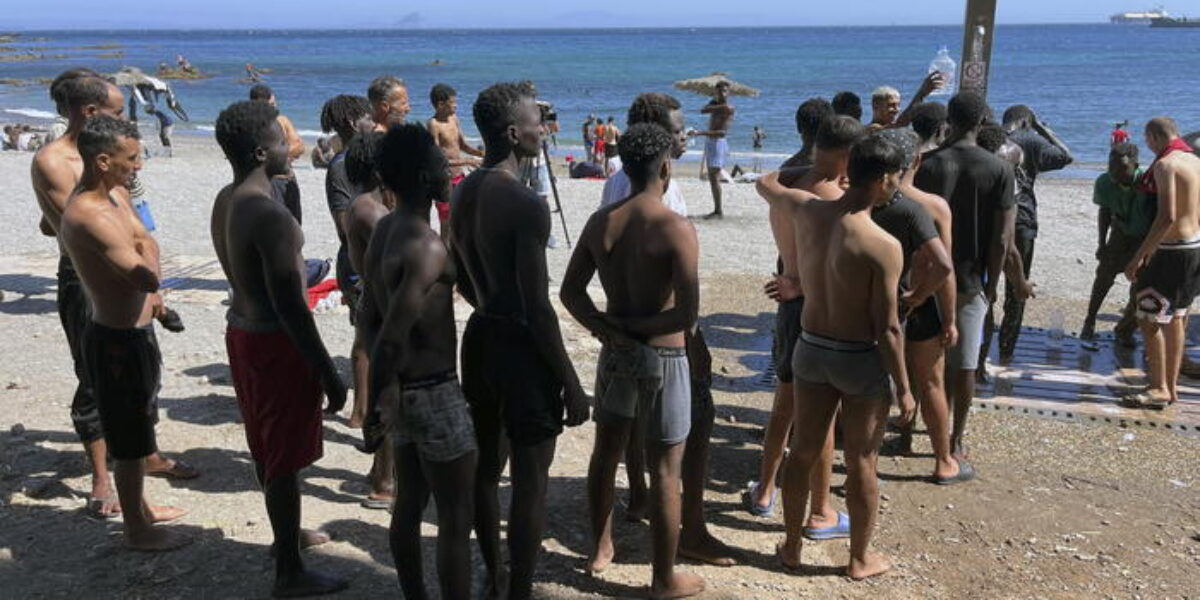
The Spanish government asks Italy to revoke by Sunday 9 August the border controls reintroduced on 1 August, after the migration crisis in Ceuta, and warns that, otherwise, it will adopt “proportional” response measures. In an official note, the Madrid executive defines the Italian decision as “unjust, contrary to the interests of the EU and discriminatory towards the Spanish population”, claiming that it was adopted “without warning, unilaterally and with spurious arguments that do not comply with either the Schengen Borders Code or the truth”.
Palazzo Chigi’s reply: “Italy does not accept ultimatums”
“Italy does not accept ultimatums or impositions from abroad regarding national security and border control”.
This is what was written in a note released by Palazzo Chigi after the Spanish government’s stance against Rome on the suspension of Schengen. ‘We do not intend under any circumstances to review the decision to suspend the application of the Schengen agreement for third-country nationals coming from Spain, at least until 15 August and in any case until security and terrorism risks for Italy have been completely excluded.’
The suspension of the Schengen treaty with Spain “is a temporary measure which is permitted by the EU treaties, we will see after 15 August. It is done selectively, there is no burden. There was a disjointed reaction from our opposition because perhaps you cannot touch a socialist-led country”. The Minister of the Interior, Matteo Piantedosi, said this: speaking at the “Bar Italia” meetings in Sorrento organized by FdI. The minister added that it is “difficult to imagine that the conditions” to maintain the suspension “do not exist” since the same “Spanish intelligence has declared that a new alarm for August 15 is founded” on Ceuta.
Pedro Sanchez’s government also disputes the reasons adopted by Rome, reiterating that the migrants who entered Ceuta irregularly last week “could not and cannot freely enter the Schengen area”, since the autonomous city “has a special regime with the same”.
Madrid underlines that “almost all of them have already entered Morocco”, recalling that, according to Frontex, Italy is the member state with the highest number of irregular crossings recorded in recent years, “with figures that have doubled those of Spain”.
In the note, Madrid invites Rome to rectify and put an end to the controls introduced on August 1st and “treat Spaniards like the rest of European citizens”. “If it does not do so before the conclusion of Sunday 9 August, Spain will be obliged to adopt proportional measures to protect the interests and dignity of its citizens,” warns Madrid.
The executive concludes by stating: “We trust that Europeanism, common sense and good faith will prevail. Governments are called to promote agreement between countries and the general interest of their respective populations, not to create fractures and sterile conflicts fueled by internal electoral motivations”.
In asking Italy to lift the controls, the Spanish government highlights that “since 2022 Italy has not respected the Dublin Regulation” and claims that this has caused “an additional burden of migratory pressure on the rest of the Member States”. Madrid claims to have never introduced controls against Italy, recalling that it has “always been supportive, welcoming some of the migrants who arrived in Lampedusa in 2023” and “having repeatedly reopened its ports to migrants rescued on the central Mediterranean route”.
Sanchez gathers ministers on Ceuta: ‘All means to return to normality’
Spanish Prime Minister Pedro Sanchez today chaired a coordination meeting via videoconference with the main ministers involved in the management of the migration crisis in Ceuta, ensuring that the government will use “all the necessary tools and state resources” to bring “in the shortest possible time” the autonomous city and its inhabitants “to full normality”. In addition to the prime minister, Moncloa reports in a note, the ministers of Defense, Margarita Robles, of the Interior, Fernando Grande Marlaska, of Territorial Policy, Angel Victor Torres, of Inclusion and Migration, Elma Saiz, of Youth and Childhood, Sira Rego and the Secretary of State for Foreign Affairs, Diego Martinez, participated. According to government sources, the operations underway in the Spanish exclave in Morocco were taken stock of and new measures were examined to assist the migrants still present in Ceuta and strengthen the security measures of the population. The executive also requested the extraordinary convocation of the Congress of Deputies for hearings, at the request of the government itself, of the ministers of the Interior, Foreign Affairs, Defense and the Presidency, who will report to the competent parliamentary commissions on the management of the crisis.
The Spanish Prosecutor’s Office ready to act against those who refuse to accept minors from Ceuta
The Spanish Attorney General’s Office has ordered juvenile prosecutors to supervise unaccompanied children and adolescents who arrived in Ceuta during last week’s migration wave and to intervene if an autonomous community refuses to welcome them under the redistribution plan envisaged by the government.
This is what is foreseen by a decree signed today by the State Attorney General, Teresa Peramato, a week after the irregular arrivals of over 72,000 people in the autonomous city, according to data from the Ministry of the Interior.
In the statement accompanying the decree, the Prosecutor’s Office states that the new guidelines contained in the decree approved a year ago by the government aim to “ensure the protection” of minors and to “guarantee adequate reception and immediate assistance”.
The provision establishes that, if an autonomous community rejects the transfer of minors from the enclave in North Africa to the Iberian Peninsula, the competent prosecutor will have to ask the administration to indicate “the structure it deems most suitable to guarantee adequate protection of the minors affected by the transfer once they arrive on its territory”, simultaneously informing the Ceuta Prosecutor’s Office.
Peramato also recalls the law decree approved a year ago by the government for migratory emergencies, recalling that the regions of destination have the obligation to take care of minors and “to ensure that they receive comprehensive assistance and adequate reception”. In case of refusal, the text provides for the intervention of the security forces and communication to the Prosecutor’s Office, “without prejudice to any responsibilities that may be ascertained”.
The Spanish Minister of Youth and Children, Sira Rego, reported today that there are at least 1,342 minors already registered in the Ceuta reception system, specifying however that they have not yet been identified.