

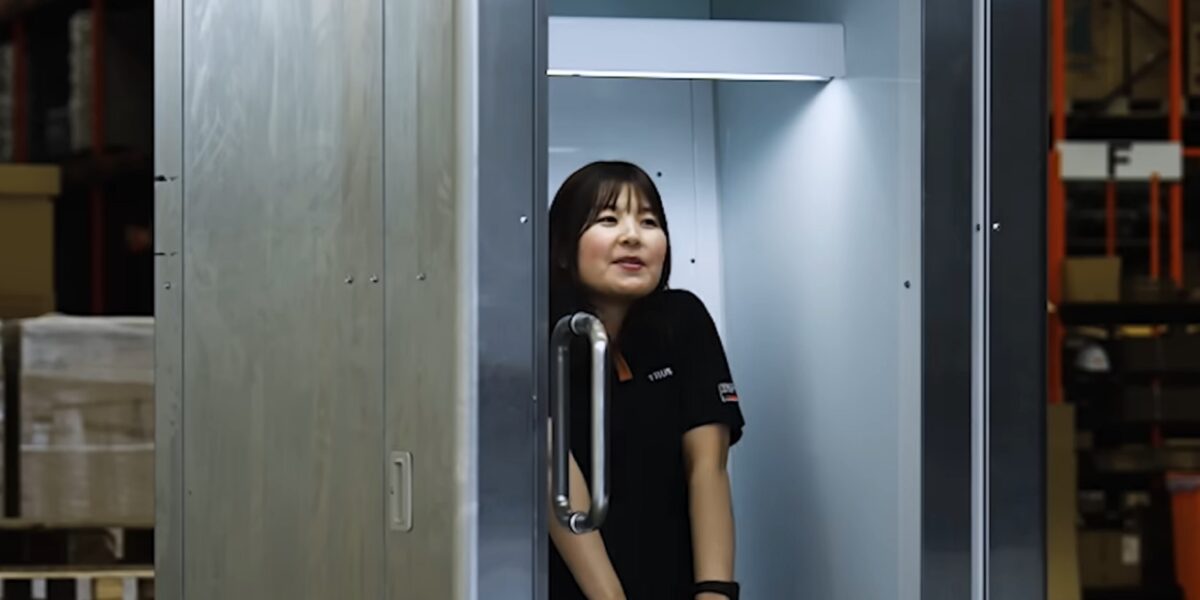
It looks like a drinks vending machine, but there are no cans inside: a person fits inside. It’s called Do Hiemon Box and it is the refrigerated cabin that in Japan they call “human refrigerator” – the expression is used by the manufacturer himself – designed to quickly lower the body temperature of those who work under the sun. The cabin maintains a temperature of around 15 degrees inside and directs a jet of air cooled by up to 5 degrees onto the head, neck, shoulders and back.
Who built it and how much it cost
The device was developed jointly by SDRS, a Japanese company specializing in refrigeration systems and vending machines, and the industrial equipment supplier Trusco Nakayama, which has been marketing it as its own product since April 1, 2026. The recall to the refrigerated vending machines spread throughout Japan is clear: the door is made of acrylic and opens by pushing from the inside, so that from the outside you can see who is inside.
The technical data sheet indicates dimensions of 931 by 1,202 by 2,031 millimetres, a weight of 293 kilos, a capacity of 150 kilos and a capacity for just one person. It works with a 100 volt Japanese domestic socket and requires no installation work, declares a consumption of 0.51 kWh with an external temperature of 35 degrees and has a declared water protection level equivalent to IPX3, which also allows it to be used outdoors. Dust protection, the company specifies, has not been tested. The manufacturer recommends use in an ambient temperature range between 20 and 35 degrees.
The price list is 1,500,000 yen, excluding taxes, between 8,000 and 9,000 euros according to the conversions reported by the international press. The product is aimed primarily at businesses and institutions and Trusco Nakayama does not sell directly to end users, who must contact a reseller.
Why it was born: the new rules against heat stroke
The regulatory environment matters. From June 1, 2025, specific obligations for companies regarding heat exhaustion came into force in Japan: a system for reporting workers who show symptoms and procedures defined in advance to stop work, cool the person, subject them to medical evaluation if necessary and organize their transport. The obligations are triggered for work carried out for at least one continuous hour or for more than four hours a day with a WBGT index equal to or greater than 28 degrees or a temperature equal to or greater than 31.
The cabin is not imposed by those regulations: it is one of the possible measures, and in the launch press release Trusco Nakayama links the birth of the product to greater attention on the topic and the desire to protect those who work in factories and construction sites and those who participate in outdoor events from extreme heat. The uses indicated range from construction sites, factories and logistics centers to agriculture, up to sports facilities and outdoor events.
A country that had to coin a new word
Japanese summers are increasingly extreme. In 2026, the national meteorological agency established the term kokushobi to indicate days with a maximum temperature of 40 degrees or higher. And in the period between May and September 2025, emergency ambulance transports for heatstroke reached 100,510, the highest value since the survey began in 2008.
Some administrations have already made the booths available to citizens. The municipality of Maebashi, in Gunma prefecture, received one as a donation: it was installed on May 25 in the atrium on the ground floor and can be used during office opening hours.
What it promises and what it doesn’t
According to the manufacturer, in about five minutes the cooling is clearly perceived and a stay of about ten minutes can help a hot person feel better. A timer switches the system off after 20 minutes to prevent overcooling, while the air temperature and ventilation are each adjustable to three levels. These are company data: there are no independent clinical studies published on the device.
The manufacturer itself presents it as a temporary stopping point for prevention, and not as a medical device. Faced with significant symptoms of heatstroke, cooling, medical evaluation and, if necessary, transport to a healthcare facility remain necessary.