

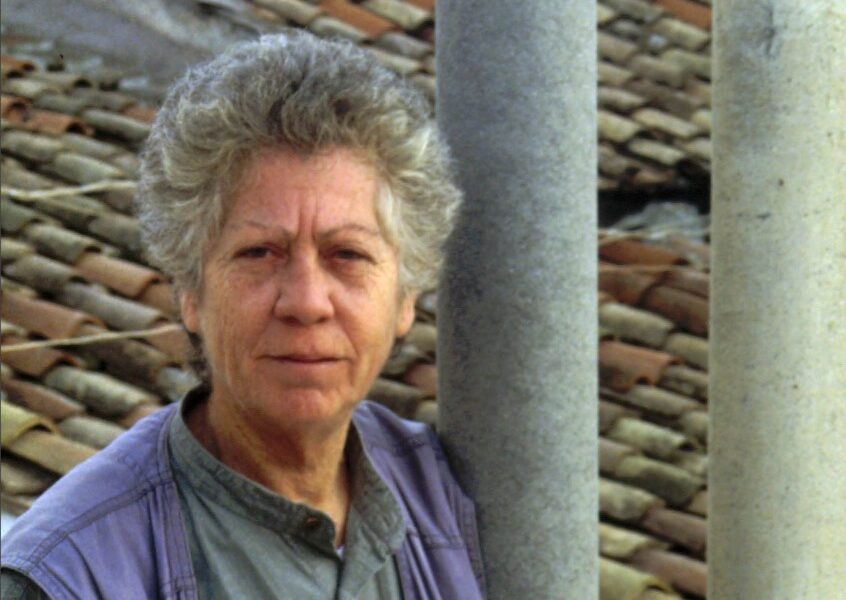
«The voice and body of Poetry»: this is the title of the conference that the University of Messina is organizing today and tomorrow to celebrate the great poet Jolanda Insana on the tenth anniversary of her death. «It is – says the prof. Gianfranco Ferraro, member of the scientific committee (with Giorgio Forni, Giuseppe Lo Castro, Novella Primo, to whom we owe the greatest organizational commitment, and Antonio Sichera) – of an extraordinary opportunity to bring together all those who have worked on Insana’s work in recent years but also to celebrate this great daughter of Messina, trying to do what she herself attempted with her voice: to form critical consciences especially in the new generations”. A collection of signatures will also be promoted for the dedication – which appears necessary – of a place in the city.
Jolanda Insana’s poetry is sharp and “weaponized”: she is not afraid of hurting if this serves to get to the center of social issues and people’s hearts. It comes into conflict with the flattening of consciences, it does not smooth out the edges, rather it seeks them to bring the accumulated dust into relief. His verses can be violent, in order not to put aside sincerity, they are capable of “awakening”, they never leave one indifferent, they dig and, albeit in a compassionate way, open even the most atrophied minds. In the Autodizionario degli italiana Insana wrote about himself: «He knew war and dried figs, and therefore prefers words of necessary substance against frost and chilblains». Titles such as «Combustion chamber», «The unassailable cursed», «Sciarra amara», «Fendenti fonici», «La stortura» are emblematic of his way of conceiving poetry, never condescending, capable of extraordinary mixes between Italian and dialect, along the sonorous lines of the highly theatrical verses of the ancient Greeks. «Insana – confirms Ferraro – believed in the shocking, far from pacifying, capacity of poetry. I believe that all the conference participants share this perspective. First of all, highlighting the relationship between voice and body in poetry, starting from the look that Jolanda’s poetry gives us in her most famous composition, “Pupara sono”, on the inexhaustible struggle between life and death. It’s about rediscovering how Insana’s poetic voice is within this struggle of life and for life, and how literature should be seen as one of the individual but also social and political forces that can transform the state of things. Then there is the philological research that helps us understand the poetic status of Insana, “classical” and in constant relationship with the classics. I think of her ancient sources and remember that she was born as a classicist, and translator from Greek and Latin, studying at the university of Messina and only then moving to Rome. It will also be an opportunity to examine his relationship with Messina, his Gravitelli, Monforte, and with the Strait, always present in his gaze on the world. Not only as biographical memories, but as a representation, metonymy of the world and the forces that fight relentlessly in it: the figure of the earthquake, for example, but also the opposing forces of the seas that meet and clash in our Strait. Then the little things: cooking, ancient dishes, especially those of the poor tradition, as a way of entering into a relationship with the world, with things, with others.”
«Finally – adds Ferraro – we will review the relationship of Insana’s poetry with its own time. She always read the newspaper. Her poetry is often a way of codifying the anger that injustices against the weakest and most defenseless caused her. Many of his poems, certainly not tender, arise from newspaper clippings of our time, they are cries of alarm driven by anguish for what he saw as profoundly rotten in our society, the way of treating those who have no voice, the elderly, young people, immigrants”.
Alchemical craftsman, never pacified with language, and – we can add – certainly Strictese. «I think – adds Ferraro (who teaches in two Portuguese universities) – that reading Jolanda Insana, in Messina, serves above all for our city to be able to recognize itself, look at itself better, and also discover itself as different and more complex, more stratified, than it thinks it is. She had an internal and external gaze on Messina at the same time. She was gone but always came back. Cosmopolitan, but “messinesazza”. I think that this challenging gaze of Jolanda’s poetry, never complacent, tender but hard, is very useful to all of us Messina people, of “rock and open sea”, and when I say Messina people I also think of the children of Maghrebi, Indian, Chinese parents who attend our schools and speak Messina dialect as a lingua franca”.
To these considerations I would like to add a reminder. When in 2008 I edited the publication of the book «Dear Messina… Ideal manifesto of the Messina intellectuals of the diaspora», for the centenary of the earthquake, I telephoned Jolanda Insana. She responded to me with her typical bitter kindness (and therefore sincere and welcoming) and accepted the invitation, sending me a poem from the book «Fragments of an oratory for the centenary of the Messina earthquake». Those verses, although sharp as always, contained love and pain, hope and disappointment: «Accurriti accurriti people / me figghia me figghia / bring a ladder / me figghia / accurrìti accurrìti / u focu u focu / sa mancia / viva / a fini du munnu / a fini da so vita / viniti curriti / ‘na scala / tièniti tièniti / daughter». There was an amazing relevance, the coincidence between the pain of a mother then and one of today, when the “earthquake” is no longer made of those concrete ruins, but of the compulsion to see their children leave who cannot find the way to grow up here by indulging in desires, qualities and possibilities. That cry – «accurrìti accurrìti» – is poetic quality and premonition, it is news and sentiment. It is poetry, for yesterday and today.
The initiative is part of the calendar of celebrations promoted by the Committee for the tenth anniversary, in collaboration with the University, the Municipality of Messina and the Accademia Peloritana dei Pericolanti, with the patronage of the Italian Society for the Study of Literary Modernity (MOD) and the MOD-School teaching section. The conference, in three sessions, with scholars from Italian and foreign universities, will open today at 2.45 pm, in the Aula Magna of the Department of Ancient and Modern Civilizations and will continue tomorrow at 9 am in the Aula Magna of the Rectorate.