

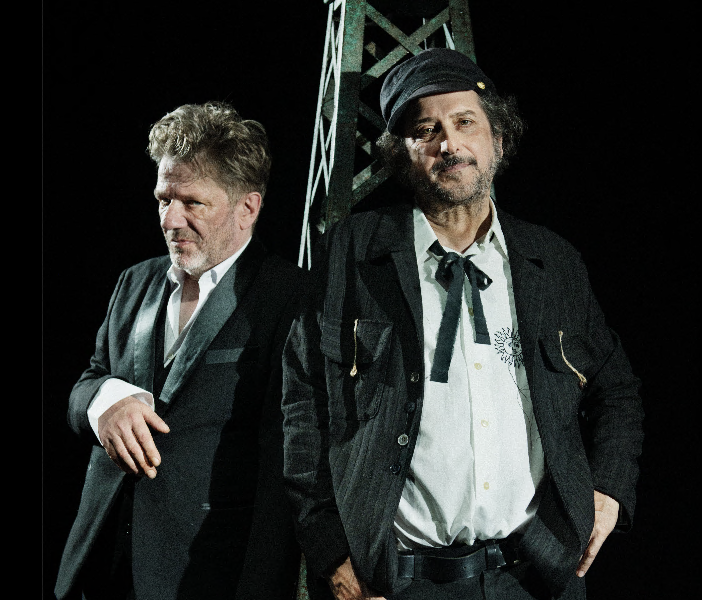
The bathtub has oars. And there’s no water inside. She travels from stage to stage, escorted by old transistor radios and antennas that search the air for signals. On Saturday it will dock at the Politeama in Catanzaro, the only Calabrian stop on the route. On board there is Pierpaolo Capovilla, lying down, lending his body to Captain Gatto, a blind sailor, and to whoever invented him: Dylan Thomas, a Welsh poet who died at the age of 39 in New York, a few months before the BBC broadcast his drama for voices, “Under Milk Wood”. A third passenger travels in the same tub, Renato Striglia, a radio man in Turin, who had dedicated twenty years to an Italian version of that text and in 2020 he passed away, leaving it half finished. It was finished by a friend with whom Striglia had shared concert venues and the bill for sheets burned by cigarettes. The friend’s name is Vinicio Capossela, he is sixty years old, he was born in Hanover to parents from Irpinia and since 1990 he has been a singer-songwriter with the air of someone who would find only one job difficult: 14 albums and five books, plus four films and a festival, the Sponz, invented in 2013. He missed opera. He christened it «And death shall have no dominion», stealing the title from Thomas. He uploaded 15 unreleased songs to us which will become an album on January 22nd, «Milk Wood Bar», and launched it in Rome on October 3rd. It will close in Florence on December 21st. Catanzaro comes much earlier, and it is best to be found on the pier. In the meantime we intercepted him…
What does the tub in which Capovilla lies represent?
«It’s a bit of Noah’s ark, a bit of a tub, a coffin and a boat. In front there is the radio piano, a short-wave piano built by our set designer, which plays the strings and the memories at the same time. Remembering comes from the heart, cordis: reviewing things from the heart. Before the start, you listen for a long time to the songs of the whales, which speak to each other through waves capable of crossing enormous distances. Beyond Renato, I’m interested in this idea of harmony with a way of looking at the world.”
While Llareggub became Italian, in your imagination was there a town in our province that provided you with a bestiary of bars and ghosts?
«Llareggub belongs to the childhood of each of us, like Ithaca, a place that we never really reach and that we continue to recognize. Childhood is our greatest myth generator. I didn’t grow up in Irpinia. I went there as a child, at the age when everything takes on a mythical dimension. When I reread the Odyssey I recognize the way of telling the stories of the elderly people I listened to as a child, like my grandmother, the same sense of honor. The Milk Forest was born to be listened to, like every myth that comes from the voice.”
What can the losers teach us today?
«A poet friend once said: “The winners don’t know what they’re missing”. Much of our life is made up of attempts that no success crowns. As that song said, “one in a thousand makes it.” And the other 999? Are their lives worth less?”.
Can innocence become a form of disobedience?
«We think of the innocence of Eden, and it seems that Thomas’ last words were the desire to return to that garden. The Edenic condition is the absence of judgement, a rebellion against the rules of a society that lives on prejudices. In the show there is “At the Gates of Eden”, inspired by a poem by Thomas about the death of a child under the bombs. How can you read it today without thinking about Gaza? Recovering innocence means defending the ability to feel. Every horror begins from dehumanization.”
Why did he want Capovilla in the tub?
«For a long time I had imagined doing everything myself, with the recorded voices of those who were absent. Then I saw him in “The Cities of the Plain” and I understood that he was the only one capable of entering that universe. It’s a work about bad teachers, and his band is called exactly that. A bad teacher finds words when we are not capable of them. Ours is a friendship founded on fragility. At a certain point the protagonist says: “I’m sorry, I didn’t understand”. Among us, no one must prove that he is the strongest.”
What will the record sound like?
«It crosses very different territories. In some pieces there is the voice of a countertenor, suspended between fairy tale and baroque opera. There is a feline blues, “The happiness of the blues”, and “Order and cleanliness” is a polyphonic rock that makes you think of Queen. The most rock song, in spirit, is “And death will not have dominion”. Arrangements and orchestrations are by Raffaele Tiseo, whom I met in Naples during a concert in the Basilica of Santa Maria della Sanità: one of the luckiest encounters of my musical adventure. We also recorded many of the choirs in a Neapolitan studio.”
“From the fear of death comes the exercise of all power,” he said. After five years of finishing the work of a missing friend, where is your fear at?
«Of course I’m afraid of death, just like before. I believe that a greater awareness of being mortal can help us live differently and gain more freedom. We live in a society that wants us to be immortal, because death is almost an obstacle to production. Power has always known how to manage this fear, just think of how much the issue of security is built around the fear of losing something. Accepting that you are finished means escaping at least in part from its dominion. And feel like brothers, because we share the same destiny.”
Why listen to songs in the theater before publishing them?
«I like to imagine them as butterflies that fly free in the woods and then end up in a record case. These songs aren’t meant for five seconds on TikTok. They ask for time, and it is precisely time that we are most stingy with today. Whoever comes to see us will have to trust us, because they will find themselves faced with something completely new. It is a trust that we feel is a responsibility.”