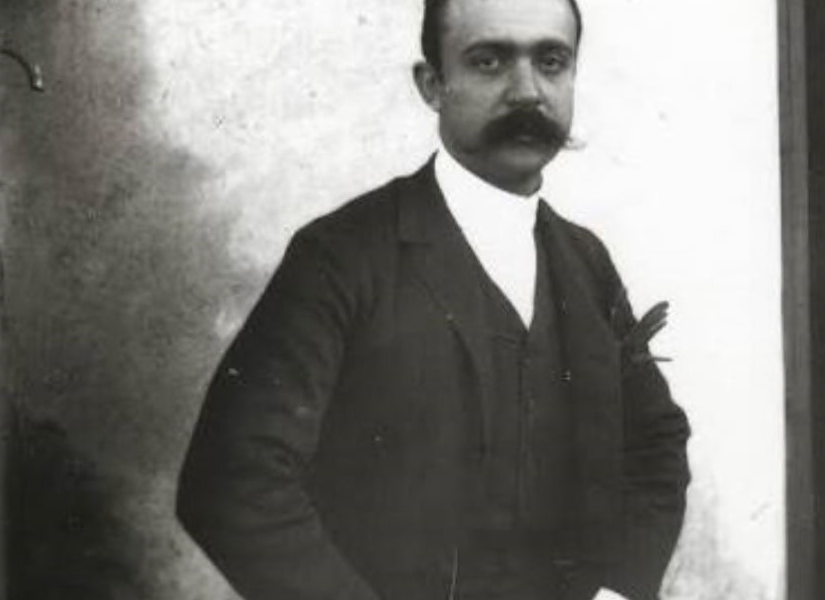
Sarah Zappulla Muscarà and Enzo Zappulla – she already full professor of Italian Literature at the University of Catania, he president of the Institute of the History of Sicilian Entertainment – have dedicated their lives as passionate scholars to literature, theatre, cinema between the nineteenth and twentieth centuries and to correspondence, some of which are unpublished. They love entering the archives with a feeling of happiness, the one guaranteed by knowledge, they stop there with trust, they slip into the lives of those who have lived of art, and that material of human genius, Pirandello, Musco, Martoglio, Bonaviri, Addamo, Patti, D’Annunzio, Turi Ferro, De Roberto, to name a few, have turned it into fascinating stories that they return to us in precious, monumental volumes (and monumentum they are, truly, which serves to remember). In the case of the correspondence, such as «La dolce e grata amici» (La nave di Teseo, I Fari series), a substantial correspondence between Federico De Roberto and Luigi Albertini between 1897 and 1915, proposed for the first time by the two scholars, it is not only an «extension of memory and imagination» as Borges said, cited in the exergue in their work, but a way to rediscover the breath, the gaze, the language, the living flame of thoughts and feelings of great authors. A corpus, the correspondence between De Roberto and Albertini, which is «extraordinary source and incomparable and fertile testimony of precious information for the knowledge of the writer, of the director, of the era».
It was November 26, 1896 when Federico De Roberto’s signature appeared for the first time in the Corriere della Sera, at the bottom of his «Spasimo», one of the first Italian detective novels, published, as was customary, in an appendix and in installments in the newspaper. Thus, the great writer from Catania (1861-1927), author of «I Vicerè» and «L’imperio» and of a very rich narrative, journalistic and essayistic production, close to Verga and Capuana, entered the house in Via Solferino 28, in the center of the city (designed by the architect and journalist Luigi Beltrami), headquarters of the newspaper, founded in 1876 by Eugenio Torelli Viollier and directed by him, before passed the baton to Domenico Oliva and in 1900 to Luigi Albertini.
A leap in quality for Albertini and also for the newspaper which, thanks to the visionary genius of its director, was brought to a circulation of 150,000 copies in 1906. In that “creature” of Albertini the “color of the time” vibrated, to use an expression dear to De Roberto, and the life of all of Italy passed, at the center of great European, political and cultural changes, and of “changes in the history of ideas, taste and customs”. A laboratory in which ideas, friendships and acquaintances grew, such as that between Albertini and De Roberto, and between “the major exponents of the intelligentsia of the time” – recall the two scholars -, from Prague to Giacosa, from the Treves to Ojetti and Boito, all in that Milan “capital of media, financial, cultural powers, rich in artistic vivacity and teeming initiatives”, home to large publishing houses, renowned theatres, elegant cafés and lounges artistic-worldly worlds where writers and artists, starting with our own Verga, Capuana, de Roberto, and many others who left the province from all over Italy, were driven not only “by a sense of restlessness but also by an aspiration for broader horizons”.
Aspirations that were realized with the landing of large publishing houses (Sonzogno, Treves, Galli) and, indeed, the prestigious collaboration with Corriere della Sera. For De Roberto, who returned against his will to Catania, forced to stay away from his beloved Ernesta Valle (their “spasimo” of love, evidenced by an ardent correspondence became another full-bodied and tasty volume for the Ship of Theseus, “Si se semper delle cose più belle”, always edited by Sarah and Enzo Zappulla), the assiduous militancy of a highly cultured critic and a tireless and meticulous reader, also passionate about authors’ letters illustrious, it was a reason for living, but also a way to maintain a dense network of friendships and acquaintances.
The correspondence, in which De Roberto’s letters to his friend Luigi, “Gigio” Albertini, towards whom the writer always declares himself “very fond”, are much more numerous, offers a very interesting cross-section of editorial initiatives and dynamics, of the promotion of information aimed at a varied public, of private and practical aspects of everyday life: to the long list of bibliographical appendices and articles edited by De Roberto are added on both sides, ideas, technical advice, news on the fertile literary environment of the time, De Roberto’s indications on typographical correction, “crocodiles”, suggestions and editorial proposals (as in the case of the Third Page, of the “Domenica del Corriere”, an illustrated weekly supplement strongly desired by Albertini, and of the monthly La Lettura for the birth of which, in 1901, De Roberto played a primary role), confidences and also practical notes, such as the solicitation, always marked by great esteem and respect, on the part of De Roberto, of remunerations for the his collaboration.
And there is no shortage of evidence of differences of ideas, of disappointments, without prejudice to friendship, as when the Corriere in 1914, with Albertini carried away by the patriotic wave, declared himself an interventionist for the Great War, while De Roberto (like Verga), who foresaw the collapse of Italy, took the opposite position. He who with «L’Imperio», which appeared posthumously in 1929, had described «the lack of education of our country, the risk we run, among unaware crowds, undisciplined plebs and inadequate politicians, in testing its poor moral fiber».