

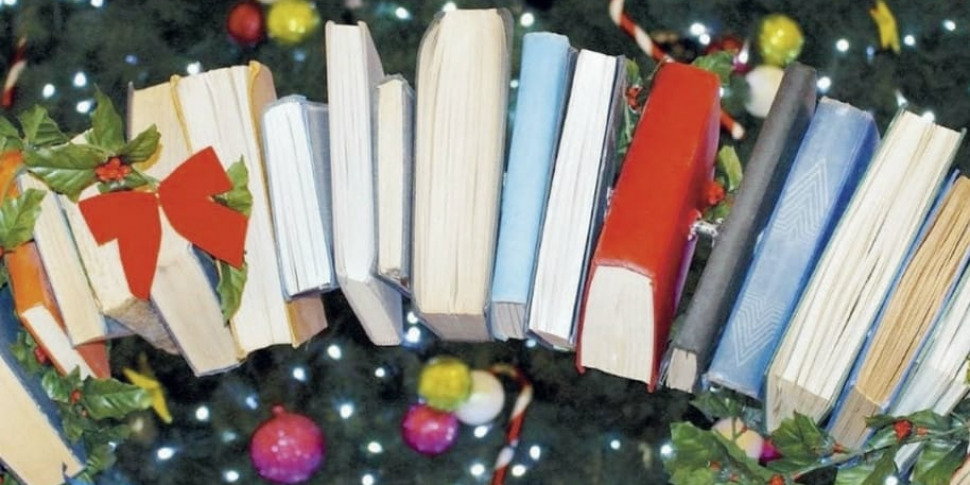
What’s better than a good novel as a gift under the tree? Books that delve into memory or question the present, established voices alongside new perspectives.
We start with The White Book (Adelphi, tr. Lia Iovenitti) by Nobel Prize winner Han Kang. A rarefied and deeply personal text, born from mourning and transformed into a gesture of restitution. At the center is the author’s older sister, who died a few hours after birth, to whom the writer symbolically offers a new life through a constellation of white images: snow, salt, the moon, the breath that condenses in the cold air. The writing proceeds in fragments, a secular liturgy in which white becomes a space of purity. It is a threshold book that acts by subtraction, using the power of words to transform absence, inviting the reader to a deeper form of attention towards life, stripped of any vanity. The gaze widens to the time that consumes destinies.
Michele Mari addresses this theme in The stone guests (Einaudi), a ferociously ironic novel. After graduation, a group of former high school classmates sets up a cruel lottery: the prize money will go to the last three survivors. Mari constructs a very lucid black comedy, making time the true protagonist in a novel about survival – biological, social, symbolic – and the wear and tear of youthful myths, told with linguistic invention and controlled irony, the author’s strong points. Between grotesque and melancholy, the reunion turns into a merciless existential balance, where friendships, ambitions and illusions are sifted without discounts.
With Vultures (And/O, tr. Dario Diofebi) by Phoebe Greenwood the gaze shifts to the most exposed present, when telling means dealing with a moral conflict. Sara Byrne is a young freelance reporter who arrives in Gaza in 2012, at the Beach Hotel, one of the last places still open in the Strip. The English author’s debut novel, celebrated by international critics, does not tell the story of the war but the gaze that observes it and transforms it into narration. With writing devoid of rhetoric, Greenwood tackles the myth of war journalism, exposing the guilt of those who watch without being able to intervene and the thin line between testimony and exploitation of pain. Sara Byrne reveals herself to be a fragile and ambiguous figure, forced to confront the ethical price of the profession.
From current events the route returns to the places and dimension of myth. In Rosa Lia and the secret of the trees (Sellerio), Nora W. Almerina builds a Palermo transfigured by magic, giving life to a bildungsroman that intertwines fantasy, ecology and popular tradition. Rosa Lia is 12 years old and a destiny that calls her to safeguard ancient knowledge, that of trees, roots, stories that resist time and destruction. The story, written under an alias, moves lightly, giving shape to a contemporary fairy tale crossed by a political urgency and the illustrations by Igor Scalisi Palminteri amplify a visionary imagery that speaks to readers of all ages.
With Sicilian Incanto (Apalòs) we broaden our gaze in a choral sense. Nine authors for nine stories compose a multifaceted portrait of the island, far from folkloric temptation. From Etna to the Puppet Opera, from Palermo to the Pantalica Staircase, the anthology crosses physical and symbolic territories, restoring a Sicily made of stratifications, contradictions and persistent memories. With contributions from Catena Fiorello Galeano, Gaetano Savatteri, Emanuela E. Abbadessa, Carmelo Sardo, Giusy Sciacca, Giuseppe Lissandrello, Manuela Spina, Dionisio Mollica and Salvo Zappulla, this collection is a narrative fresco between landscape and identity that tells of Sicily as a mental place, full of emotions.
And recently in Palermo the debut novel by La Gazzetta journalist Anna Mallamo received the SuperMondello prize: in With the Dark I See Me (Einaudi) the story of Lucia, a sixteen-year-old from Reggio who kidnaps her schoolmate Rosario, son of an ‘Ndrangheta boss, in the basement of her grandmother’s house, is the starting point for a story of transformations – of the gaze, of relationships, of the world – of which the protagonist is an unpredictable, brand new language turgid and resonant, nourished by dialect but also by classical culture.
Broadening our gaze, we close this journey with three great international novels, starting with Twist (Feltrinelli, tr. Marinella Magrì) by Colum McCann: the reporter Anthony Fennell embarks on a ship that repairs submarine cables. Evoking Conrad McCann atmospheres, it talks about the theme of loss, intertwining technology and introspection. On the occasion of the tenth anniversary, Fazi publishes a special edition of Anima by Wajdi Mouawad (tr. Antonella Conti) entirely narrated from the point of view of animals, silent witnesses of human violence: a radical novel, a descent into the abyss of evil that takes the protagonist from Quebec to Lebanon, a contemporary bestiary of great literary force, without any redemption. Finally, we fly high with Daniel Wallace who in Big fish (Il Saggiatore, tr. Silvia Lalia) tells of a son’s attempt to understand his father through the incredible stories he has always told. A melancholy fable about the power of storytelling, it reminds us that we are also what we choose to tell, dancing between myth and reality. A luminous closure that reiterates all the strength of literature.