

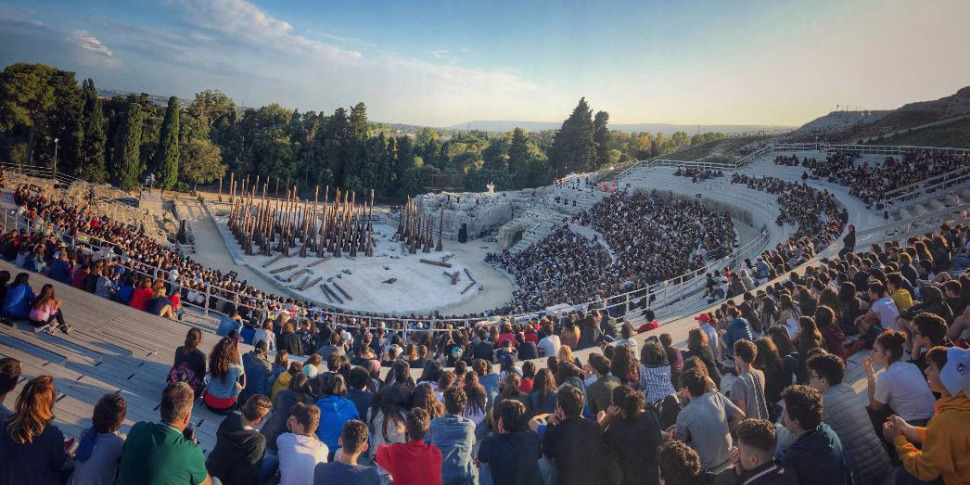
The limits of power and the danger of hubris, that blindness that leads men to believe they are invincible, at the center of “The Persians” by Aeschylus, which debuts tomorrow evening at 7.30pm at the Greek theater in Syracuse. It is the third production of the 61st season of classical performances of the National Institute of Ancient Drama Foundation, after the public and critical success of Sophocles’ Antigone and Euripides’ Alcestis.
The director is Alex Ollé, one of the founders of the Fura del Baus, with the translation by Walter Lapini. «The Persians can be read both as a reflection on the universal suffering caused by war and as an implicit defense of one political model over another – explains the director -. The defeat of Persia is not just a military defeat; it is also the defeat of a conception of power based on the absolute authority of a single man in the face of a community of citizens capable of collectively assuming their own destiny. Perhaps the greatness of Aeschylus lies precisely in this complexity: in his ability to look at the enemy with humanity without giving up affirming the values of the society to which he belongs.”
A work perhaps born precisely in the Greek theatre, which talks about the human being, but above all about power. We are in Susa, capital of the Persian Empire: the great king, Xerxes, played by Massimo Nicolini, left some time ago at the head of an enormous expedition against Athens and has not yet returned. Atossa, the king’s mother, played by Anna Bonaiuto, reports a prophetic dream, which showed her son falling into the dust at the hands of a filly of Greek origin. One of the few survivors arrives in Susa and reports the rout of the Persian army off the coast of Salamis – Xerxes’ fleet, too numerous, was surrounded by the ships of Athens, and the Persian army was massacred. In terror, Atossa and the Chorus summon from Hades the soul of Xerxes’ deceased father, Darius, Alessio Boni (in his Greek theater debut). Finally, Xerxes himself arrives in Susa: humiliated, his clothes torn, the great king sings the funeral lament for the fallen Persian youth.
The text talks about how to perpetuate power: after 2500 years it becomes inevitable to think about the military and politicians of any country in the world and about what happens in Iran, or Russia or Ukraine. The Persians are the aggressors: the pride of the young Xerxes who violates the borders to attack Greece. Today, those same Persians are the direct ancestors of the Iranians.
On stage Giuseppe Sartori the messenger; Marco Maria Casazza is the leader of the choir.
And then Francesco Biscione, Fabrizio Bordignon, Nicola Bortolotti, Rosario Campisi, Francesco Migliaccio, Giovanni Nardoni, Antonello Cossia, Stefano Quatrosi, Michele Cipriani, Rosario Tedesco, Elena Polic Greco, Simonetta Cartia. The Women’s Choir: Arianna Angioli, Carla Bongiovanni, Margherita Cinardi, Alessandra Giovannetti, Gaia Lerda, Giulia Maroni, Maria Rita Sofia Di Stasio, Francesca Totti.
The men’s choir: Samuele Cannoni, Samuele Ingrosso, Salvatore Mancuso, Riccardo Massone, Lorenzo Patella, Tommaso Quadrella, Daniele Sardelli, Adriano Spera.
The show will remain on stage until June 28th and will then be staged at the Teatro Grande in Pompeii, from July 10th to 12th.