

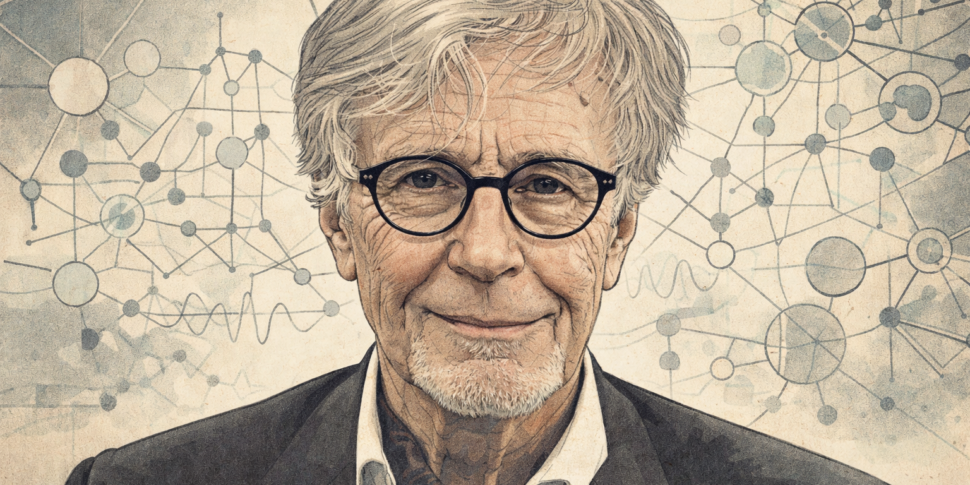
When I was asked to review «Quantum Man. Mind, society, democracy: where the next digital revolution will take us” by Derrick de Kerckhove, I was dealing with an unusual pastime: I was asking ChatGPT to put himself in the shoes of a philosopher and imagine (a curious coincidence) the future of humanity. Among the less distant predictions, the chatbot evoked the birth of a new “ontology of distributed subjectivity”: “The self no longer coincides with a body or an individual mind, but with a network of biological, technical and symbolic processes.” What appears to be a disturbing prospect instead accords with the anything but threatening vision supported by the Canadian-Belgian sociologist and journalist in his latest book (Rai Libri).
De Kerckhove, heir of Marshall McLuhan, uses an idea from contemporary physics to clarify a key point of his reasoning. Quantum suggests to us that particles are not isolated “bricks”, but exist as a function of their bonds: if something happens to one, the other reacts immediately, even on the other side of the world, as if there were an invisible bond between the two.
Here: the author proposes to bring this metaphor into our daily lives and to read it as a real anthropological mutation, also in light of the transformation announced by quantum computers.
We are no longer there to watch reality from behind a glass, like lazy spectators: we are immersed in a tangle of connections that continually shapes us. It is here that De Kerckhove goes to the heart of the matter, talking about the leap from the “point of view” to the “point-of-being”: we do not observe the world passively, we inhabit it; we get our hands dirty and build it together with others, through every single contact.
The technological revolution we are experiencing, due to its impact on social relationships, on the way of thinking and knowing the world, is comparable to the birth of alphabetic language and the written word. The linearity of the text and the ordered sequence of reasoning, according to the author, have marked our culture, from the vision of the world to the very idea of time as an ordered succession on a single line.
But in recent years, first with digital, then with the overwhelming impact of generative artificial intelligence, something has changed. Without almost realizing it, we ourselves have become part of an invisible code: immersed in a continuous flow of data that intertwine and move simultaneously, in a “permanent present”.
More than spectators of a chain of events, we rediscover ourselves as an active part of a system in which everything seems to happen at the same time.
Philosophical abstractions? Far from it. With a pragmatic gaze and an acute sociopolitical analysis, De Kerckhove paints this epochal change neither as a miracle to be celebrated nor as an apocalyptic threat, while admitting the risks to democracy, already evident with the rise of the radical right in Europe and the United States.
George Orwell’s disturbing “Big Brother” can be glimpsed in the manipulation of consciences, in the standardization of behaviors and in ever more widespread forms of control.
In the era of “datacracy” (the dominance of Big Data), the spread of “alternative truths”, starting with social networks, and the decline of trust in institutions have favored the rise of authoritarian figures who “offer simple certainties in an increasingly complex” and subtle way.
The “quantum leap” evoked in the title is not a distant event in time, but a transition already underway “towards something radically different and still not fully identifiable”.
We can undergo the metamorphosis, letting new technologies take control of our lives, or we can face it with a critical spirit. At stake is our way of being human in a world that, day after day, mixes the natural with the artificial in indecipherable ways.
In order not to get lost in such a “cultural operating system”, we must learn to cooperate with these devices as co-creators, not as simple beneficiaries.
To confirm the effectiveness of the collaboration between human intellect and digital code, the author reveals that he wrote the essay by interacting with DerrAIck, a cybernetic alter ego based on an artificial intelligence system and trained on the texts produced by De Kerckhove himself in his prolific scientific, academic and journalistic activity.
Among the reflections scattered throughout the text, we also talk about the profound crisis of traditional media and their indispensable role in giving a reliable interpretation of the complexity of the present. In the dissemination of news, warns the father of Connective Intelligence, we cannot continue to snub virtual communities, often considered a taboo by reporters and editors. It is an adaptation that does not equate to a surrender to lightness, but to a strategic choice. Even TikTok (yes, the social network of compulsive “scrolling”) can become a “Trojan horse” to reach millions of lost readers and digital natives, without sacrificing the ethical and professional principles of information.
These pages, disconcerting and provocative, are “a compass for navigating contemporary complexity”, as Guido Scorza defines them in the preface, or, according to Andrea Colamedici’s summary in the afterword, a true “act of pedagogy of the future”.
«Quantum man» deserves to become an «on-board manual» for those who can guide the fate of the planet, from Strasbourg to Washington, from Brussels to Beijing, not to offer pre-packaged solutions, but to focus on what is at stake and attempt to answer the question: «How to maintain our humanity when the tools we use to express it pretend to be us?».