

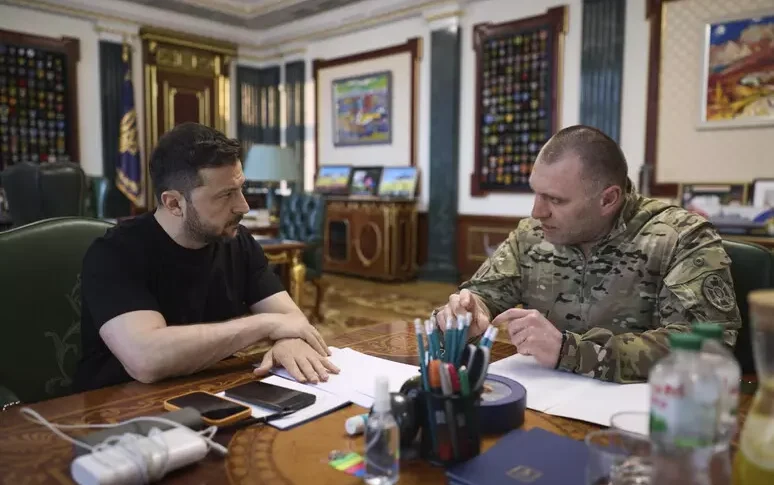
Today in Paris, a meeting of those who are willing to help Ukraine, with Prime Minister Giorgia Meloni also present; for the USA there are Witkoff and Kushner. Zelensky torpedoes Malyuk, who will lead the National Security Services from 2022.
Reshuffle after the corruption scandal
The robust government reshuffle, initiated by Volodymyr Zelensky after the explosion of the corruption scandal, marks one of the most controversial and contested steps: the last head to fall was that of the powerful head of the security services, Vasyl Malyuk, who coordinated some of the most sensational operations against Russia since the beginning of the war. The change at the top of the SBU came as Kiev once again became the target of raids by the occupying forces, which caused at least two deaths in the capital and surrounding areas. The daily bombings are counterbalanced by the frenetic diplomatic activity, especially by the Westerners, who are working to close the circle on security guarantees. The United States remains in the game, and this is excellent news for the Ukrainians: Donald Trump’s envoys, Steve Witkoff and Jared Kushner, will participate in person at the meeting of the leaders of the Willing Party tomorrow in Paris.
Malyuk announced his resignation as head of the SBU, which he had led since 2022, explaining that he would remain within the structure “to implement world-class asymmetric special operations, to inflict maximum damage on the enemy.” An apparently conciliatory statement, which however does not change the substance: Zelensky had effectively removed him, offering him another position. And in Ukrainian circles it is remembered that Andrij Yermak, when he was still the shadow of the president, had already attempted to torpedo Malyuk for failing to prevent the start of the maxi-corruption investigation that had overwhelmed the leaders of Kiev. Including Yermak. The interim leadership of the security service goes to Yevhen Khmara, who commanded an operational department.
Malyuk’s daring blitzes
The now former head of the SBU had been the protagonist of daring raids against the enemy: from the repeated attacks on the Crimean bridge to the sensational operation last June, when drones clandestinely introduced into Russia simultaneously hit enemy nuclear bombers and airfields located deep behind the front line. Such resounding successes that now his abrupt exit from the scene has created an uproar, raising for the first time protests from other influential figures in the armed forces.
Renewing the network of loyalists: Zelensky holds the point
Zelensky has held his ground amid the wave of criticism, making it clear that he will not back down. The Ukrainian leader wants to renew the network of loyalists in this crucial phase (also looking at the elections that will take place sooner or later), with the Russians continuing to press militarily. The last wave of pre-dawn bombings across the entire country (165 drones and at least 9 missiles, according to the air force) also reached the capital, starting a fire in a clinic and causing one death and three injuries. Another casualty was reported in the nearby town of Fastiv. The raids resulted in power outages. Making things even more difficult for the population is the “general winter”, with temperatures dropping to -8.
Trump angry at Putin
Continued Russian raids have apparently brought Trump closer to Ukraine. The US president, who in recent days had said he was “very angry with Putin”, disavowed the tsar for the first time, stating that he did not believe that Kiev’s drones attacked the Valdai residence. And above all he gave a positive signal to the European allies: the not obvious participation of his emissaries, Witkoff and Kushner, at the Willing Summit which will be hosted by Emmanuel Macron in Paris.
The leaders’ meeting after the technical discussions
The leaders’ meeting was preceded in recent days by a series of technical meetings at the level of security advisors and chiefs of staff: the objective is to create a more defined framework on future security guarantees for Kiev, which will discourage Moscow from new attacks, in the case of a ceasefire. Waiting to deal with the last real obstacle on the road to peace: the future status of the disputed territories.