

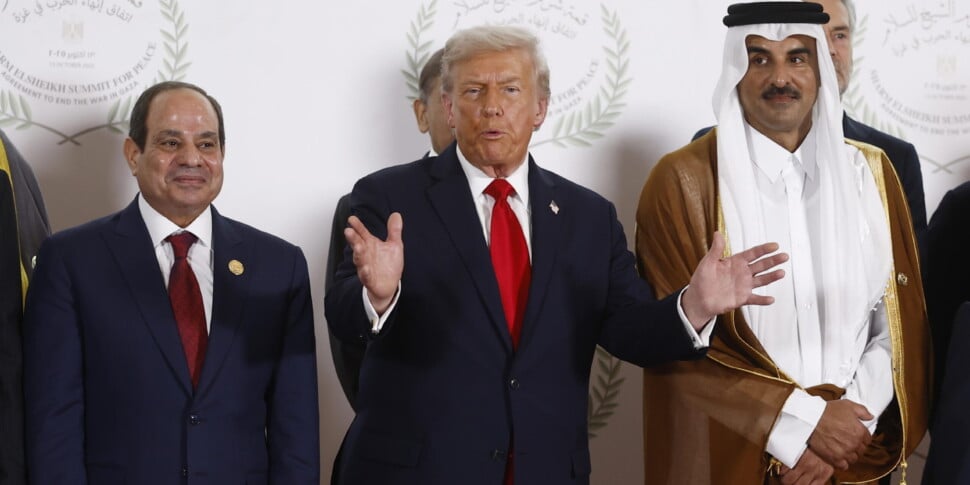
The Gaza summit is “an extraordinary day for the Middle East”. Donald Trump said this when signing the peace agreement for Gaza in Sharm el Sheik. Shortly afterwards it was the turn of Egyptian President al Sisi, with whom he co-chairs the Egyptian summit on the future of the Strip, Turkish President Erdogan and the Prime Minister of Qatar, all countries mediating the agreement. The audience gave a round of applause. “It’s an incredible day for the Middle East, it took three thousand years to get here,” he added.
«Today is perhaps the best day of the last two years.» Roni repeats it with a smile that can be perceived even from a distance, on a day that for many Israeli citizens marks the return to hope and life. In these very long months Roni has lived suspended between memories and expectations. He is 27 years old, Italian-Israeli, born in Rome but in Tel Aviv for seven years, where he works on collaborative projects between the two countries. And his life was forever intertwined with the massacre of October 7, 2023, when his uncle Shlomo Mantzur was kidnapped by Hamas in the Kissufim kibbutz, on the border with the Gaza Strip. He was the oldest hostage of all.
«My uncle was 85 years old. He lived in the Kissufim kibbutz, a community right on the border with Gaza”, says Roni, his voice weighing on every word. Shlomo was born in Iraq, into a Jewish family. In 1941 he managed to save himself from the Farhud massacre, fleeing from Baghdah towards Israel. Eighty years later, the story ended in the same place he had chosen to live in his land. «They entered my uncles’ house, shot inside and took them both. My aunt managed to escape, but my uncle was taken to Gaza”, says Roni who was with her grandmother in Tel Aviv that morning, during the Simchat Torah celebration, when the sirens began to sound.
«We ran into the bunker. My grandmother tried to call her sister who answered only 48 hours later, when rescuers saved her. She was the one who told us that my uncle had been kidnapped,” he explains. For more than a year the family lived in uncertainty. Then, in February, the news: «My uncle’s body was returned during one of the exchanges between Israel and Hamas. For a year and a half we hoped that he was still alive, until we were told that he had passed away.” Analysis showed that Shlomo had died in the first days of the kidnapping: “It’s sad to say, but for us it was a relief to know that he hadn’t suffered for long in the Hamas tunnels.” And then “for our religion, burial is fundamental, and getting the body back was very important.”
On the day of liberation and return, Roni looks at the images of the other hostages now free with a suppressed emotion: “It is perhaps the most beautiful day of the last two years, because twenty hostages have returned home after having lived through hell.” Then he stops and adds: «Precisely because of my uncle’s story I understand how important it is for families to get back even just the bodies of their loved ones. It is a question of dignity, of peace, of closure.” On the day when Israel breathes a sigh of relief, Roni’s words are a reminder of a pain that cannot be erased. The words of those who still manage to share the joy of others, despite not having someone to hug again.