

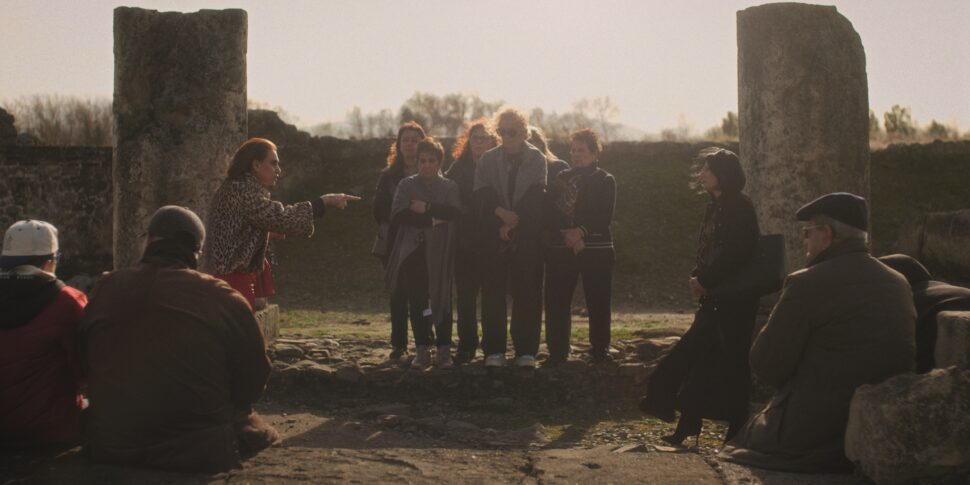
In some films, it happens! You understand that what you are looking at is neither true nor false. It is something more complicated and more beautiful. It is the life that she allowed herself to film. Do not capture. Film. As if it had agreed, for once, to remain still long enough to become an image. Gianluca Matarrese knows that moment well. He has been chasing it for years, through theatre, documentaries, TV and cinema. He pursues it with the patience of someone who knows that reality is not conquered quickly. That you have to prepare the ground – the lights, the crew, the camera points – and then wait for something to happen that can’t be written in the columns of a screenplay.
With «The Quiet Living» he did something simple and daring at the same time: he took his family, brought them in front of a camera, and asked them to be themselves. Not about acting. The protagonists are in fact his cousins Maria Luisa Magno and Imma Capalbo, his mother Carmela Magno and his aunts Concetta and Filomena, his cousins Sergio Turano and Giorgio Pucci and other relatives. In Calabria, during Christmas, with all the holiday lunches and dinners. And old grudges. And stories told a thousand times. With Luisa – her aunt, a natural narrator of rare power – in a continuous duel with Imma, at the center of everything, like an actress who doesn’t know she is and perhaps is precisely for this reason the best. Venice International Film Festival (Authors’ Days), International documentary film festival Amsterdam, Marrakech International Film Festival. Everywhere, after the screening, the public approached Matarrese to tell him their family stories. Because certain conflicts have no passport. And perhaps there will be more, «a Calabrian trilogy, with Donatella Palermo»; that explores the family’s past.
We met him to understand how to film the truth when the truth never stands still…
Your film mixes documentary, fiction and theatre. How did you prepare your family for this role-playing game?
«It is a territory that I have always explored in my cinema. My training comes from theatre, which was my first expressive language. Then when I started working in documentaries I naturally found myself dealing with the living material of people. At a certain point, these two paths began to intertwine. In the case of this film I worked with people who play themselves and who bring their own truth into the story. I knew I would be shooting during Christmas. And on these authentic appointments we built situations, preparing the context but letting the dynamics develop spontaneously. Once the scene came to life, everything became completely authentic.”
Luisa emerges as a magnetic storyteller. How did his gaze influence the dramaturgical construction?
«She’s a natural storyteller. He has an extraordinary ability to tell stories, almost as if he were editing a film with words. I have been listening to his stories for more than ten years and I am struck by the strength with which he manages to capture attention. The surprising thing is that his way of telling stories is extremely visual: he uses images, pauses, narrative rhythms that recall the work of great storytellers. Some stories he always told in the same way, with the same words, the same pauses. There was something profoundly theatrical in this repetition, as if it were a monologue that was refined over time.”
Was there a scene where the reality surprised you so much?
«Reality always surprises me. Sometimes I have the feeling that to understand my life I must first make it into cinema. With this film I reflected on how often, in families, conflicts arise from something minimal and then turn into hostility that lasts for years. Deep resentments, of which, perhaps, one no longer even remembers the initial reason for the quarrel. After seeing the film, everyone asks me the same question: “Did they make peace in the end?”. The truth is that the real situation hasn’t changed much. But through this form of theatrical catharsis the protagonists express their truth. They release tension with fiction. And cinema takes on a saving function.”
What role did Calabria have in the construction of this microcosm?
«Calabria is the starting point of everything. I am Calabrian on my mother’s side, even though I was born in Turin and have lived in Paris for twenty years. My mother emigrated to the North in the 1970s, but as a child I spent every summer in Calabria. This gave me a particular look: on the one hand it is my land, on the other I have always observed it even from a certain distance, almost like a foreigner. This distance, paradoxically, is very precious for a director. The tragic and ritual dimension that runs through the film arises from the awareness that certain family dynamics – the conflict, the story, the confrontation – have something very similar to the structure of Greek tragedy. Even though it starts from a very specific microcosm, the film touches on something universal.”
How did you work with Cantautoma to find a sound that conveyed the biorhythms of the film?
«I have been collaborating with Cantautoma for years: this is the tenth feature film we have made together. The music in my films is not accompaniment, but a narrative character. The starting point was the reference to Greek tragedy and the function of the choir. Cantautoma started research on Calabrian popular sounds, inventing a cinematic Calabrian folk. The female voices function like a tragic choir – some were created with the singer Claudia Briguglio –: sometimes they reflect on what has just happened, sometimes they anticipate the fate of the characters. It is an emotional counterpoint that holds together the two souls of the film, the tragic one and the ironic one.”