

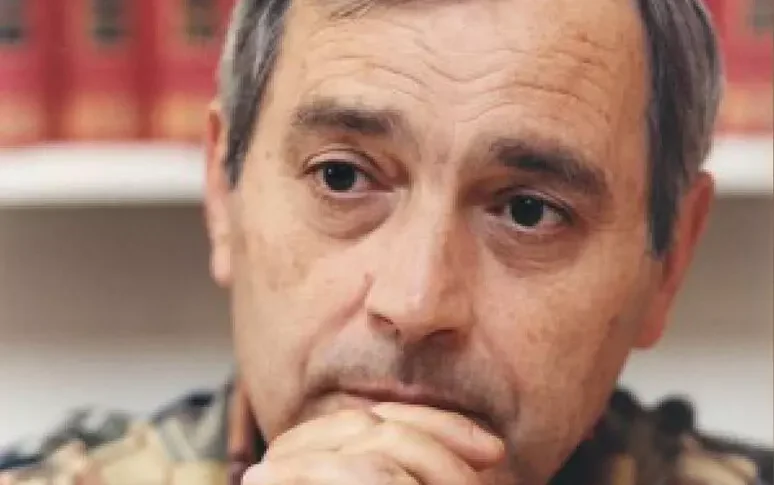
The death of Vittorio Messori, which occurred yesterday, 3 April – Good Friday – seems to embody a powerful symbol, almost a synthesis of his entire existence: that of a man who dedicated his life to telling, investigating and defending the Christian mystery with the tools of journalism. He was 84 years old and died in his home in Desenzano del Garda, after a long illness: a fatal heart attack, despite living with a pacemaker for years.
Messori was not only a successful writer, but a unique figure in the Italian cultural panorama: a “chronicler of the faith”, capable of applying the method of investigation – made up of documentation, verification and rigor – to the deepest questions of Christianity.
His most famous book, «Hypothesis on Jesus», published in 1976, has become a true international best seller (over one million copies sold in Italy), translated into 20 languages and capable of bringing the debate on Christ back to the center of contemporary culture. In those pages, Messori addressed the figure of Jesus not with sentimental devotion, but with the critical approach of a journalist, reaching a clear conclusion: faith can also be reasonable.
His subsequent book “Hypothesis on Mary” was equally important and successful. His career was marked by extraordinary encounters. In fact, he was the first lay person to interview a Pope, John Paul II, giving life to the book-interview “Crossing the Threshold of Hope”. But even before that he had held a long dialogue with Cardinal Joseph Ratzinger, then prefect of the former Holy Office, in the famous “Report on the Faith”. Two works that marked an era and contributed to defining a new way of communicating the thought of the Church.
Alongside intellectual rigor, Messori’s life is crossed by episodes that seem to border on mystery, starting with a mysterious phone call he received as a boy and which after making many conjectures he ended up attributing to the afterlife.
Born into an anticlerical family in Sassuolo (Modena) on 16 April 1941 (he would therefore have turned 85 in a few days), Messori converted from an atheist to Catholicism after reading the Gospels.
As a young journalist, in a moment of profound sadness, he found himself walking along the Murazzi of Turin, observing the waters of the Po. An elderly man approached him, fearing an extreme gesture, and dissuaded him with simple but profound words, then inviting him home for tea. When, some time later, Messori returned to look for him to thank him, he discovered that the house had been uninhabited for years. An episode that he himself would have remembered as a sort of “sign”, consistent with his vision of a reality in which the visible and the invisible touch each other.
In recent years, Messori had continued to reflect publicly on the issues that were dearest to him, especially in the Nursery page held for years in Avvenire, the CEI newspaper. In particular, he often reiterated the centrality of the figure of Mary, declaring to Stefano Lorenzetto in an interview with Corriere that her presence accompanied him every day and that she would be the one to welcome him after his death.
Likewise, he greatly insisted on the meaning of Christianity as the acceptance of a God who gives himself to the point of sacrifice, especially in the mystery of Good Thursday and Friday. For him, there was no room for alternative visions such as reincarnation: the ultimate truth was the love of God. Until the end, Messori defended with conviction the historicity of the Gospels and the real existence of Jesus, considering it not only a truth of faith, but also a sustainable conclusion on a historical level. In this sense, his work can be seen as a bridge between faith and reason, between theology and journalism, between spirituality and culture.
His legacy is that of a man who sought to make the faith understandable without trivializing it, accessible without debasing it. A “special envoy of faith”, as he was defined, who spoke about Christianity not from the height of a professorship, but with the curious and honest gaze of someone who investigates reality.