

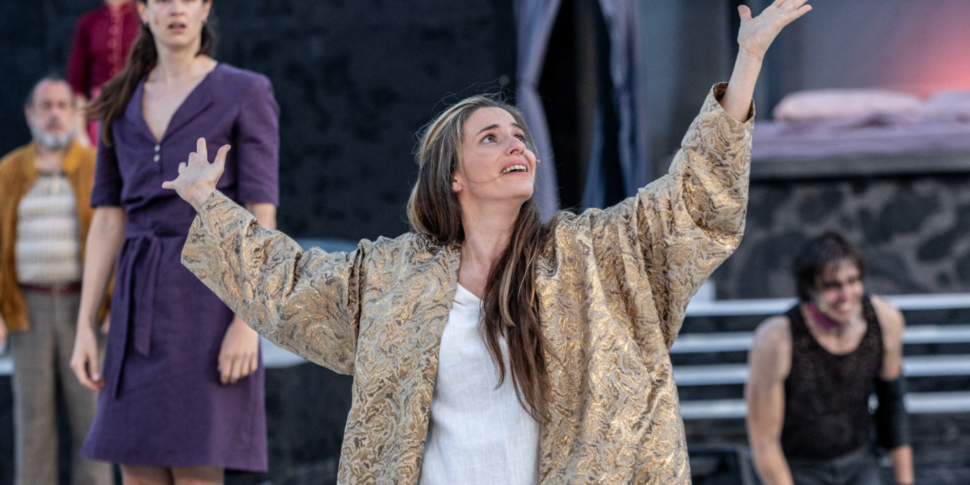
«Alcestis is scary. It’s a story that touches me viscerally. In the end she doesn’t speak because she has to allow us to fill that silence. It is an invitation to the public.” Filippo Dini, making his debut this evening at 7pm at the Greek theater in Syracuse, presents his «Alcestis» by Euripides, the first tragedy of the season of classical performances of the National Institute of Ancient Drama Foundation. Tomorrow will be followed by the premiere of «Antigone» by Sophocles directed by Robert Carsen in the translation by Francesco Morosi. Camilla Semino Favro plays Antigone. On June 13, Àlex Ollé, a Catalan director among the founders of the Fura dels Baus, will make his debut at the Greek Theater, directing «The Persians» by Aeschylus in the translation by Walter Lapini.
«Many results have been achieved but in fact women continue to be in an extremely different condition compared to men from a social and professional point of view» summarizes Dini, artistic director of the Teatro stable del Veneto, who 11 years ago walked the ancient cavea as an actor, but signs for the first time the direction of a tragedy which in his intentions must lead to a reflection on the condition of women today. A “horror journey” that every woman finds herself forced to go through.
«Alcestis is scary because it is the story of a woman who, driven by the fury of her love for her husband, chooses to die in his place – explains Dini –. And it’s scary because he returns from Hades. I think of the woman’s path in history, her evolution, her tragic daily deaths, her possibility of coming back from the horror to finally be able to face the object of her infinite love.”
The translation is by Elena Fabbro, with the music by Paolo Fresu who will perform it live this evening. The scenes of the show, co-produced by the Teatro Stabile del Veneto, are by Gregorio Zurla.
«My soul is in turmoil with the excitement of telling this story, the work of an absolute genius. Just as Alcestis’ soul is in turmoil and she makes a choice: she is not a submissive, but a strong woman, convinced of what she is doing and extremely in love with life. Out of her great love for her husband – continues the director – and so as not to see her fatherless children, she chooses to die in her husband’s place. This leads her to lead a path of horror in Hades. Alcestis’ adventure is passionate and contradictory and lived with passion even in death. And his silence must be filled by us.”
What does Alcestis teach us?
«This is a female tragedy. Alcestis, through his act of love, teaches us to have a deeper relationship in our daily reality. It teaches us to experience love in a deeper and less superficial way. A love that we can’t even understand how great it is.”
Did you even talk about the need for a new civilization?
«We absolutely need it. We are not in a phase of improvement. For thousands of years the world functioned in a certain way: man commanded and woman submitted to his power. A hundred years ago we realized that this was not right. Very little happened after that. I can’t stand the catcalls in the street and the loud praise: all this mediocrity. We can and must be better than this.”
You have already performed in Greek theater and this year you are directing. What choices did he have to make?
«Greek theater is a source of inexhaustible wisdom and inspiration. Magical and mysterious place. Extraordinary place that ignites the imagination and the possibilities of staging are not unlimited because this space has its needs and therefore it must be respected. I think I did: the scene is a fairly aristocratic and contemporary apartment. The scene, in colors and composition, fits into the structure of the rock. And also in all the greenery that surrounds. We tried to respect a classicism within a contemporary project. I hope I did it in the costumes too. Restore the classic nature of the text in that space by seeking rhythms and suggestions that are everyday.”
Another attempt to interpret that space in a contemporary way is the presence of Paolo Fresu?
«The trumpet was rarely heard in the Greek theater. I ask for a little indulgence from the theater. Paolo Fresu draws heavily on antiquity and the archetypes of music. It has a contemporary sound but is based on a wisdom closely linked to classicism.”
Filippo Dini will play the role of Ferete. Deniz Ozdogan will play the title role. And then Alessio Del Mastro (Apollo); Luigi Bignone (Thanatos); Sandra Toffolatti (Handmaid); Aldo Ottobrino (Admeto); Giorgio Signorelli, Riccardo Scalia (Eumelus, son of Alcestis); Maria Sole Gennuso (Daughter of Alcestis); Denis Fasolo (Heracles); Bruno Ricci (servant); Carlo Orlando (choir leader). Coreuti: Simonetta Cartia, Gennaro Di Biase, Riccardo Gamba, Lucia Limonta, Margherita Mannino, Carolina Rapillo, Ottavia Sanfilippo, Roberto Serpi, Chiarastella Sorrentino, Dalila Toscanelli. On stage the choir composed of students of the Academy of Art of Ancient Drama.