

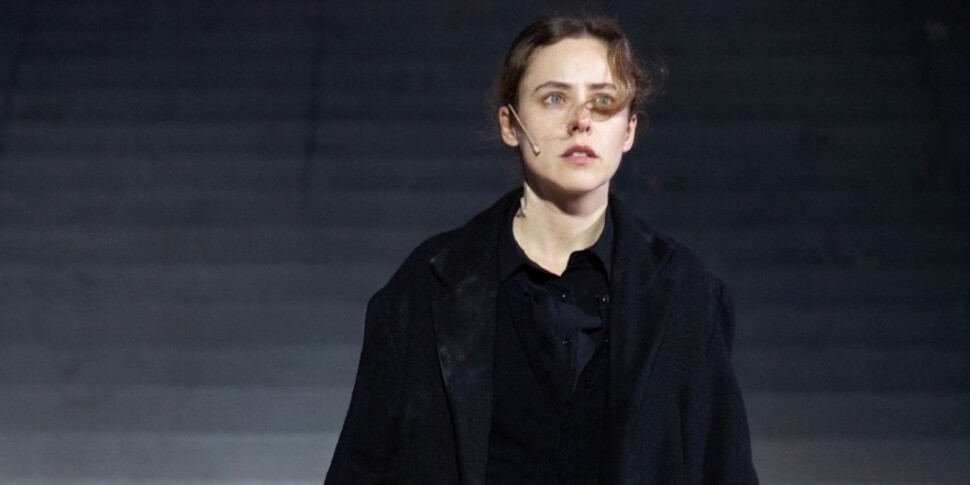
A sold-out theater decrees the success of Euripides’ Alcestis directed by Filippo Dini which opened the 61st season of classical performances yesterday evening.
Applause and ovations from the audience at the Greek theater in Syracuse. Before the start of the show, the mayor of Syracuse Francesco Italia, president of the National Institute of Ancient Drama Foundation, Marina Valensise, managing director and Daniele Pitteri, superintendent of Inda, announced the titles of the next season: from 7 May to 27 June on stage The Trojan Women by Euripides directed by Theodoros Terzopoulos in the translation by Alessandro D’Avenia, Philoctetes by Sophocles directed by Luca Micheletti in the translation by Walter Lapini and Aristophanes’ Birds directed by Davide Livermore in the translation by Mauro Bonazzi. Livermore was present among the spectators of the ancient cavea.
Many students were present last night who were carried away by the music composed by Paolo Fresu and performed live: «What I composed for Alcestis – are Fresu’s words – is the externalization of the internal song which becomes dance-like. A pure sound that adds up and explodes, amplifying feelings.” Alcestis will be on stage until June 6th. Then on tour from 3 to 5 July at the Teatro Grande in Pompeii; on 17 and 18 July at the Roman Theater for the Ostia Antica Festival and on 17 and 18 September at the Roman Theater in Verona.
This evening, at 7pm, the second debut of the season with Sophocles’ Antigone directed by Robert Carsen in the translation by Francesco Morosi. Camilla Semino Favro plays Antigone while Paolo Mazzarelli plays Creon.
«The conflict between morality and state authority is at the center of the work – explains Robert Carsen -. We continue to encounter weak, dictatorial politicians like Creon, politicians who seek to rule through fear. The Greeks, through their theater, repeatedly teach us that only love can break the vicious circle of hatred and misunderstanding. In a world where leaders have decided that strength equals justice, these values become very difficult to find and embracing them requires ever more conviction and courage.”
Is the third and last of Sophocles’ three Theban tragedies the closest to us?
«We are in a Thebes that has suffered a lot from this war – he explains -. I feel the community trying to move forward in this place. It is a tragedy closer to us, it speaks of conflicts of people, of interests. And even if Creon says that he does not cultivate his interests, there are courageous people ready to die for justice: two conflicts and two extreme points of view. The public will choose a side. Antigone has always been about the present, now perhaps more than ever.”
A conflict also between men and women?
«Creon says incredible things against women. Things that we today would consider terrible. Antigone gives us her vision on independence. Ismene does not have the courage of her sister Antigone. The chorus is ambiguous. The choir is afraid of power and what might happen if they said they don’t agree.”
What does Antigone teach us?
«Antigone tries to do the right things according to the law of the gods and comes into conflict with Creon. Antigone feels the obligation and duty to bury her brother. You have a moral, religious and family obligation to provide burial. It’s not courage. But for us it is. It makes us think of other martyrs who sacrificed themselves for what they think is right. We each have a voice that we need to use and not be part of the silent majority. The audience hears and sees. We share this tragic event: Antigone feels the weight of the past. We must learn the lessons of the past but unfortunately man always wants more.”
The cast is completed by Mersila Sokoli Ismene, Gabriele Rametta (Emone), Graziano Piazza (Tiresia), Ilaria Genatiempo (Euridice), Pasquale di Filippo (the guard), Dario Battaglia (the messenger), Rosario Tedesco (the choir leader), Elena Polic Greco and Maddalena Serratore (the chorus girls). The sets are by Radu Boruzescu, the costumes by Luis Carvalho, the movements by Marco Berriel, the music by Cosmin Nicolae, the lighting design by Robert Carsen and Giuseppe Di Iorio. Antigone will remain on stage until June 5th.