

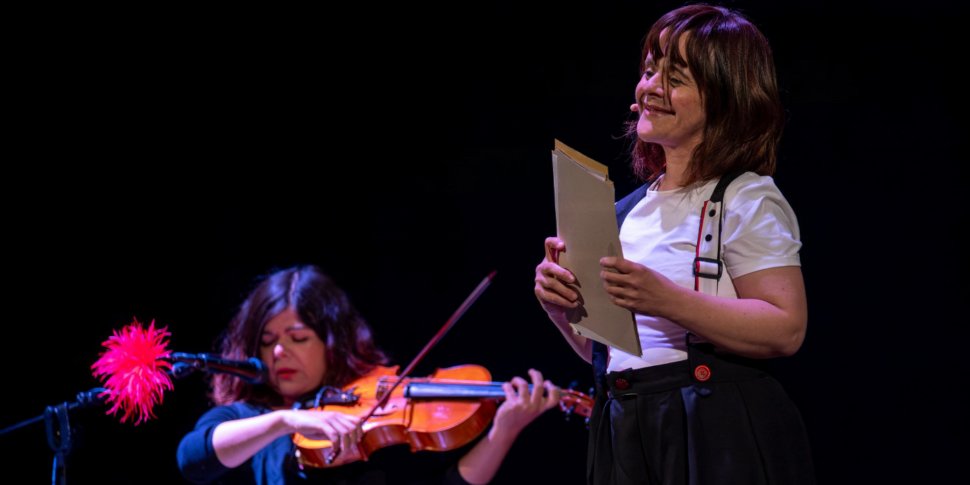
What happens to a life that is not told, that, in some way, is excluded from the official narrative? The life in question is that of Asja Lacis, director, pedagogue, revolutionary woman born at the end of the nineteenth century who intertwined her destiny with that of the German philosopher, writer, literary critic and translator Walter Benjamin, with whom she shared an intense intellectual confrontation, a liaison dangereuse and a passion for revolution. Born with the intention of shedding light on this extraordinary forgotten existence «Asja Lacis – The woman who makes history speak», through a fervent dialogue between music and words, the new production of the award-winning Compagnia Carullo-Minasi, from Reggio-Messina, is the result of the collaboration with Pim Off Milano, Atcl Spazio Rossellini, Teatri di Vetro.
Written and directed by Cristiana Minasi who dialogues on stage with Irida Gjergji (viola, voice, electronics), dramaturgy by Silvia Bragonzi, directorial consultancy by Giuseppe Carullo and scientific consultancy by Alessio Bergamo, the show is proposed as an act of resistance and reflection on history and theatre, broadening the perspectives and multiplying the points of view, in which the rediscovery of Asja appears central.
From a difficult childhood in Latvia to her youth in Petersburg, up to her participation in the Russian Revolution and the creation of the Proletarian Children’s Theatre, Asja challenged artistic and social conventions, proposing theater as a tool for change. His strength, courage and independence are told by Minasi, through a mosaic of encounters, voices, places, between gesture and movement, in which his relationships with men such as Benjamin, Brecht and Meyerhold emerge.
«The creative process – says Cristiana Minasi, artist and scholar from Messina, founder of the Company with Giuseppe Carullo – takes inspiration from the “Proletarian Manifesto of Street Children”, written by Walter Benjamin thanks to the dialogues with Asja in Capri in 1924, from which his imprint was erased. The show invites you to enter this creative game, inheriting from Asja’s work a method that is together research, play and freedom, a jam session in which each member contributes to a collective vision. Her vision of theater as an instrument of transformation and resistance finds new life in a synthesis of fragments, letters and sounds, giving voice to a woman who, through the Russian Revolution, was able to make the theater a place of struggle, change and experimentation.”
The encounter with the figure of Lacis, the idea and the desire to delve deeper into her life and art «comes during my academic research journey, for my doctorate, when – explains Minasi – I had the opportunity to delve into the study of the animated theater of the Seventies which continually refers to a series of methodologies that were born in the early twentieth century between Russia and Germany. And the show begins just like this, with me, the actress, declaring this discovery and this source.”
For many years Lacis was cancelled, despite playing a fundamental role: «It generates real geographical and human constellations of understandings and interests, it sees potential in people and brings it out, both with children and adults», explains Minasi.
But how does this creative process, made up of meetings and experiments, materialize? «The meeting with Irida was absolutely casual as was the one with Silvia Bragonzi who helped us in the recomposition of all the improvisations – continues Minasi – furthermore, the scientific collaboration with Alessio Bergamo was fundamental which allowed us to find exclusive materials, among others, the biography Garofano Rosso, in Russian. Through improvisation, particularly on the world of childhood, we began to put together the show. In the small space of the theatre, Asjia reconstructs a space for street children and orphans through imagination, and this is a point of conjunction with the poetics of the Carullo-Minasi company.”
A long journey underlying the construction of this project: first a residency at the Pim Off in Milan last year, in April, then, again in Milan, a first study as part of the fourth edition ofNessun Confine; prestigious and applauded preview at the Polis Festival in Ravenna, an event that has always investigated fundamental and current issues, including borders, identity, art and which dedicates its ninth edition to a “Nordic Focus” focused on the contemporary theater of the Baltic and Scandinavian countries.
The show is scheduled in Messina, at the Sala Laudamo, until tomorrow.