

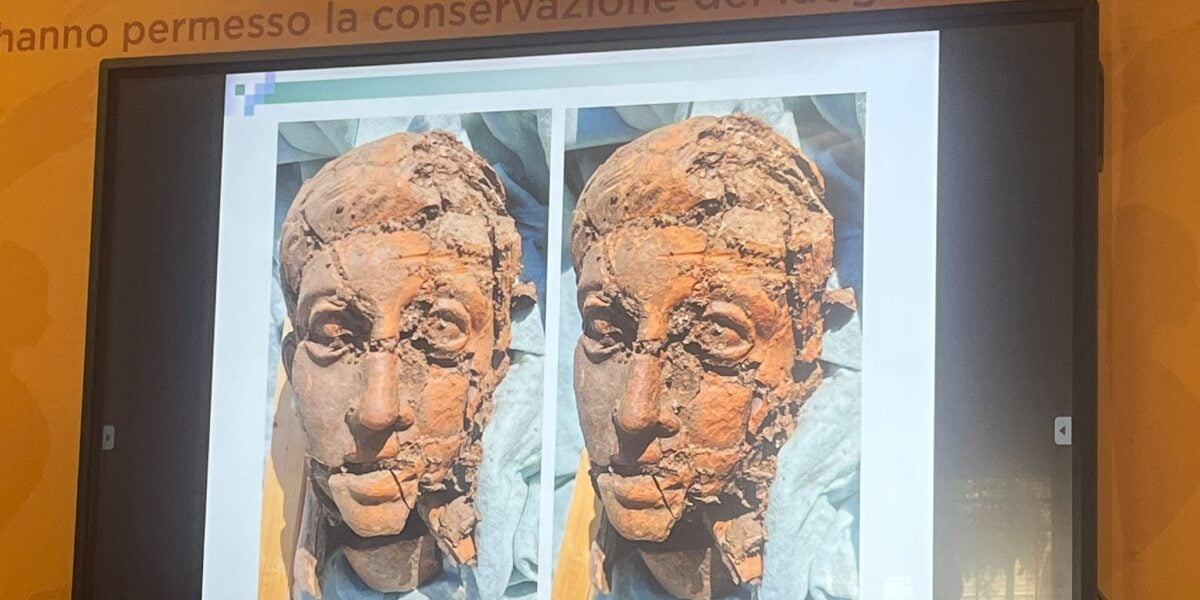
A head with apparently Italic characters from the 3rd century BC. This is the most important find found during the excavation campaign underway in the Pignera-Stadio area in Crotone as part of the Ancient Kroton project. Not only that, because the research also revealed the face of a gorgon, a Greek mythological figure from the 2nd century BC
The first results of the excavation, which covered over 4,000 square metres, were presented this morning by the archaeological superintendent for the province of Crotone and Catanzaro, Stefania Argenti. Only a few photos of the 3rd century BC artefact have been shown and distributed because the artefact, in extremely fragile conditions, is preserved in the superintendency’s warehouses awaiting restoration.
The riddle of the head from the 3rd century BC
«The head – explained Alfredo Ruga, archaeological official of the superintendence and coordinator of the construction site – could date back to the period of the Hannibalic war, which saw the presence of the Brettii and the removal of part of the Greek citizens from the city of Kroton. However, only the restoration and more in-depth analysis of the ceramic body and the material itself could reserve surprises, perhaps by slightly backdating the piece and inserting it into the last production phase of the actual Greek city”.
The face of the gorgon and its apotropaic value
As for the gorgon – explained Ruga – “it is relevant not as a finished artefact intended for use, but as a valuable waste”. The gorgon, in fact, presents very particular characteristics compared to those already known from the various excavations in Crotone. The most similar one can be dated to the archaic period. In this piece the gorgon loses its feral characteristics and no longer has its sharp teeth visible, but the grin with angled lips and tongue out still prevails, since the figure has an apotropaic value and must maintain this characterizing element.
The discovery of the Kroton ceramic district
The excavation is allowing the area to be given a precise identity: it was the ceramic district of Kroton. In fact, many fragments of matrices have been found. «These demonstrate that at least 80% of the coroplastic artefacts (statuettes and other) circulating in the city of Crotone between the 5th and 4th centuries BC are productions carried out within this ceramic district», explained the archaeologist.
«Antica Kroton – explained superintendent Argenti – is a unique laboratory in the national context. It has a very large scope from a scientific point of view for studies on Magna Graecia which could be used to write new elements of knowledge.”