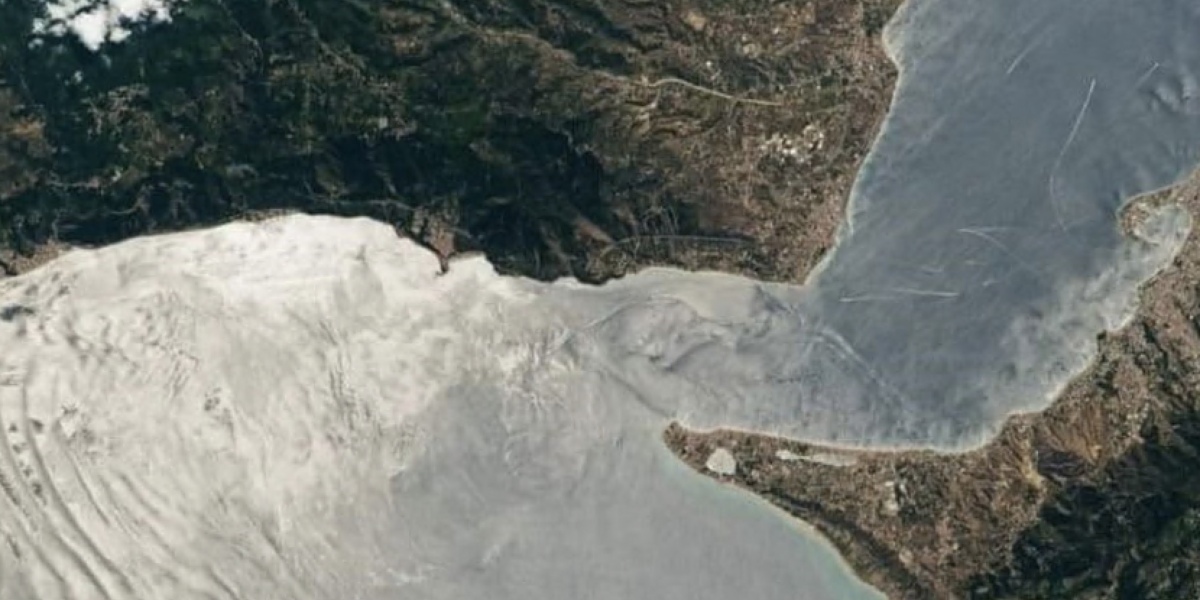
Those who do not want the Bridge over the Strait of Messina rely on myths as on a reason older than reason itself, the one that a Strait inhabited for millennia has been able to give itself. Whoever wants it, on the contrary, reads cliff tales disguised as wisdom, tales of times gone by, a dead weight that keeps tomorrow entangled like fish in a net.
But, in reality, those who want the Bridge believe in an equally entrenched myth, and rely on its representation: union as destiny, primacy as a measure, the salvation of the South as a promise. If a public work like this is discussed, in one way or another, for one hundred and sixty years without being built, it is reasonable to suspect that its function was never to let trains and cars pass, but to let meanings pass.
The works that serve to convey meanings have an ancient name: they are called myths. I will not talk about costs, wind, shocks or rowing – as fishermen call the current – on which there are technical reports that are worth more than any opinion. We need a word on the bridge as a myth, for those who want it and for those who don’t want it.
Antiquity imagined the Strait. Scylla and Charybdis make an opening which is paid for with a tribute of men; but the text that matters most is in the third book of the Aeneid, where Helenus explains to Aeneas that those lands were once a single land and that a vast ruin divided them, letting the sea enter. Strabo and Pliny repeat the story: Sicily was not born an island, it became one through a catastrophe.
From this story comes the verb that, from the nineteenth century to today, governs every discussion favorable to the work: to unite. Anyone who says that Sicily should be united to the continent assumes, without knowing it, that it has been divided by a wrong of nature and that steel can correct it. It is here that the bridge takes on its deepest dimension, the soteriological one, that is, it represents a salvation: the bridge saves because it mends an original fracture.
However, antiquity also knew the opposite myth: Xerxes, who causes the sea to lash after the storm destroyed his bridges over the Hellespont, is for Aeschylus the very sign of arrogance. Throwing a bridge over the sea can be repair or profanation, and for this reason the bridge has always generated both faith and scandal.
The lexicon of salvation is moreover linked to bridges: Varro derived pontifex from pons, and Catherine of Siena, in the Dialogue of Divine Providence, describes Christ as a bridge thrown between heaven and earth after the fall of Adam had opened a river that no one could cross anymore.
No designer of the Strait has read Saint Catherine, but when the bridge is called redemption of the South, rebirth, sign of an Italy that is getting back on its feet, the language resonates with that memory, even if those who use it don’t know it.
The Strait, meanwhile, had given itself its own myths, and in those myths the bridge is not there. Colapesce, sent by the king to explore the bottom of the sea, discovered that Sicily rests on three columns, that Messina’s is cracked, and he remained down there, at the bottom, holding it up with his shoulders.
It is a myth of salvation, but reversed: salvation occurs below and not above, through sacrifice and not through construction, through a man who sinks and not through a work that is shown to the world. The island is not united to the continent: it is supported in its separateness.
Messina already has its own redeemer, and it is at the bottom of the sea. The other native myth is the Fata Morgana, the illusion that makes towers and suspended cities appear on the water, and then melts them. Yet, the Strait had found, centuries before the renderings, the exact form in which the bridge would be seen: an image that arises at intervals, shows itself for some time and vanishes.
The bridge enters the discussion with the metal constructions of the nineteenth century: Cottrau in 1866, Navone with a tunnel in 1870, Zanardelli in 1876 with the phrase, repeated for a century and a half and never precisely documented, according to which “above the waves or below the waves” Sicily would be united to the continent.
It is here that the bridge is understood mythically for the first time: not in Messina nor in Reggio, but in Rome and Turin, by ministers and engineers from the North. In the same years, Villari, Franchetti and Sonnino describe the South as a body separated from the rest of the country, and the bridge responds to that economic and civil separation with the figure of a physical conjunction. The Strait is three kilometers wide; the distance they wanted to bridge was of a different nature, and a bridge, no matter how long, does not reach there.
Then comes December 28, 1908, which repeats the ancient myth in literal form: the earth is torn apart with a terrible earthquake, the sea enters. The Futurist Manifesto appeared in the Figaro less than two months later, and in the eleventh point it exalts bridges “like giant gymnasts who cross rivers”.
Have the futurists ever dreamed of a bridge over the Strait? No. The silence weighs, because the conditions were all there: Antonio Sant’Elia designed metropolises of bridges between skyscrapers, and in Messina Guglielmo Jannelli founded La Balza futurista in 1915. Young people who grew up among the post-earthquake shacks did not make the bridge over the Strait their emblem.
In the post-war period, mythographers allowed themselves to be named with a certain clarity. The first is industry: in the 1950s the Gruppo Ponte di Messina and the American Steinman proposed a suspension bridge, and the myth is that of the record, the longest span in the world. The second is the republican state, with the 1969 contribution, the 1971 law on the “stable connection”, the 1981 society: what has been stable, in forty years, has been only the society that had to build it. The third, the most explicit, is the personalized policy: since 2001 the bridge has been the emblem of the “Italy of doing”, then tender, revocation, relaunch, liquidation, resumption by decree in 2023, approval by the Cipess and denial by the Court of Auditors in 2025, favorable opinion in the summer of 2026 and announcement of the construction sites within the year.
The formulas are known: the largest work in the world, the work that changes the history of the South. None describes an infrastructure; they all describe an event. And an event announced for seventy years, which each postponement does not deny but relaunches, has the temporal structure of prophecies, not of construction sites. “I believe in it” is perhaps the most pronounced phrase on the bridge, and it is the phrase of a faith. Every soteriology needs an opponent, and when a work is thought of as salvation the technical objections become heresies.
The place of the myth has always been the center: Rome, television, the decrees. The two sides reacted divided, but were never the source. They responded with other myths, which are their own. Vittorini, in Conversation in Sicily, makes the Strait a threshold that can be crossed by sea and slowly, because the crossing is the time of returning to oneself: a threshold crossed in four minutes is no longer a threshold, it is a toll booth. D’Arrigo, in Horcynus Orca, made Scyll’e Charybdis the vastest mythical space of Italian literature of the second half of the twentieth century, a sea that one deals with, not an obstacle that can be overcome: in his world the bridge is unthinkable, just as a roof over the sky is unthinkable. Consolo made it an explicit polemic; Sciascia had described insularity as a form of the spirit, not as a defect in the geographical map.
That the bridge is a myth is not in itself an accusation. The problem is that the myth of salvation has worked in silence, and has thus replaced evaluation.
Colapesce’s lesson remains: the salvation of the island, in the tradition that the Strait has produced itself, can only come from a cure, made up of schools, hospitals, railways, courts, that a land requires. The futurists, who loved bridges, didn’t want it, and perhaps they had a reason they couldn’t explain: a bridge that must redeem is no longer a bridge, it’s an altar. And the altars, on the Strait, have always asked for their tribute.