

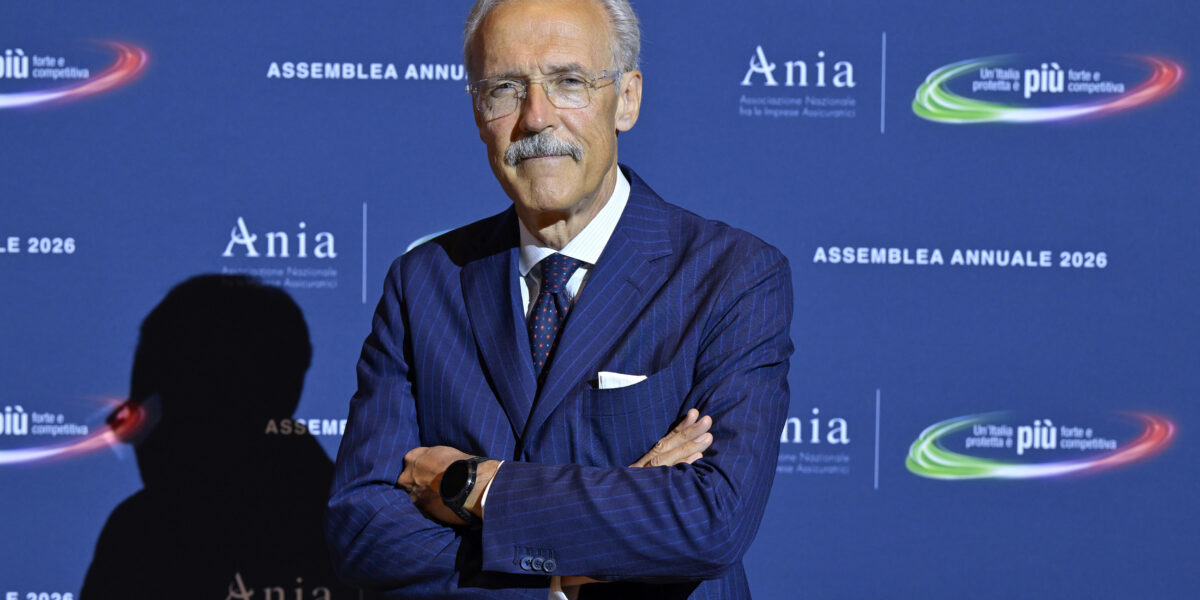
“Twelve months ago, from this same stage, I launched a common challenge: a “Pact for a protected and therefore stronger and more competitive Italy”. Today, the global scenario does not allow us the luxury of slowing down, on the contrary. We live in an era of geopolitical fragmentation, of neo-protectionist pressures and international trade tensions, of wars, which generate inflation, recession, volatility on the financial markets, economic-financial effects but also material risks never seen before. There are adverse events from which it is urgent protect ourselves with the appropriate tools and structural phenomena that generate investment needs for which the resources must be found. In this complex geopolitical and macroeconomic context, Italy is demonstrating extraordinary tenacity and I say this to all the representatives of the institutions. But tenacity alone is not enough if it is not supported by a protection infrastructure that allows families and businesses to look to the future with serenity and optimism and which guarantees the socio-economic system the necessary resources to invest with courage the social and economic mission of the insurance sector”.
The president of Ania Giovanni Liverani outlined the budget and strategies yesterday in Rome during the annual meeting of the National Association of Insurance Companies, which brings together over 90% of the companies in the sector. The meeting, like every year, recorded important institutional sharing, with messages of good wishes from the Head of State Sergio Mattarella and the Prime Minister Giorgia Meloni, and the interventions of the deputy prime ministers Antonio Tajani and Matteo Salvini and the ministers Adolfo Urso and Giancarlo Giorgetti. Also present was Paolo Angelini, president of Ivass, the insurance supervisory institute.
Italy, exposed to serious catastrophe risks, remains a country that is still underinsured. In fact, among the most important steps, Liverani highlighted the need for wider sharing on the value of risk coverage for families and businesses also through a greater diffusion of insurance culture, an objective that the association tries to achieve for example in the sports sector, by communicating with athletes, and in schools, thanks to the agreement with the Ministry of Education. And among the proposals on the subject of supplementary pensions, one concerns young people, with the idea of an “entry bonus”: “A sum, even symbolic, that the State would provide to all girls and boys who turn eighteen, with the obligation to invest it in a pension fund or in a social security policy”.
The issues of demographic decline and ageing, with the consequent social security scenarios, were examined by Liverani, together with the prospects regarding technological progress and the performance of the various sectors (protection from natural disasters, car civil liability, life), highlighting the role of the sector as the largest private investor in the country.
“The metric that best describes our mission – he underlined – is the real impact on people’s lives. Millions of citizens and millions of entrepreneurs are guaranteed and protected by an insurance or insurance and social security savings contract. In the last year, the sector has disbursed 42 billion euros of which 27 to compensate the over 18 million damaged customers and 15 billion for risk policies linked to human life, as well as transferring around 93 billions to its customers in the form of annuities, redemptions and other types of benefits in the context of Life financial management. It means that every day, every hour, thousands of times a minute, an insurance policy has taken concrete action”.
The consolidated data emerged from the report
Overall premium income reached 182 billion euros, marking solid growth of 7.8%. A symmetrical increase which sees the Non-Life sector grow by 6.5% and the Life sector confirm its development trajectory of over 8%. The overall capital solidity, measured by an average sector Solvency Ratio firmly at 274%, is positioned at the top in Europe “confirming our companies as a rock of stability for the entire Italian macroeconomic system” stated the president.
“We are Italy’s leading private institutional investor: with over 1,000 billion euros of active investments, of which approximately a quarter are allocated to our sovereign debt, we directly finance the development of the nation, its infrastructure and its real economy. We contribute – and I say this with a certain pride – with approximately 14 billion euros to the State’s fiscal revenues, including direct and indirect taxes, and we offer quality jobs to around 300 thousand families who work in our supply chain and stability second to no other production sector”.
Ministers’ speeches
“We need your participation,” said Deputy Prime Minister and Minister of Foreign Affairs and International Cooperation Tajani, underlining the importance of the insurance sector and the challenge for the Government to involve it in large strategic operations, but also to protect it from unfair competition. He outlined in particular the scenarios that are also opening up on the major international routes, thanking the sector for the contribution made during the last financial year following agreements and negotiations.
The deputy prime minister and minister of Infrastructure and Transport Salvini provided worrying data on the evasion of the insurance obligation (out of 47 million vehicles in circulation, 9 million are uncovered and in some provinces the rate exceeds 40%) hoping for a reduction in the costs of car insurance. He then outlined the related scenarios for the development of railway infrastructures, reiterating how “with 1300 open construction sites, an average of 10,000 trains and 500,000 passengers there may be some delays or inefficiencies”.
The Minister of Business and Made in Italy Urso underlined the need to build a resilient production system, capable of facing contemporary risks, including those linked to the interdependence between nations. And in this sense he outlined three major directions of industrial development, such as energy (with a firm hope for the strengthening of civil nuclear power and renewables), infrastructures (also necessary to reduce dependence on the supply of critical materials) and new technologies (in particular robotics to be applied to business processes without however compromising the social sustainability of the production system).
Economy Minister Giorgetti highlighted the government’s role in spreading the importance of protection to families too and hoped for an increase in investments by insurance companies in government bonds, which fell in 2025 in the face of growing interest from the retail market and foreign investors. “We have given the country stability – he stated – it is now time to get back on track together with the insurance sector”.
A collaboration that is already in the strategic directions of Liverani, who also wanted to underline the internal unity of the sector within ANIA, with the collaboration of parallel structures such as Ania SAFE, Fondazione Ania and Fondazione Ania-Consumatori: “We are no longer a fragmented sum of acronyms or market interests. Thanks to the new impetus deriving from the approval of the statutory reforms, we have developed a courageous and long-term strategic vision: ANIA today speaks to the institutions and to the country with one voice, strong, united, cohesive and authoritative, making not claims but concrete proposals”.