

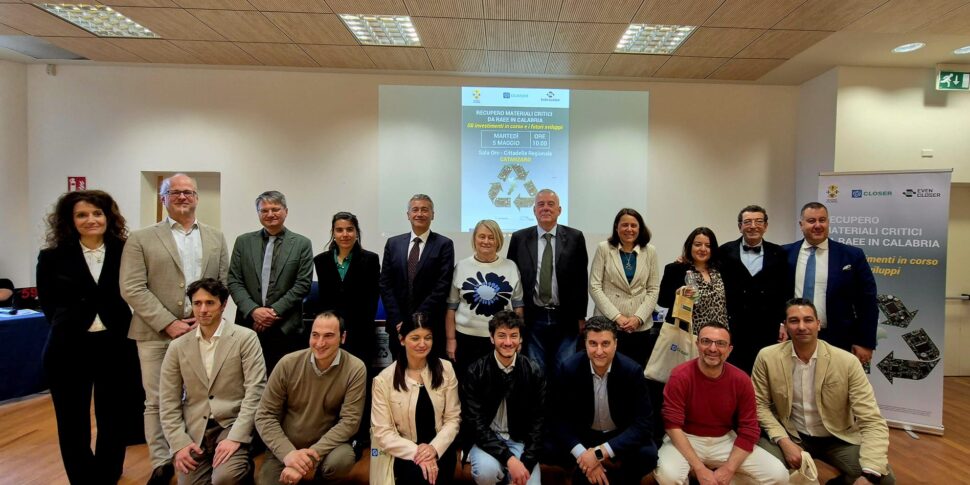
The workshop dedicated to the presentation of the results and future developments of the international Closer and Even-Closer projects, both financed by the European Commission as part of the I3 instrument for supporting interregional technological scaling-up, took place today in the gold room of the regional Citadel. The meeting, moderated by Caterina Loddo, manager of the Innovation Sector of the Calabria Region, saw a high-profile technical and institutional discussion.
Calabria as a hub of the circular economy
The event was opened by the general director of the Department of Work, Business and Productive Areas of the Calabria Region, Fortunato Varone who, in offering greetings from the branch councilor Giovanni Calabrese, highlighted how the Calabrian territory is becoming a cutting-edge laboratory for urban mining: “With the Closer and Even-Closer projects, Calabria becomes the protagonist of the green industrial revolution in Europe. Recovering critical materials from electronic waste means transforming a waste into a strategic resource, guaranteeing our companies a front row seat in the markets of the future, from automotive to photovoltaic. Our goal is clear: to make Calabria a European hub for the circular economy. Such an ambitious goal would not be possible without a great collective effort. For this, I want to sincerely thank the entire team of the Department, the academic partners and the companies who have worked and continue to work with dedication on these projects innovative, sustainable and competitive.”
The results of the Closer project: traceability and recovery
The Closer project, now halfway through its 18-month journey, has already achieved extraordinary goals that place Calabria at the center of a pan-European network made up of 32 partners. To date, the consortium has successfully implemented a corporate network for reverse logistics, allowing the reinsertion of end-of-life products into the production cycle through the selective disassembly of LCD displays and photovoltaic panels. Technology has made great strides with the development of advanced diagnostic systems for the characterization of critical raw materials and the creation of the first phase of the Digital Product Passport, an essential tool for the traceability of recovered components.
Future developments: the Even-Closer project and academic research
In parallel, the Even-Closer project projects this vision towards even broader sectors, involving defense and heavy industry in the challenge of reparability and recycling of silicon. The scientific interventions by Sofia Ubaldi for the Tor Vergata University and by Stefano Curcio of the University of Calabria, coordinator of the Even Closer project, illustrated how academic research is being translated into concrete industrial applications, supported by excellent local entities such as Ecosistem and Hts.
In the final part, Carlo Polidori of Veltha highlighted how the involvement of local businesses must be increasingly stimulated by the regional administration to involve the territory in new value chains.
Towards European strategic autonomy
The day ended with an exciting prospect for the second phase of the project, which will see the practical creation of silicon wafers deriving from secondary raw materials and the functional testing of reconstituted electronic boards. This path not only reduces Europe’s dependence on non-EU markets, but defines a new model of economic development for Calabria, capable of combining environmental protection and global industrial competitiveness.