

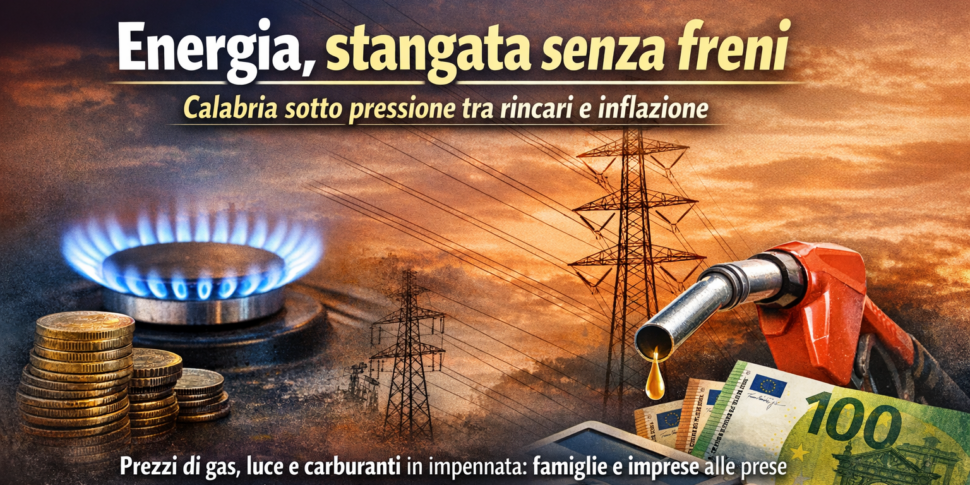
The tug of war triggered by the energy crisis has updated the map of survival in a Calabria that has had to deal with the soaring costs of electricity and gas. Schizophrenic increases which do not only concern the perimeter of businesses but which have already reshaped the financial certainties of Calabrian families. Irregular dynamics triggered by the devastating effects of the conflict in the Middle East which generate chain landslides within the banks of the social resilience of an increasingly tested humanity. A collapse facilitated by an inadequate energy system and a structural dependence on fossil fuels is putting the entire productive and social system to the test. The out-of-control prices of electricity and gas and the rising price of fuel at the pump weigh down the shopping cart, including food products.
Rising prices and uncertain scenarios
One month after the start of the conflict, projections for the near future lack certain coordinates since the energy markets have suffered immediate and devastating reactions. The price of gas increased by 26 euros per MWh (+81%) and that of electricity increased by 41 euros per MWh (+38%). The forecasts for 2025 and 2026 are not reassuring, with an estimated economic impact that will inevitably be reflected in bills. Families and businesses risk being stranded in the shadow. Estimates from the Mestre CGIA Research Office speak of an overall increase in energy costs that could reach 15.2 billion euros by the end of the year. In particular, the production sector could suffer an increase of approximately 9.8 billion euros, while families will see their energy expenditure increase by approximately 5.4 billion euros.
The impact in Calabria
Calabria is also experiencing days of anguish, caught in the grip of continuous surges in energy prices capable of generating very dangerous inflationary spirals, capable of causing the collapse of internal consumption which is the pillar on which our economy is based. Specific estimates for the region speak of an overall increase of 222 million euros between 2025 and 2026. Of this sum, approximately 97 million relate to the impact on costs for businesses, while 126 million of additional spending will burden families. The overall price increase for households is equal to a percentage of +13.4% compared to the national average of +13.3%. The situation does not appear likely to improve in the short term, especially with international instability continuing to impact prices.
The difficulties of businesses
Businesses, which represent a fundamental part of the Calabrian economy, are particularly vulnerable. Increases in the cost of energy could force many small and medium-sized businesses to review their operations. Aldo Ferrara, president of Unindustria Calabria, in recent days, spoke of a growing concern among local entrepreneurs, some of whom are already adopting countermeasures to contain the effect of energy hyperinflation.
Families and risk of energy poverty
But the high energy costs don’t just affect businesses: the effect also spills over directly to Calabrian families. Electricity and gas bills, which already represent a significant burden in many homes, are set to increase further. According to forecasts, the cost for Calabrian families will rise to 1,060 million euros in 2026, with an annual increase of approximately 126 million compared to 2025. This means that many families will have to allocate an increasingly significant part of their income to cover energy costs, further worsening the situation of energy poverty that already afflicts a significant part of the population.
Fuels on the rise
Added to these difficulties is the trend in fuel prices, which periodically record significant increases. The average price of diesel in Calabria reached 2.061 euros per litre, while petrol rose to 1.766 euros per litre. However, the cost of filling up varies from area to area, with some areas offering lower rates. For example, in the Reggio Calabria area, the Panoramic Stop offers the cheapest price, with petrol at 1.659 euros per liter and diesel at 1.669 euros. In other areas of the region, prices are around 1.70 euros for petrol and 1.99 euros for diesel, with differences depending on the location and the availability of petrol stations.
Requests to the Government
The measures implemented so far by the Italian Government are not sufficient to deal with the emergency. Although measures have been adopted such as the temporary elimination of system charges in bills and the introduction of tax credits for businesses, the situation continues to be critical. The president of the Cna Calabria, Giovanni Cugliari, asked for urgent intervention from the Region, urging President Roberto Occhiuto to convene a conference of the regions to find a common and coordinated strategy. According to Cugliari, it is no longer a technical issue, but a political, economic and social one.