

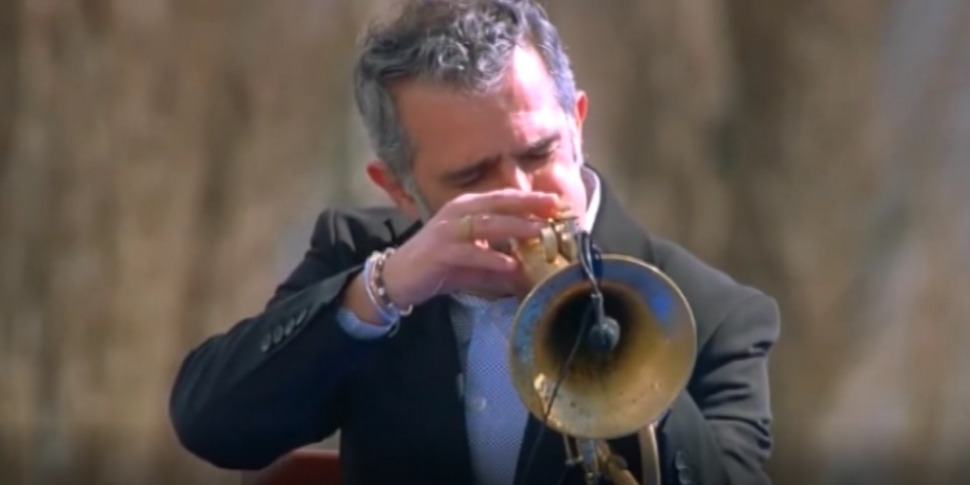
The floral shirt. A voice that almost forces you to come closer to hear it. Paolo Fresu speaks as he sounds: slowly, holding his breath for a moment before letting it go. In Cosenza he held the lectio magistralis «The roots and the wings. It is from the earth that we take flight” to celebrate his Sila Lifetime Achievement Award. He told a packed audience about Sardinia like a stone thrown into the Mediterranean, about his shepherd father who wrote poems in Sardinian on little pieces of paper, about the trumpet hidden in the upper part of a bookcase so that little Paolo, or rather him, wouldn’t break it. At the end, he greeted the audience with an intense version of «Bella ciao»… naturally in a fantastic trumpet solo. Now you would sit here listening to his stories for hours. Following him everywhere. Like the children of Hamelin behind the piper. Except that here the goal is the discovery of the artistic and civil commitment of a man who made the trumpet his voice in the world.
The Prize Jury defined your trumpet as “a now classic voice not only of music, but of the entire contemporary Italian culture”. What does this recognition represent?
“Very. It is an award with an important history. It arrives at an intense moment, of battles also faced through music. I often read on social media, when I take a position on Gaza or anything else, comments like: why don’t you just play? As if the artist were prevented from contributing to a reflection on the world. This award tells me otherwise. It is an incentive to continue with the same passion, the same energy, the same desire to carry on the battles and tell a bit of beauty.”
Time in Jazz is in its 39th edition. This year is dedicated to Miles Davis on the centenary of his birth, with the title «Kind of Blue»…
«The festival has become a great cultural container where very different languages meet. This year we will have a lot of electronics, Diodato, a tribute to Fabrizio De André. There is Time to Children, the children’s festival, very important for us, where we present books, discuss culture, talk about authors, about what we are experiencing. There is the Festival Bar, concerts in the bars of the town where young Sardinian and continental musicians converge who otherwise would not have an important showcase. Starting from music, which is capable of uniting everyone and making hearts beat in unison, it is possible to investigate very different areas, to reflect on the meaning of beauty and the possibility of using it to build a better world.”
Amnesty, Francesca Rava Foundation, UNESCO Youth Ambassador, closeness to the Palestinian people. Has civil commitment ceased to be something separate from music? And when?
«Never, actually. When I first heard a trumpet player on the radio playing jazz in the late 1970s, I was shocked by the sound, unlike any trumpet I had heard until then. Then, reading the stories of that music, I understood that it was protest music. Black Americans, those strange fruits sung by Billie Holiday who were men hanging from trees in the South of the States. Miles Davis beaten in ’59 because he left the club with a white woman by his side. I chose jazz for the aesthetic aspect, of course, but also for the social and political content that other music didn’t offer me. Over the years, an increasingly broader civil conscience has developed, up to this moment in which the disparities and injustices are so many that we cannot remain silent. Mine is instrumental music, it doesn’t use words. The word strikes in a clear way, it punctuates and defines boundaries. Music without lyrics is universal: you can go to the most distant place, where a language very distant from yours is spoken, and communicate something important, which is no less sharp than words.”
Over 450 records, with musicians from all latitudes. How do you choose the next album, the next collaboration?
«These are things that happen randomly. People met at lunch or backstage. We liked each other, we tried to do things. Sometimes it ends there, other times it continues. My historic quintet has existed for 43 years, a unique case on the international scene. The collaboration with Uri Caine for 22 years, the Devil Quartet 20. Now we resume a trio tour with Antonello Salis and Furio Di Castri, a group that has existed for dozens of years. In October I will go into the studio to record a new album with Devil. I’m not interested in playing with the best musician in the world. I’m interested in building with people who want to do things together. Behind it there is esteem, respect, friendship, research. Groups divide for a thousand reasons: someone passing away, relationship problems, money problems. We were lucky enough to find each other, to believe in it. When you find people like that, you feel very lucky.”
You have collaborated with writers of the caliber of Bergonzoni, Benni, Celestini. And published books for Feltrinelli. What relationship do you have with the written word?
«I love writing very much, I love reading even more. Traveling is my creative moment: I can’t wait to get on the plane because no one bothers me, I can read, put my thoughts on paper, write the festival programme. Twelve hours to Buenos Aires or New York is plenty of time to yourself. In Sardinia there has always been this propensity. It still happens that shepherds in the countryside know entire passages of the Divine Comedy by heart. There is an idea of oral tradition which is expressed through the sound of the spoken language, the Sardinian language. My idea of writing is always the slightly poetic one of sound. Music is an urgency and a goal, because I consider myself a musician. Writing is not a goal: it is an urgency. I leave the objective to others.”