

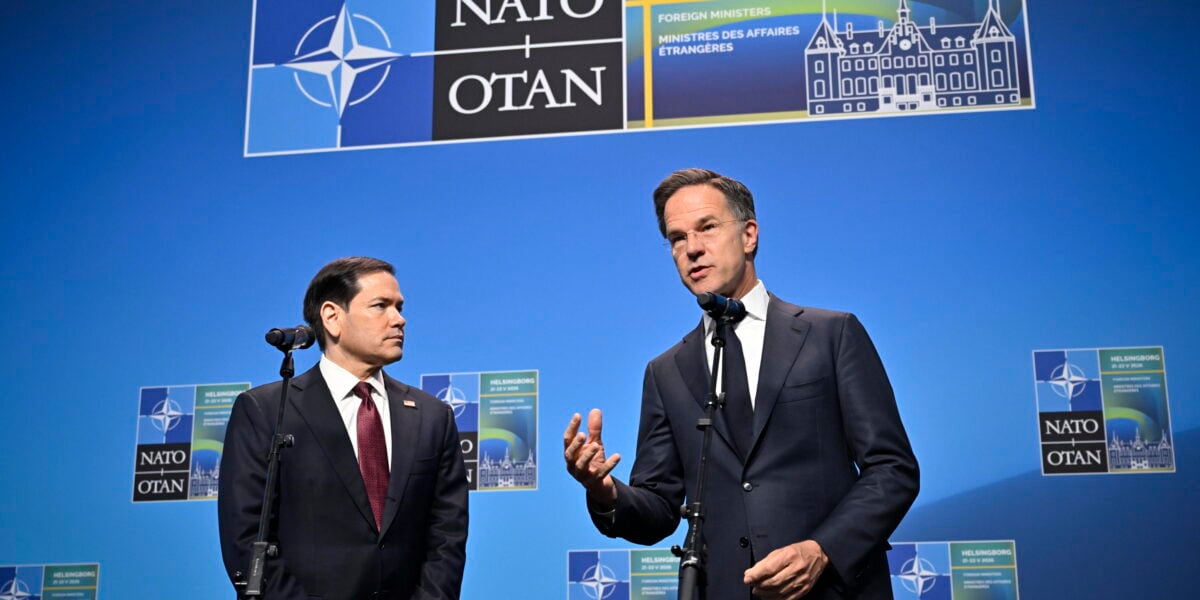
The president of the United States, Donald Trump, was “frankly disappointed” by the lack of support of “some NATO allies” for the attack on Iran. This was declared by the US Secretary of State, Marco Rubio, at the opening of the NATO ministerial meeting in Helsingborg.
“We’re here to lay the groundwork for what I think will probably be one of the most important leaders’ summits in NATO history,” Rubio said. “The president has been frankly disappointed in some of our NATO allies and their response to our operations in the Middle East.” «This problem will have to be addressed. It will not be resolved or addressed today. It’s an issue that leaders will have to discuss,” Rubio added.
Peace near?
There has been “slight progress” in negotiations with Iran, Rubio said. «We await news on the ongoing talks. There has been some slight progress,” Rubio said, “I don’t want to exaggerate, but there has been a little development, and that’s good.”
Changing US presence is not punitive
The reduction of the US military presence in some European countries “is not punitive”, Rubio then highlighted. “You saw the president’s announcement last night regarding Poland and troop deployment,” Rubio emphasized, “obviously the United States continues to have global commitments to meet in terms of force deployment, and that requires us to constantly review where we place troops.”
«This is not a punishment», explained the US Secretary of State, «it is simply an ongoing process that precedes all this recent news, tensions and so on». «So it is a process that will continue and I believe it will be very positive and productive», concluded Rubio, «collaboration with our allies can lead to decisions but in the end, like any alliance, it must be advantageous for all involved. There needs to be a clear understanding of what the expectations are.”
Trump is disappointed, Ankara summit will be in NATO history
«We are here to lay the foundations for what, in my opinion, will probably be one of the most important leaders’ summits in the history of NATO. The president’s views, disappointment with some of our NATO allies and their reaction to our operations in the Middle East are well documented. These are issues that will need to be addressed. They will not be resolved or addressed today. It’s a topic for leaders to discuss.”
If we accept Hormuz tolls the case will repeat itself
If Iran is allowed to establish a toll system for crossing the Strait of Hormuz, a precedent will be set and other nations in a position to do so will follow suit. «Iran is trying to create a toll system. They are trying to convince Oman, among other things, to join this tolling system on an international waterway,” Rubio stressed, “there is not a country in the world that should accept it. I don’t know a country in the world that is favourable, apart from Iran.”
«Right now at the United Nations we have a resolution supported by Bahrain. We put a lot of effort into it. It has more co-signatories than any other resolution ever before presented in the Security Council,” the Secretary of State explained, “unfortunately, a couple of countries in the Security Council are considering vetoing it. That would be deplorable. We are doing everything we can, however, to reach the kind of global consensus needed to prevent this from happening. And we are trying to use the United Nations.”
«Let’s see if the United Nations still works. That’s where we will try to get a result. And obviously, I believe that almost every country represented here today has signed on as a co-sponsor of that resolution,” Rubio continued, “and if they haven’t done so yet, I’m sure they will soon. Because I don’t know anyone in the world who should be in favor of a tolling system on an international waterway.” «It’s simply unacceptable. It can’t happen. If this were to happen in the Strait of Hormuz, it will happen in five other places around the world,” Rubio noted, “why wouldn’t other countries around the world say, ‘well, we want to do this too’? Not to mention how vital and crucial that strait is for every country represented here today, but frankly also for countries not represented here, particularly those in the Indo-Pacific.”
We are not producing ammunition at the rate needed
NATO countries do not produce munitions “at the rate necessary for future needs”. This is the warning launched by Rubio. «One of the sectors in which I believe we can certainly collaborate is that of the defense industry. It is clear to everyone, within the alliance and beyond, that today we are not able to produce munitions at the rate necessary for future needs,” Rubio said, “this is a problem that must be addressed. This is something we can work on together. It’s something we want to work on together. I believe it is fundamental not only for production, but also for interoperability. So I imagine it will be a topic of discussion.”