

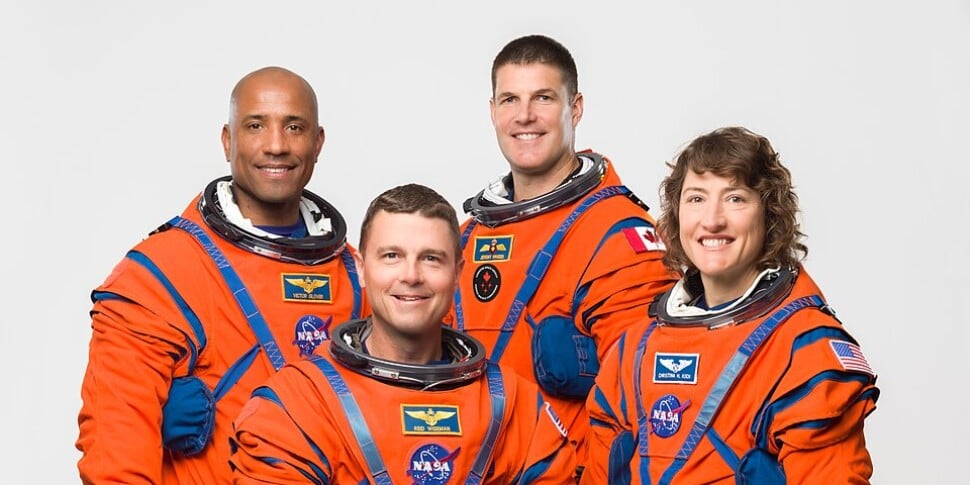
An epic adventure: this is how the four astronauts of Artemis II defined their mission, destined to reach lunar orbit. They arrived at Cape Canaveral (Florida) and, after postponements due to technical problems in the upper stage of the launcher and in the midst of the reorganization of the exploration programs announced by NASA, they are now focused on the launch, scheduled for April 1st.
“I don’t think about anything else,” said NASA Commander Reid Wiseman. Ready to fly with him and collect records are pilot Victor Glover, also from NASA and the first black person to fly beyond Earth’s orbit, and mission specialist Christina Koch (Nasa), the first woman to fly to the Moon, who considers participating in this mission “an incredible privilege and responsibility”. The other mission specialist is Jeremy Hansen, of the Canadian space agency CSA, the first non-American to fly to the Moon.
54 years after the last Apollo mission, number 17 in 1972, the four astronauts are ready to face the journey that will take them into lunar orbit for ten days. They will not touch the ground, in this mission which NASA considers “demonstrative”, and will reach the closest point to the lunar surface on the fifth day after launch. They could however set a new record because, depending on the time and day of the launch, they could beat the record for the longest distance traveled by a human being from Earth, set in 1970 by Apollo 13 with 400,171 kilometres.
The Space Launch System (SLS) rocket is ready on the ramp, once the technical problems relating to a helium leak in the upper stage and which in February had made it necessary to bring it back from the launch pad to the assembly building, the Vehicle Assembly Building, have been resolved.
The Orion capsule, called Integrity and intended to host the crew, is also ready on the rocket. There is also a lot of Europe on Orion. In fact, the European Space Agency has created the second Service Module which will provide energy and propulsion to the capsule and which will ensure air, water and internal temperature control for the astronauts. Built by over 20 companies in 10 ESA member states, including Italy with Thales Alenia Space (Thales-Leonardo), under the leadership of prime contractor Airbus, the module is the result of almost a decade of work. Rise, the gravity indicator, will also travel on Orion with the four astronauts.
As always in space missions, it is a colored puppet destined to float inside the capsule when there is weightlessness. The design, colors and name are inspired by the rising of the Earth observed in 1968 from lunar orbit, in the Apollo 8 mission. The launch is currently scheduled for 6.24 am on April 1st (00.24 am Italian time on Thursday 2 April), but if a postponement is necessary, due to bad weather or technical reasons, five other launch opportunities are planned: (in Italian time) at 1.22 am on April 3rd, at 2.00 am on April 4th, at 2.53am on 5 April, at 3.40am on 6 April and at 4.36am on 7 April. In the event of any postponements, the astronauts will remain in quarantine, where they have been since March 20, when the SLS rocket was brought to the launch platform for the first time.
A new opportunity could arise on April 30th. If there are no surprises, on the morning of April 1st astronauts will begin wearing spacesuits inside the testing and operations facility dedicated to Neil Armstrong, the first man to walk on the Moon. While the countdown continues, the propellant loading operations are scheduled for 2.45pm Italian time and the launch will take place at 12.24am.