

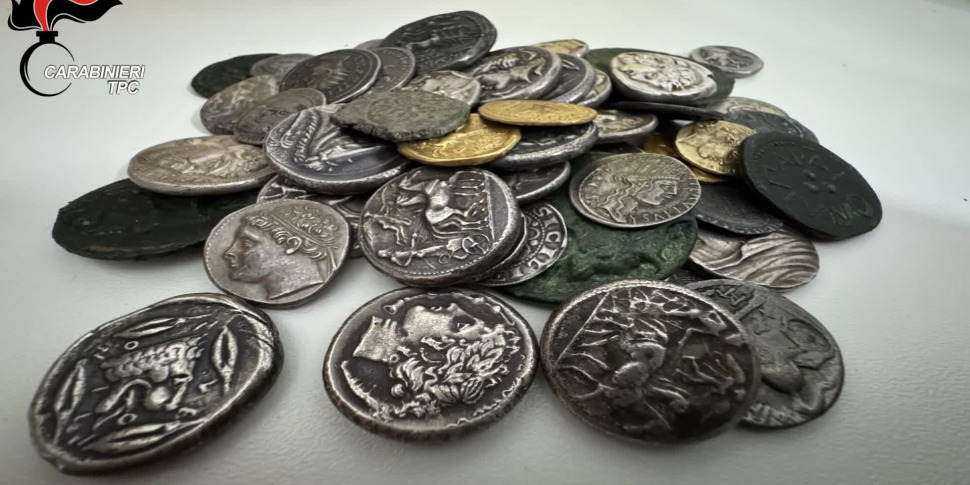
The Carabinieri of the Cultural Heritage Protection Command (TPC) have carried out, in Calabria and Sicily, an order for the application of precautionary measures, issued by the GIP of the Court of Catanzaro, at the request of the local Public Prosecutor’s Office – District Anti-Mafia Directorate, which coordinated the investigations, against 11 people (2 in prison and 9 under house arrest), held responsible, in various capacities, for being part of a criminal association aimed at committing multiple crimes of execution of illicit excavations, defacement of archaeological sites, theft and receiving of archaeological goods following clandestine excavations, carried out at important Calabrian archaeological sites, as well as receiving of cultural goods, an association detailed by the recognized aggravating circumstance referred to in the art. 416 bis.1 CP, in the aforementioned crimes were committed by associates also with the aim of facilitating the ‘ndrangheta Arena gang which in this way also consolidated control of the territory in Isola di Capo Rizzuto (KR) and in the neighboring territories, as well as benefiting from the proceeds of the criminal activities. At the same time, 12 local searches were carried out.
The measures in Sicily and Calabria
The investigation, which for the Sicilian side involved 45 people (of which 9 with custody orders in prison and 14 under house arrest) and 11 people for the Calabrian side (two in prison and 9 under house arrest) – also touched Rome, Florence, Ravenna, Ferrara, and extended to the United Kingdom and Germany. The Sicilian suspects were also subject to 17 residence obligations, 4 obligations to report to the judicial police, of which 2 were notified in foreign territory, and a suspension of the business activity of the owner of an auction house.
The looting of the excavations was systematically organized by gangs from Catania and Syracuse, who had identified archaeological sites of great importance in Sicily and Calabria, and collaborated with the ‘Ndrangheta in their exploitation: the Calabrian suspects were also charged with aggravating mafia charges for having facilitated the ‘Ndrangheta gang of the Arena di Isola Capo Rizzuto (Crotone).
The operation was conducted in synergy with the Carabinieri provincial commands of Crotone, Catania and Messina as well as with the support of the “Cacciatori di Calabria” helicopter squadron and the 8th Carabinieri Helicopter Unit of Vibo Valentia. Over 80 carabinieri were employed, who operated in the territories of the Calabria and Sicily regions.
The names of those arrested in Calabria
In prison
Vincenzo Godano, 12-23-1987, Crotone
Roberto Filoramo, 22-9-1989, Crotone
Under house arrest
Giuseppe Guarino, 4-6-1980, Crotone
Carmine Minarchi, 16-3-1979, Catanzaro
Michele Nicoscia, 22-7-1995, Crotone
Luca Filoramo, 16-8-1978, Crotone
Francesco Salvatore Filoramo, 14-8-1949, Isola Capo Rizzuto
Francesco Caiazzo, 7-1-1972, Isola Capo Rizzuto
Nicola Filoramo, 18-2-1965, Crotone
Michele Consolato Nicotra, 5/22/1983, Paternò
Stefano Rottella, 17-9-1966, Paternò
Investigation launched in fall 2022
The precautionary measure was issued at the conclusion of the investigative activity developed by the Carabinieri of the TPC Unit of Cosenza, started in October 2022 and concluded in October 2024, which began with a series of investigations carried out on the initiative of the soldiers of the special department of the Carabinieri, following which the presence of numerous clandestine excavations conducted within various archaeological sites was found.
The subsequent investigations made it possible to ascertain illicit conduct linked to the trafficking of archaeological finds coming from clandestine excavations carried out within the national archaeological parks of Scolacium (Roccelletta di Borgia (CZ)), ancient Kaulon (Monasterace (RC)) and Capo Colonna (Crotone) as well as in other private areas of the province of Crotone. It was ascertained, in particular, that the aforementioned areas were the subject, for the entire duration of the investigation, of systematic looting carried out by a team of “grave robbers” who, with an organized and detailed division of skills, fueled the clandestine market of archaeological material. During the activity, the existence of a complex organization (grave robbers – intermediaries – fences) well rooted in some territories of the province of Crotone was noted. The phases of the illicit activities were ascertained and documented in detail through telephone, electronic and environmental interceptions, video recordings and seizures during the work. The action of the criminal group was therefore evident in the use of methods typical of well-structured associations, composed as it is of unscrupulous individuals accustomed to operating in the sector.
The top management of the organization directed and controlled the activities of the members, planned the individual expeditions and identified the places of interest, thanks to the specific skills in the field “acquired in the field”. Furthermore, operational methods have been put in place to avoid, or at least contain, the risk of checks by the police, also through the use of communication channels that are difficult to intercept.
The use of conventional languages
Furthermore, the associates all showed themselves to be aware of having to limit telephone conversations to a minimum or reduce them to short dialogues where any reference to archaeological materials was masked with conventional terms (such as “faggots”, “hunting”, “frames”, “coffee”, “asparagus” or “chainsaw”, the latter term with which the metal detector was usually indicated).
At the top of the criminal organization are two people from Crotone
At the top of the criminal group are, in the role of promoters, two individuals both resident in the province of Crotone, lovers of archeology and knowledgeable of the places where archaeological material can be found to be introduced illicitly onto the clandestine market. They were constantly engaged in the clandestine search for finds and were permanently connected to each other in the marketing circuit of the same. Specifically, they organized and directed the criminal group, planning the commission of individual crimes and participating directly in them.
The overall investigative findings have highlighted how a parallel form of crime (even organized in a basic form) can exist and operate in the territory where the gang exercises its dominance, with the implicit approval of the “local” and where the related illicit profits are inevitably destined to feed, directly or indirectly, also the ‘Ndrangheta gang of reference and its ability to permeate the territory in which it operates.
The role of the Arena ‘Ndrangheta gang
During the investigation, the “originality” of the crimes (theft and receiving of archaeological finds) compared to the traditional mafia context also emerged. It is, in fact, a particularly profitable activity and favored, in the reference territory, by the presence of various archaeological sites, sometimes even little explored by archaeological excavations formally authorized by the state bodies appointed for this purpose; a situation which obviously favored the interest of organized crime.
From this perspective, there is a need for the ‘Ndrangheta organization to turn “outside”, also recruiting enthusiasts and experts in the sector, in order to be able to operate in a specialist context which, although a source of large profits, would otherwise be precluded to it. In the evidentiary framework collected, all the elements of the aggravating mafia were identified, as the contested conduct was immediately functional to the interests of the association, exacerbated by the circumstance of the non-fungibility of the service provided by the subjects under investigation.
Thanks to the work of its main associates, the ‘Ndrangheta organization of the “Arena” was placed in a position to obtain resources, conveyed by specific skills, and consequent benefits in a sector in which, not possessing the necessary specialist knowledge, it would not have been able to operate effectively.
Nine arrests in Crotone, two in the provinces of Messina and Catania
As previously mentioned, with today’s activity, 9 precautionary custody orders were carried out – in the province of Crotone – (of which 2 in prison, against those who are considered at the top of the organisation, and 7 under house arrest), as well as 10 local searches, and – in the provinces of Catania and Messina – 2 custodial measures under house arrest and 2 local searches were carried out.
The investigation activities were also conducted with the collaboration of the Superintendency of Archaeology, Fine Arts and Landscape for the provinces of Catanzaro and Crotone and with the help of the Calabria Regional Museums Directorate, which provided an effective contribution according to their specific skills.
The completed operation constitutes an important signal of the State’s response to the deep-rooted criminal phenomenon of the illicit trafficking of archaeological finds, belonging to the national cultural heritage, in Italy and abroad, in a territory such as that of Calabria, particularly rich in vestiges of the past, which is the object of an incessant and intense phenomenon of plundering of this type of goods which feeds the related clandestine market.