

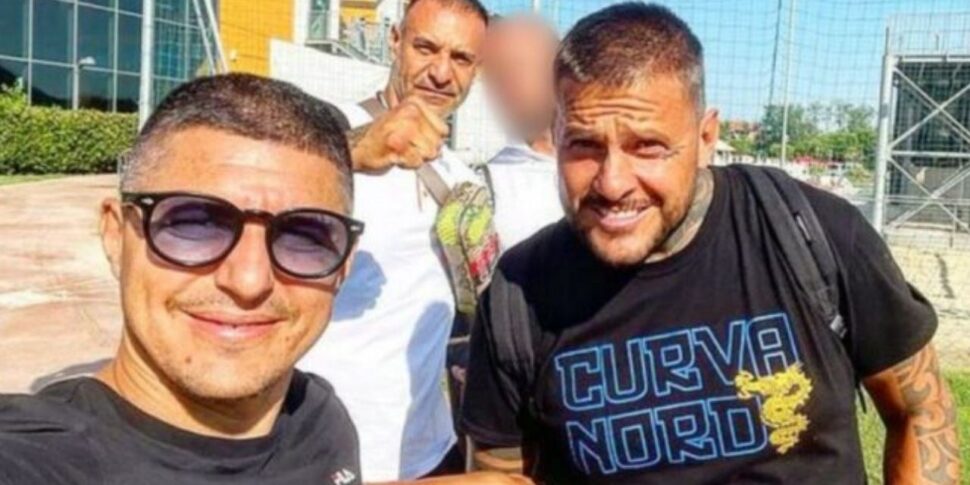
On the one hand, Milan’s Curva Sud which with “actions of intimidation and violence”, without “sharing the management and revenues with anyone”, managed to secure earnings in excess of “100 thousand euros per year”. On the other hand, the Inter Nord which was “a mere material cover context” again for illegal businesses and enjoyed “a mafia-style protection relationship”, which had the “backing” of the Bellocco ‘Ndrangheta clan.
These are passages from the reasons for the sentence with which, on 17 June, the Milan magistrate Rossana Mongiardo inflicted sentences of almost 90 years in prison on 16 defendants in the abbreviated trial resulting from the investigations of the DDA prosecutors Paolo Storari and Sara Ombra and which had led to the maxi “double curve” blitz of September 2024 by the Police and Gdf. Judge who recognized all the charges, from the 2024 murder of Antonio Bellocco, scion of the gang of the same name, to an attempted murder six years ago, up to the two criminal associations, complete with a “non-belligerence pact” for the affairs between the South and the North, the latter also with the aggravating mafia.
The highest sentences
The highest sentences were imposed on the leaders of the two San Siro curves, the Inter player Andrea Beretta, a collaborator of justice from the end of 2024, and the AC Milan player Luca Lucci: 10 years each. Beretta was at the top of the aggravated criminal association and killed Bellocco, who was also on the Nerazzurri ultra board. The judge points out that he was recognized, “in addition to the special mitigating factor of collaboration”, also the generic ones for the “significant contribution” to the investigations. Before his “choice of ‘redemption'”, some aspects were “unknown territory for the investigators”. It was he, in fact, who accused himself and led to arrests for the murder of the historic ultra leader Vittorio Boiocchi in 2022, for which another trial is underway. He said he was “repentant”, saying that he was “moved by the aegis of money” and “power”. However, Bellocco’s lawyers and family members protested against the 10-year sentence.
The judge clarifies that Lucci, on the other hand, acted as a “counterweight” to Beretta, because “more than anyone else, during the trial he defended himself, almost making himself the protagonist”. He “appeared shrewd, endowed with an almost superfine mentality” and an “intelligence and ruthlessness”, denying “with obstinacy all the accusations”. And if for Beretta, we read, economic interests were more important “than cheering”, Lucci “has always proclaimed himself a true fan”, talking about “mistakes” in life, such as on the drug trafficking front. He seemed “sincere and honest” about this, but did not provide useful information and hence the failure to grant mitigating circumstances.
The various businesses
The businesses are lined up in the reasons, from ticket touting to merchandising and parking around the stadium. All this in addition to extortion and violence against stewards and other ultras. Recalling the case of the “punitive expedition” against the personal trainer Cristiano Iovino, the judge also speaks of the “link” between Lucci and Fedez (not investigated), who “shared an economic project”, and this was part of “a real strategy of the ultras” group, which had “connections with sectors of the entertainment world”, also through “bodyguard functions of well-known showbusiness personalities”.
Furthermore, that “situation of subservience” on the part of the Nerazzurri club “towards the exponents of the North”, which ended up, “in fact, facilitating them, albeit ‘obtorto collo'”, as already highlighted by the prosecutor Storari. So much so that Inter and Milan were subjected by the Prosecutor’s Office, directed by Marcello Viola, to a prevention procedure and worked to sever unhealthy relationships with organized fans. And they entered the trial as civil parties, as did the Serie A League with the lawyer Salvatore Pino, obtaining compensation. The “systematic violence”, writes the judge, has “undermined the perception of safety inside the stadium” and has “damaged the image” of the teams.