

It is difficult to find a more urgent theme, capable of embracing every nuance of the human dimension returned by this complex time. Trust is probably at the center of the greatest challenge posed by the present we live in: we cannot do without it, to exist as individuals and as part of a community, yet that of trust becomes an increasingly fragile architecture, targeted by overt and hidden attacks, by the distrust caused by the crumbling of the value of relationships and of the “truth” as we have always perceived it.
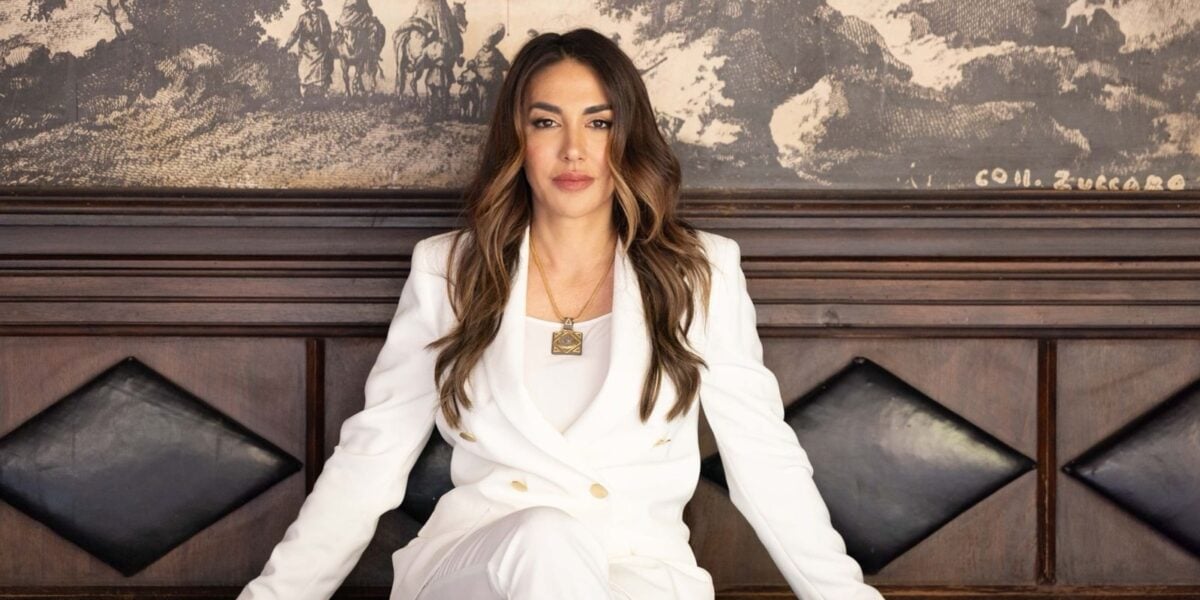
Trust, word of the year 2025 for Enciclopedia Treccani, as a cultural, civil and political act. As a manifestly, exclusively, profoundly human value. Originated in a pact of co-responsibility from the gesture of trust and the effort of deserving it. In a time marked by “growing erosion of certainties”, trust becomes “indispensable to continue to believe in the future”. For this reason, Trust is the concept around which the 16th edition of Taobuk flourishes, the Taormina International Book Festival which from 18 to 22 June will once again place Sicily at the center of the international debate, with 200 guests from 30 countries. We talk about it with Antonella Ferrara, president and artistic director of the event that she created in 2010 and which she cultivates with passion, making it a fertile cultural laboratory around which every year a sharing sprouts fueled by increasingly prestigious voices, offered to the public who will flock to Taormina in the coming days.
In a historical moment marked by wars, polarizations, crises of institutions, of human relations and even of truth, how can a cultural festival concretely contribute to rebuilding trust?
Culture does not replace politics or diplomacy, but creates the conditions without which no society can survive. Trust comes from listening, from mutual recognition, from the willingness to expose oneself to the other’s point of view. Today all this seems more difficult. We live in a time in which the speed of information, the polarization of public debate and the mediation crisis fuel mistrust and identity closures. This is why we have chosen trust as the theme of Taobuk 2026. Not as an abstract concept, but as a civil and political issue. A cultural festival can help rebuild it by creating real meeting places, where complexity is not simplified but faced. Every dialogue that takes place in Taormina represents a small exercise in trust: in the word, in knowledge, in the possibility of understanding those who are different from us.
Taormina is increasingly the capital of international dialogue. What contribution to public debate and the exercise of free thought does an event like this intend to offer?
The task of culture is not to provide definitive answers, but to formulate deeper questions. In an era dominated by simplification, free thinking arises from the ability to restore depth, articulation and critical sense. Guests like Haruki Murakami, Abdulrazak Gurnah, Jonathan Coe, Adonis, Esther Duflo or Anish Kapoor don’t come to Taormina just to testify to the excellence of their works. Each of them brings a perspective on the world. Murakami explores the most enigmatic areas of contemporary identity; Gurnah recounts the wounds of exile and memory; Duflo reflects on the concrete conditions that allow societies to thrive; Kapoor invites us to question our perceptions and our certainties. Their contribution consists in making us more aware, in asking ourselves new questions. Culture does not produce consensus; produces understanding. And understanding is the first step towards every authentic form of freedom.
Today, to understand the present, is specialization or the ability to relate different knowledge more important?
I believe that the contemporary challenge consists in keeping both dimensions together. Specialization is essential because it guarantees competence and rigor. But the great issues of our time cannot be understood through a single lens. Artificial intelligence, geopolitical transformations, the crisis of democracies, migrations, new inequalities require a gaze capable of crossing different disciplines. This is why Taobuk has chosen, since its inception, to be much more than a literary festival. Literature, philosophy, economics, science, visual arts and politics interact because the present cannot be understood in watertight compartments. The most fertile intuitions often arise precisely at the points of contact between different languages.
TaobukTeen and the cultural challenge of the new generations: how will it be expressed at the festival?
I don’t agree with the narrative according to which young people are distant from culture. I rather believe that they need places where they can feel involved and recognized as authentic interlocutors. TaobukTeen was born from this belief. Throughout the year we work with schools, universities, students and trainees to ensure the Festival becomes a participatory experience. We are not only interested in promoting reading, but in encouraging the formation of aware citizens, capable of interpreting their own time. Trust is also learned in this way: through the concrete experience of responsibility, discussion and participation. Every year we see girls and boys become active protagonists of the Festival. It’s one of the achievements I’m most proud of.
From the first editions to today: was there a moment when you felt that Taobuk had become a real cultural reference?
It was a process built over time, through growing relationships, recognition and responsibility. The awareness came when we saw that the conversations born in Taormina continued well beyond the days of the Festival, contributing to the national and international cultural debate. Today Taobuk is a community that involves writers, artists, scholars, institutions and citizens from all over the world. Previous editions have taught us one thing above all: that no society can face its challenges without places of open discussion. The crises of recent years, from wars to technological transformations, have made clear how fragile the fabric that holds communities together is. From this awareness naturally arises the choice of trust as the key word for 2026.
What trace do you hope this edition dedicated to Trust will leave?
I hope he leaves a legacy that goes beyond the Festival. Trust is not naivety or automatic optimism. It is a form of civil courage. It means accepting the vulnerability that every relationship entails and, despite this, continuing to choose encounters instead of closure. In the Mediterranean, and in Sicily in particular, different cultures, languages and traditions have coexisted for centuries. This land teaches us that identity is not built against someone, but through encounters. Trust is always a risk. But it is also the only force capable of transforming interdependence into solidarity and coexistence into a common project. And today, perhaps more than ever, we need this vision.