

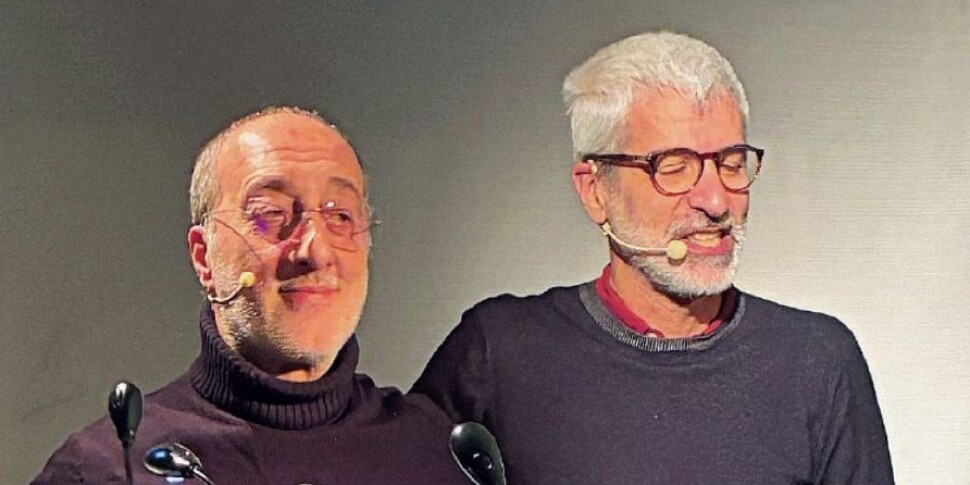
It was like feeling the lyrical wave of «Horcynus Orca», the total novel by Stefano D’Arrigo, of which this year marks the fiftieth anniversary of its first publication, listening to «Three small shadows», the reading by Massimo Barilla and Salvatore Arena, a Mana Chuma Teatro production with original music by Luigi Polimeni, which suggested the breathless and melodious voice of the Strait, in homage to D’Arrigo’s immense word: first a four-day appointment of theatre, music and poetry in the name of memory, in the exhibition «The word naked», curated by Dario Tomasello and Gigi Spedale scheduled in Messina until the 19th, an initiative promoted by Mana Chuma Teatro with the support of the Municipality of Messina, the MIC 2025 and the University of Messina-COSPECS and in collaboration with numerous cultural entities in the area, as part of Epic, a project dedicated to live entertainment.
A very beautiful text, taken from «Inside, more inside, where the sea is sea» (Historica Edizioni, 2021), authored by Massimo Barilla, playwright, poet, screenwriter and director, head of the cultural area of the Horcynus Orca Foundation of Messina and director of Mana Chuma Teatro, a dirge story «that seems to come from beyond the sea, from beyond many seas…», in which three small shadows are imagined, «the shadow from the head full of hair, the tiny shadow, the seafaring shadow”, the young D’Arrigo, together with his friends Saro and Luigi, standing in front of the sea of Alì Terme, the landscape of D’Arrigo’s heart-obsession, on a last night which between memories of the infinite time of childhood, the presence of parents-guardians and the shadow of omens, in an atmosphere of bewitching suspension, marks, as in a rite of passage, their farewell.
In front of that sea of wine, with its thousand odors over which that stunning jasmine imposes itself «which seems almost impossible not to be able to overcome the sea and embrace itself with the scent of the Aspromonte jasmine, the one that comes from the heart of Calabrian Greece», and under a dazzling moon, in front of the Aspromonte and behind the other Alì, the twin town, and under the feet and in the hands the mysterious stones, «solitary, innocent, dead and alive, little girls, streuse stones and camurriuse who call you back like sirens, who look at us as if they knew that the moment has arrived» say the three little shadows.
A text immersed in Darrighi’s breath, to which Barilla abandoned himself “on tiptoe with the utmost respect in homage to an extraordinary author, while inventing something that was within the spirit of Darrighi’s imagery”. And this breath, which – in the two voices of Arena and Barilla, alternating and mixed like waves – unites the two shores of that Mother Strait, «a place apart which from Cape Peloro is a single large door from which everything begins, a sort of dark triangle that resembles the one from which we all come into the world, a place that opens you up to a new space» can truly be the suggestion for «a reservoir of ideas – as Tomasello recalled – a sort of fruitful construction site for recovering D’Arrigo as a great living heritage, capable of generating new stories.”
The other three days of theatre, music and poetry in the name of memory, all at 11am, divided between the Dams Cospecs and the “Archimede” high school, will continue today with the homage to Rosa Balistreri, an I Musicanti production, with «La vuci di Rosa», a text by Luana Rondinelli that brings Rosa’s proud song to life with the music of Gregorio Caimi on the guitar and the voice of Irene Sciacca. The Astragali Teatro company will stage «Fimmene!», a choral story about women in Salento folk songs through the voices of Anna Cinzia Villani, Roberta Quarta and Simonetta Rotundo together with the poems of Fabio Tolledi and Matteo Mele on Thursday. In conclusion, on the 19th, at the Archimede, Dario Tomasello will present his text «L’ora guasta», a visionary poetic performance that enters our exhausted and apocalyptic current situation through the word-body.